An insurance company grows from 3,000 employees to 4,000 in a year. That sounds like a recruiting story. In Aquera’s telling, it became a story about PowerShell. The scripts moving employee information from UKG Ready into Okta had become unreliable. IT kept patching them. The company considered writing a replacement, then confronted the development and maintenance that another homegrown solution would require.
Aquera describes this unnamed customer’s decision on LinkedIn: replace the scripts with its supported UKG-to-Okta integration. The revealing detail is what gave way first. The machinery between the HR system and the identity system needed attention as the workforce grew. Hiring another thousand people had exposed the cost of keeping two perfectly useful systems in agreement.
- Follow the person. Carry hiring, role changes and departures from HR into IT.
- Include the awkward apps. Collect access files when a live connection is missing.
- Price the upkeep. Compare a subscription with the continuing work of maintaining integrations.
The person between the systems
Aquera sells that agreement as a service. Its cloud platform links HR applications, identity directories, service desks and business software. A worker appears in an authoritative HR record; the integration carries the relevant information downstream. Accounts can be created for the person’s role. Changed attributes can follow a transfer. A departure can trigger access removal.
Some work still requires hands. A laptop must be ordered; a badge must be arranged. Aquera’s onboarding solution also generates IT service-management tickets for manual tasks. This is a pleasingly concrete detail in a field full of abstract nouns. Someone’s first morning depends on both the account being ready and the computer existing.

The audience is the team responsible for making those steps repeatable: HR operations, IT administrators, identity specialists and security staff. Aquera lists customers including Allbirds, Warby Parker, Toyota and Wikimedia. Its customer page claims more than 1,500 customers. The variety matters more than the logo parade: employee access is a coordination problem across very different kinds of organizations.
A file gets a second career
The most interesting product begins with an unfashionable object: a file. An identity-governance program needs records of who has accounts and what those accounts permit. Some applications supply that information through a connector. Others require somebody to export it. Those exports have to arrive, contain usable data and reach the governance platform.
Aquera’s File Operations and Compliance product organizes that routine. It schedules collections, validates incoming data, reminds administrators and escalates missed steps. Files can arrive through manual upload, SFTP or an API. The product also keeps associated artifacts and audit information. The ambition is to make a recurring administrative chore dependable enough to support access reviews.
“Start First with File Integrations for All Apps”Aquera’s published implementation strategy
The company goes further: begin with entitlement extracts even where connectors exist. Then replace selected file integrations with connectors if needed, preserving the application’s identity history. The sequence separates getting visibility from completing every integration. A team can begin governing access while deciding which systems justify a more elaborate connection.
There is a useful limit here. A collected file describes access at a point in time. Its freshness depends on the collection schedule and the application administrator. A file-based review also does not automatically remove an account. Buyers should distinguish seeing a permission, reviewing it and changing it. Each is a separate job.
Translation is the product
The Account Provisioning Gateway handles another kind of mismatch. Identity platforms send requests using SCIM, a standard for managing user identities. Target systems may expect REST calls, SOAP services, SQL commands or LDAP operations. Aquera translates between them. Its published list even includes robotic automation, library calls and queue messages.
Alongside it, the Governance Aggregation Bridge detects account changes and sends the differences into a governance platform. Contingent Worker Identity addresses people who may never appear in employee HR records. It provides a separate record with a sponsor, engagement dates and revalidation, feeding identities into the existing stack and automating offboarding.
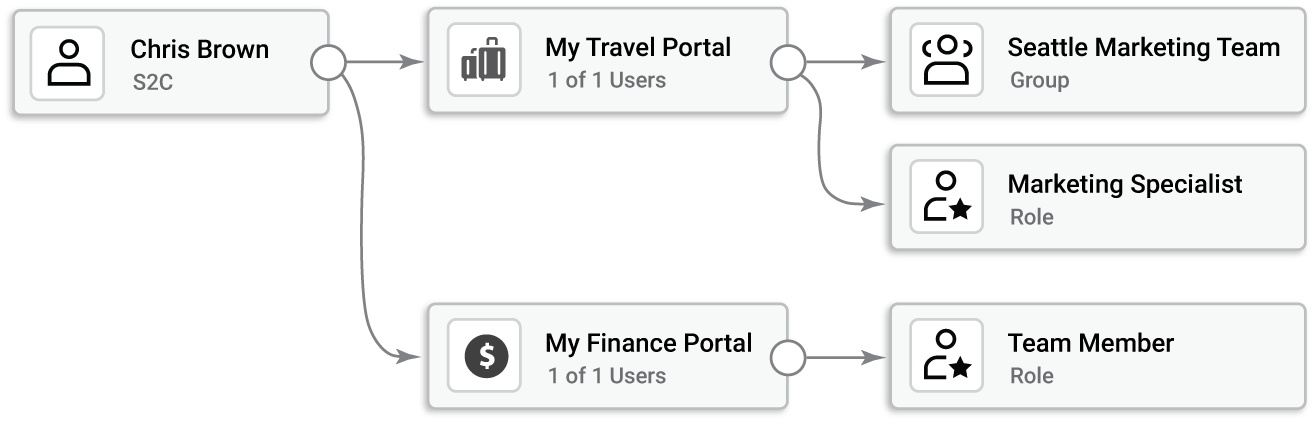
Conceptual workflow across configured integrations.
That puts Aquera beside established identity vendors as well as in competition with alternative integration methods. Native connectors, customer-written scripts and general integration platforms can cover parts of the same work. Aquera’s particular pitch is breadth around worker identity, including disconnected applications. The sensible comparison starts with the actual portfolio and its exceptions.
The invoice behind the handoff
The business model is a subscription. Aquera’s public agreement places the service, licensed capacity, price and term in an order form. Implementation work can sit in a separate statement of work. Exceeding licensed user limits can bring additional fees. For a buyer, the cost exercise starts with those documents and the workflows being purchased.
The insurer’s script problem suggests the other side of that calculation: engineering time, troubleshooting and continuing maintenance. A fair comparison includes both bills. Teams with simple requirements and reliable native connections may have little need for another integration service. Teams with mixed infrastructure and many exceptions have more to evaluate. Neither connector counts nor a polished demo settles the question.
The next person asking is an agent
The founders’ experience helps explain the focus. CEO Reed Henry previously held marketing leadership roles at enterprise software companies including SeeBeyond. CTO Jerry Waldorf was SeeBeyond’s chief architect and later a principal architect at Okta. Their backgrounds put integration and identity in the same room.
Aquera now promotes an Agentic AI Bridge for governed access to business records, alongside a Data Lake Loader for workforce analytics. Okta named Aquera in its June 2026 Cross App Access ecosystem announcement. The customer-facing question is familiar: can a request reach the right system with the right permissions? The requester may now be an assistant.
The practical lesson travels well beyond Aquera. Choose the authoritative record. Name the owner of every exception. Decide how quickly a change must arrive, and record whether it did. Then test the departure as carefully as the arrival. The handoff deserves its own engineering.