The employee who worries security chiefs most in 2026 does not have a badge, a payroll number, or a habit of reusing passwords. It is an AI agent with permission to read a customer database, update a ticket, call another model, and keep working after everyone has gone home. Saviynt has spent since 2010 answering the dreariest useful question in corporate computing: who should be allowed to do what? Suddenly, the answer has to cover workers who are not people and actions that happen faster than a person can approve them.
That twist explains why a company from El Segundo, California, best known to identity administrators, could raise $700 million in December 2025 at a valuation of approximately $3 billion. Saviynt reported more than $300 million in annual recurring revenue the following July. It says more than 500 companies use its software and that the platform secures over 100 million identities. The customer roll includes Shell, GEICO, Hertz, Maersk, Petco, RELX and Equifax. This is software for organizations where removing the wrong permission can stop a refinery workflow and leaving one behind can become an audit finding.
The job behind the jargonA permissions department that never sleeps
Saviynt is not primarily the login screen. Its center of gravity is everything before and after login. When an employee joins, the platform can provision the right accounts. When she moves from sales to finance, it can remove yesterday's privileges and request approval for tomorrow's. When an auditor asks who can alter a payment and approve it, Saviynt can flag that toxic combination. When a contractor leaves, it can shut the door. Privileged access management handles powerful administrator accounts; application access governance looks deeper into business systems; posture management hunts for accumulated risk.
The company's distinguishing choice is to put those functions on a shared cloud platform. The market has traditionally sold them as adjacent kingdoms with their own databases, policies and consoles. Saviynt's pitch is that identity governance, privileged access, application controls, external users and posture signals work better when they share context. A manager deciding on access should see the person's role, the sensitivity of the application, prior behavior and conflicting permissions in one place. Consolidation is not glamorous. Neither is plumbing. Both become attractive when six point products disagree about who still works here.
The Saviynt control loop
What failed firstEighteen months, one missing connection
The cleanest explanation for why companies switch is buried in a customer story. RingCentral had spent 18 months deploying a competing identity platform. The product still could not integrate with the cloud support-ticket system essential to serving customers, and manual work remained. Renewal forced the issue. RingCentral evaluated alternatives, chose Saviynt and connected multiple applications in four months. The failure was not an abstract breach. It was an integration that never worked, followed by a calendar date that turned frustration into a buying decision.
Another customer, an unnamed American retailer, had maintained Oracle Identity Manager for 15 years. According to Saviynt's account, the system was expensive and no longer provided the required coverage. In the first three months on Saviynt, the retailer integrated 70 applications and automated 47,000 joiner-mover-leaver tasks. The interesting lesson is that legacy software rarely loses because a new feature wins a beauty contest. It loses when maintenance cost, missing coverage and audit pressure arrive at the same meeting.
“When it comes to audit and compliance, we could prove the new solution's value from day one.”Kenneth Townsend, CISO at Ingredion
The cost questionNo menu price, but plenty of receipts
Saviynt does not publish a simple per-seat price. Enterprise cost moves with identity count, modules, applications, connector work and the implementation partner. Public customer results reveal the shape of the economics more honestly than a fictional sticker price. Ingredion projected more than $1 million in first-year savings and an 80 percent reduction in audit and compliance risk while managing 12,000 identities. An unnamed financial-services company reported 30 percent lower overall cost and 40 percent faster identity processes. A fabric retailer reported $240,000 in annual savings.
Saviynt's 2026 impact study puts the combined case at a 269 percent return, $29.5 million in benefits and payback within nine months over a modeled three-year period. Those are vendor-commissioned or vendor-published figures, useful as a map rather than a guarantee. Identity programs create value when they eliminate labor, unused licenses and audit preparation. They disappoint when a company buys a control plane before agreeing on application owners, approval rules and clean source data.
| Customer case | What hurt | Reported change |
|---|---|---|
| RingCentral | Competitor rollout stalled for 18 months | Multiple apps integrated in 4 months |
| University of Ottawa | Labor-intensive legacy infrastructure | 42 servers retired, about 900K identities managed |
| Danfoss | Global growth across 100+ countries | 83% faster onboarding for 45K identities |
| Ingredion | Manual lifecycle and compliance work | $1M projected first-year savings |
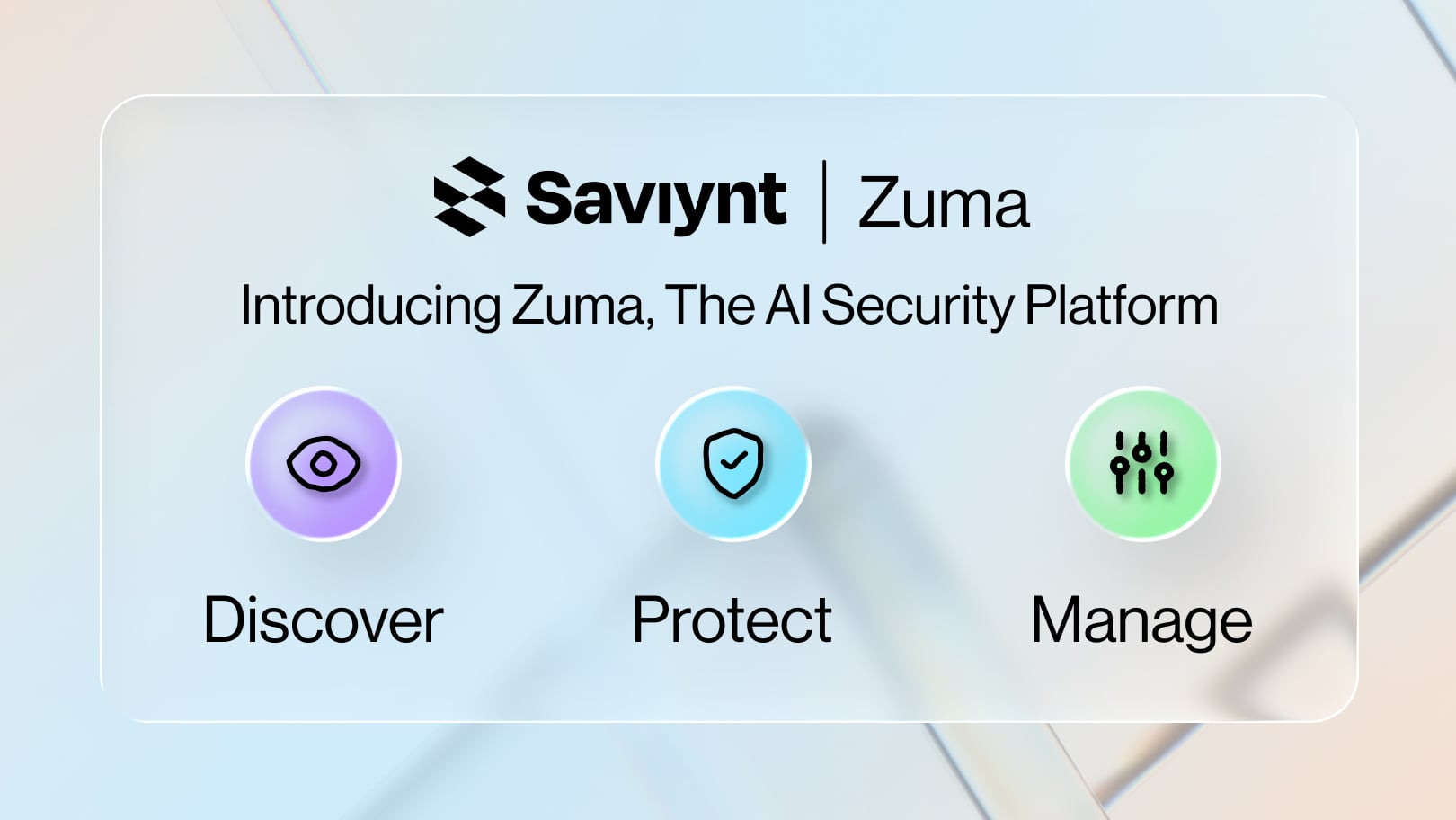
The machine-speed turnZuma moves the review to the moment of action
Saviynt launched Zuma in July 2026 for the population it calls AI identities: agents, AI applications, large language models, service accounts and other non-human actors. Zuma Insights discovers them and maps ownership. Zuma Governance manages lifecycle and policy. Zuma Access evaluates an agent's intent, context, permissions and risk while it acts. That last part matters. A quarterly access review might confirm that a procurement agent may use an ERP system. Runtime control asks whether ordering 10 laptops is consistent with its task before the order lands.
Partnerships fill in context Saviynt cannot manufacture alone. Wiz supplies cloud-security findings around non-human identities. Cyera adds data sensitivity. Zscaler can enforce policy in network traffic. An AWS agreement reaches Amazon Q workflows, while a Snowflake integration targets third-party agents touching enterprise data. This is where Saviynt fits in the market: not the system that trains the model and not the application the agent uses, but the policy checkpoint between identity and action.

A founder returnsDebt first, then the giant equity round
Sachin Nayyar co-founded Saviynt with Amit Saha in 2010, after previously building identity-governance company Vaau. He later founded security-analytics company Securonix and returned to Saviynt as CEO in 2023. The company financed its expansion in an unconventional sequence: a $40 million Series A in 2018, $130 million of financing in 2021, and $205 million of debt in 2023. Nayyar told TechCrunch the debt was the funding option best aligned with growth needs. Then came the $700 million KKR-led Series B, joined by Sixth Street Growth, TenEleven and existing investor Carrick Capital.
That capital arrived as the identity market compressed. SailPoint remains the obvious governance rival. CyberArk, BeyondTrust and Delinea approach through privileged access. Okta and Microsoft Entra stretch from authentication into governance. Larger security platforms want identity context inside their own suites. Saviynt's answer is breadth without acquisition: it says the code has been built in-house, around a common data fabric. The risk is equally clear. A wide platform must be credible in several categories at once, while specialists can concentrate on one sharp problem.
Governance rivals
SailPoint, One Identity, Omada and Microsoft Entra compete for lifecycle, certification and policy work.
Privilege rivals
CyberArk, BeyondTrust and Delinea begin with administrator accounts and high-risk sessions.
Broad identity suites
Okta, Microsoft and IBM can bundle identity functions with authentication or infrastructure.
Saviynt's wager
One identity data layer can govern humans, third parties, machines and agents across the stack.
Steal this playbookStandardize before you automate
Saviynt's own case studies contain a useful antidote to transformation theater. A manufacturer found that changing employee workflows could be easier than customizing the new interface to imitate the old one. Custom screens cost money, slow upgrades and preserve obsolete habits. The retailer used an expert services partner to hold an aggressive timeline. The pediatric health system built middleware to speed application onboarding. Different companies, same pattern: the platform does not erase implementation work; it rewards teams that make the work repeatable.
What another operator can copy
- Inventory identities and applications before choosing the first migration wave.
- Start with a painful, measurable workflow such as onboarding, termination or access certification.
- Keep connector endpoints simple and assign a named owner to every governed application.
- Change old workflows when customization would merely preserve legacy behavior.
- Measure time to provision, orphaned access, audit effort and unused licenses before expanding.
Where the model breaksA control plane cannot fix organizational fog
The converged approach is least likely to work in a small company with a few cloud applications and no dedicated identity team; simpler directory and access-review tools may be enough. It also struggles when HR data is unreliable, applications have no owners, or managers approve every request to avoid conflict. AI-agent controls add another dependency: the organization must know which agents exist, who is accountable for them and what an acceptable action looks like. Software can enforce a policy. It cannot invent a policy everyone has avoided writing.
Saviynt's opportunity is therefore attached to its customer's maturity. The more complicated the enterprise, the more useful a common identity graph can become. The mess also grows harder to migrate. That tension is the business. For years, identity governance was purchased as compliance medicine. AI agents are turning it into operational infrastructure. Saviynt has the funding, customer base and product surface to make that transition. The next proof will not be another acronym or analyst badge. It will be whether an agent can move quickly without becoming the ghost administrator nobody remembered to fire.