The original Wealthbox pitch was not really about contact management. Every CRM could store a phone number. The pitch was that a financial advisor might voluntarily use this one. In 2014, that counted as a provocation. Advisor software had inherited the mood of the enterprise database: gray screens, deep menus, mandatory training, and an uncanny ability to turn a simple note into clerical punishment. Wealthbox arrived with a social-style activity stream, a clean blue interface, and the cheerful promise of software that did not feel like a tax.
Twelve years later, the Providence company sits at a more interesting junction. It serves thousands of advisory firms, connects with more than 150 custodial and wealthtech products, and sells plans ranging from $59 to $99 per user each month, plus a custom enterprise tier. Sixth Street Growth made a $200 million majority investment in 2025. The money is pushing Wealthbox toward larger institutions and toward artificial intelligence that can prepare meetings, summarize conversations, draft follow-ups, build reports, and eventually run background processes.
The bet has expanded. First: make the database pleasant. Now: make the database useful enough to act.
The first product was adoption
Cofounders John Rourke and Dan Ferranti were not CRM tourists. The team had already built two CRM companies and sold one. For attempt number three, they narrowed the customer and widened the definition of quality. Wealthbox spent most of 2013 in private beta with roughly 40 financial advisors. Those users helped determine the initial feature set before the public launch on February 11, 2014.
That sequence is worth stealing. Wealthbox did not begin with a giant horizontal platform and then paste a financial-services template over it. It recruited a small room of practitioners, watched the repeated work, and built familiar objects around it: contacts and households, notes, tasks, calendar events, opportunities, workflows, files, and a running feed of client activity. The firm sold consumerization before consumerization became an exhausted SaaS slogan.
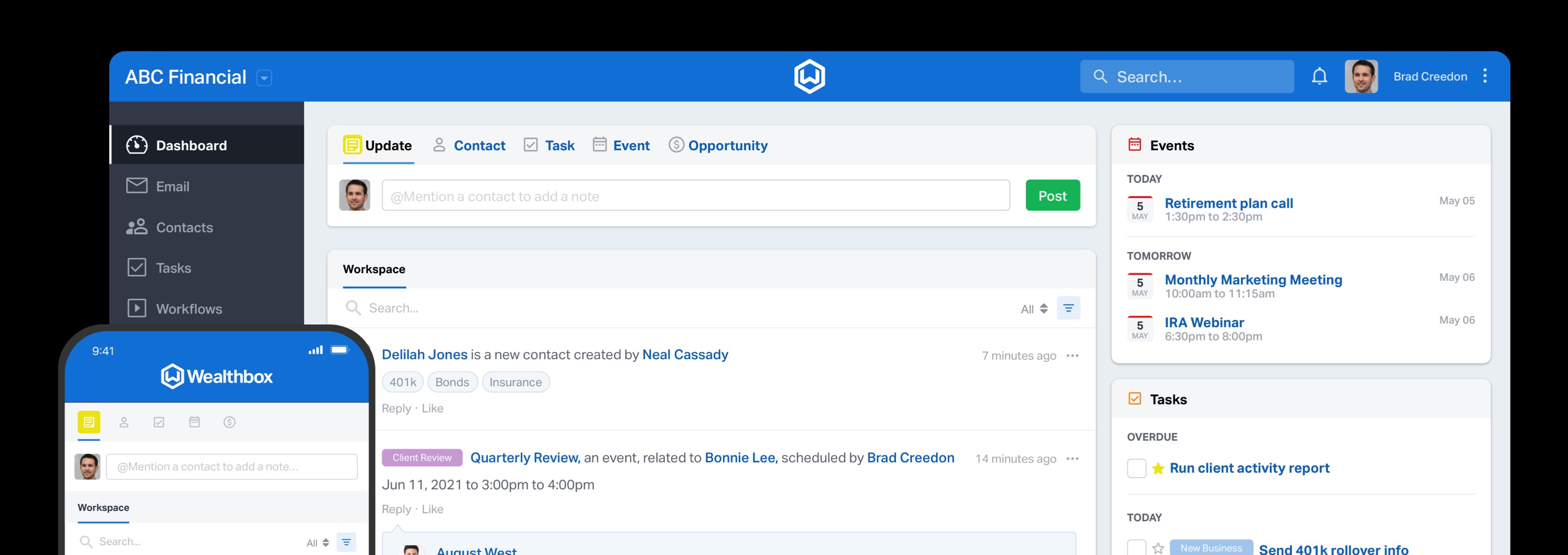
The key design move was social rather than financial. A teammate could post an update, mention a contact, attach a note, see a reply, and watch the firm's work accumulate in one shared stream. That made the CRM less like a vault and more like a room. The distinction matters because stale CRM data is usually an organizational failure disguised as a software problem. If the interface discourages updates, the record decays. If the team enjoys the loop, the data becomes useful.
The sneaky feature was never the database. It was persuading the humans to keep the database alive.
What the machine actually does
Today Wealthbox is the operating ledger for an advisory relationship. A firm can import contacts, group them into households, sync two-way email and calendars, record notes, assign tasks, design onboarding or annual-review workflows, move prospects through an opportunity pipeline, store files, and view work on mobile or desktop. Reporting and dashboards turn those events into operating metrics. Role-based permissions, single sign-on, organization administration, SOC 2 controls, two-factor authentication, and encryption address the less charming requirements of regulated work.
Its customers span solo advisors, registered investment advisers, broker-dealers, banks, trust companies, family offices, advisor networks, and enterprise firms. The public customer list includes Snowden Lane Partners, an advisory boutique that oversaw about $13.5 billion in client assets when its Wealthbox selection was announced. That range reveals the product challenge: the system must feel obvious to a three-person practice and controllable to a compliance department.
One record, three jobs
Integrations supply much of the leverage. Advisors already live among custodians, portfolio systems, planning software, document tools, marketing platforms, and compliance products. Wealthbox's API and partner catalog let the CRM behave like a hub instead of a replacement for every spoke. The 2025 two-way integration with LPL ClientWorks is a good example: contact changes can move between systems, account information appears in the CRM, and the firm chooses an initial source of truth. This removes re-keying, but only after somebody makes the grown-up decision about which database wins a disagreement.
What it costs - and what the price misses
The sticker is legible. Basic is $59 per user per month, Pro is $75, and Premier is $99. Enterprise is quoted privately. A 14-day trial requires no credit card. The public plans climb through email and calendar sync, richer customization, reporting, dashboards, storage, and administration; AI Notetaker is sold as an add-on.
Public monthly price per user
But subscription price is not implementation cost. A ten-person firm on Pro spends $9,000 a year before migration labor, data cleanup, workflow design, integration setup, and the internal argument over what counts as a completed task. The first thing to fail is often not the sync. It is ownership. If every advisor invents a different tag, if nobody closes workflows, or if two systems are both treated as canonical, the cleanest CRM becomes a handsome junk drawer.
That is also where competitors separate. Redtail remains an advisor-specific heavyweight with deep industry history. Salesforce Financial Services Cloud offers much more customization, usually with more configuration and expense. Advyzon, Practifi, AdvisorEngine, Tamarac, and general CRMs compete from different directions. Wealthbox's position is the middle path: more tailored than a generic CRM, less like an implementation program than Salesforce, and designed to get a working team into the product quickly.
The $200 million change of mind
Wealthbox did not abandon simplicity. It changed its idea of what simplicity could contain. The 2022 Series B from Frontier Growth funded hiring and product expansion. Dashboards arrived with bigger teams in mind. Omniview Reporting gave approved supervisors and compliance staff organization-wide visibility without granting edit access. Enterprise controls got deeper. The $200 million Sixth Street transaction in June 2025 accelerated the move upmarket while Frontier and management rolled equity into the recapitalization.
Then meetings became structured data. The native AI Notetaker can prepare an advisor using recent client activity, transcribe a conversation, highlight important moments, produce a summary, draft a follow-up email, and suggest tasks. Meeting Reports let leaders examine whether conversations happened and whether notes were captured. This is a more concrete AI proposition than a chat window with a sparkle icon: take an expensive human interaction and remove the administrative wake it leaves behind.
In March 2026, Wealthbox opened early access to Agents, Playbooks, and an AI Assistant. Agents are intended to monitor records on schedules or triggers. Playbooks save repeatable prompts for jobs such as onboarding or annual reviews. The Assistant can answer questions across CRM context and propose actions, asking for confirmation before it writes. Wealthbox's argument is that AI belongs inside the governed system of record, where permissions and audit history already exist.
A meeting summary saves minutes. A trusted workflow that catches every promised follow-up changes how the firm behaves.
The part anyone can copy
The Wealthbox operating recipe
- Recruit the workflow before building the platform. Forty beta advisors gave the team repeated jobs, vocabulary, and edge cases.
- Make adoption measurable. A powerful database with stale records is weaker than a modest one the whole team updates.
- Own the record, connect the stack. Use integrations to pull context inward while keeping one declared source of truth.
- Automate only after the process is named. A reusable workflow or Playbook should encode an agreed practice, not improvise one.
- Add complexity under the surface. Enterprise permissions and audit controls can grow without turning every screen into a cockpit.
The broader lesson is observational: vertical SaaS can enter a crowded category by fixing the emotional texture of repeated work. Wealthbox did not need to prove that advisors required contacts, tasks, or email. It needed to notice that many advisors resented the software carrying them. Design became distribution because an advisor who liked the interface could pull in the rest of the firm.
The same pattern now shapes its AI plan. Wealthbox has years of notes, relationships, workflows, and permissions. That context can make a drafted follow-up more specific and an automated task more accountable. The advantage is not merely access to a language model. It is proximity to the firm's accepted version of reality.
Where the playbook breaks
This approach does not work everywhere. A large institution that needs deeply bespoke objects, unusual approval logic, or extensive internal development may still prefer Salesforce or a specialized overlay. A firm whose crucial vendor is not supported may create manual seams. A bargain-seeking solo practice may decide that $59 per month is too much for what becomes a note keeper. And a team without a consistent service model cannot buy its way into operational discipline.
LIKELY FIT
- Advisor-specific workflows matter
- Fast adoption beats infinite configuration
- The stack depends on custodial and planning integrations
- One team wants one shared client record
PROCEED CAREFULLY
- Every office runs a different process
- Bespoke customization is non-negotiable
- No owner exists for migration and data hygiene
- The firm will not agree on a source of truth
There is also a strategic risk inside Wealthbox itself. Moving upmarket creates requests for more fields, more roles, more controls, more views, and more exceptions. AI creates another layer of settings and trust. Every addition is individually reasonable. Together, they can recreate the bloat the founders mocked in 2014. The company's hardest design problem is no longer making CRM simple. It is keeping CRM simple while the work underneath becomes substantially more capable.
That makes Wealthbox a useful company to watch. It is trying to preserve a small-firm instinct - software should feel humane - while building for institutions that cannot run on instinct. If it succeeds, the CRM becomes less of a place where advisors document yesterday and more of a quiet operator preparing tomorrow. If it fails, the symptoms will be familiar: too many switches, inconsistent data, clever automation nobody trusts, and a fresh generation of advisors reaching for spreadsheets.