Imagine an advisor looking at two clients who want the same investment strategy. One arrives with cash. The other arrives with shares bought years ago, a handsome unrealized gain and an understandable reluctance to hand a piece of it to the tax authorities. The destination is identical. The journeys are not. This is an illustrative problem, but it captures the territory Vestmark has made its business: the space between a portfolio someone recommends and the account someone actually owns.
- Vestmark sells portfolio software and outsourced services to financial firms.
- Its technology supports $2 trillion-plus in assets and five million-plus accounts.
- VAST adds personalized investment implementation and tax management.
- Envestnet agreed to acquire the company in September 2026.
That space is full of small indignities. A model says buy; a restriction says don’t. A rebalance improves the allocation but realizes a gain. A withdrawal changes the cash balance. Multiply these differences across an advisor’s book, then across a national firm, and personalization becomes an operating problem with a very expensive vocabulary.
Five million accounts, each with a past
Vestmark’s portfolio platform connects accounting, trading, rebalancing, account maintenance, compliance workflows and reporting. Its buyers include banks, broker-dealers, registered investment advisors and asset managers. An investor can benefit from the machinery without ever choosing it; the financial institution makes that decision.
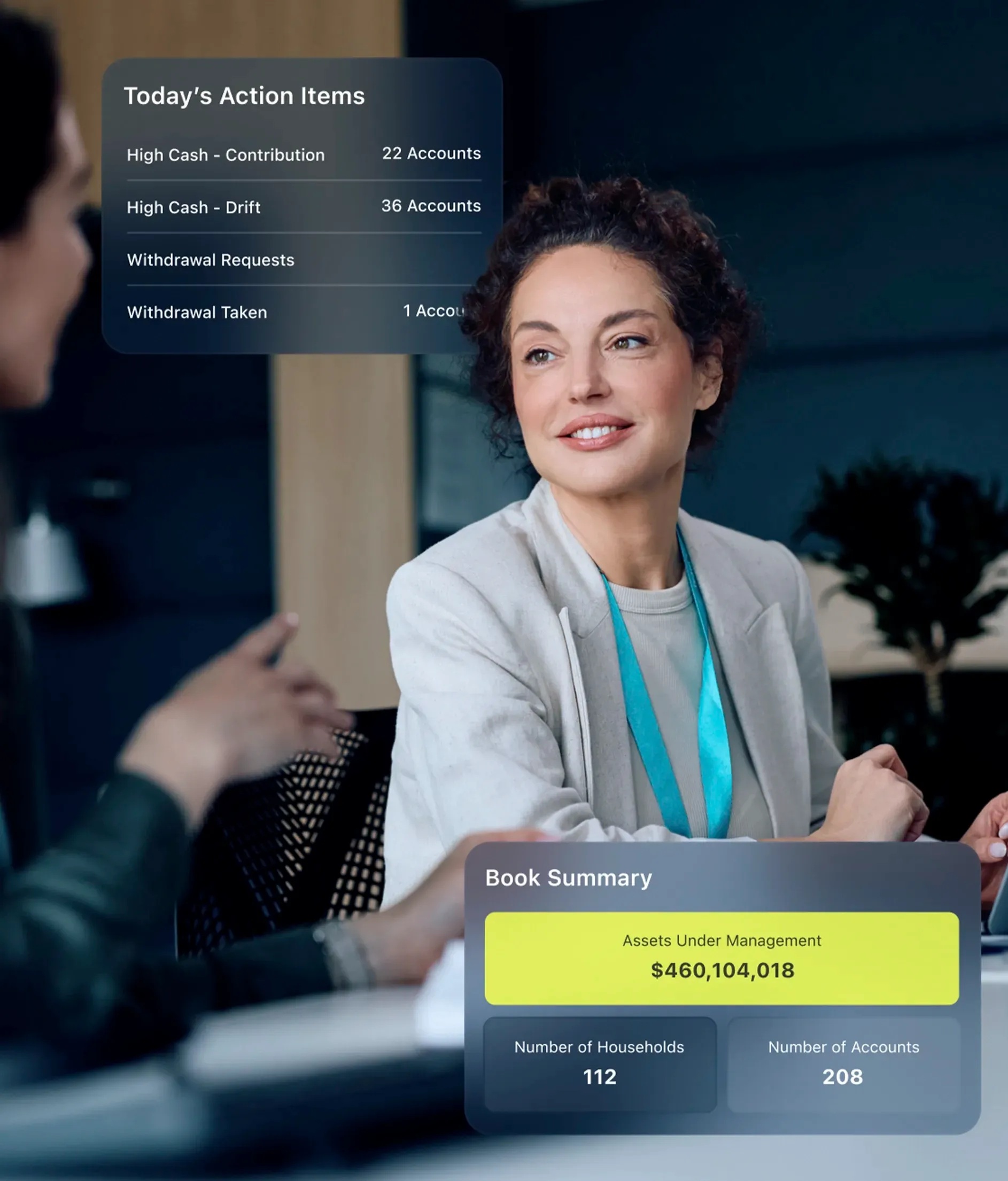
The company reported more than $2 trillion in platform assets, more than five million investor accounts and over 72,000 supported financial advisors as of June 30, 2026. These are company-reported operating figures, not an investment return. They also describe technology’s reach, rather than money that Vestmark itself manages.
Assets supported by the platform
Assets under management at VAS
Vestmark Advisory Solutions, its SEC-registered investment adviser subsidiary, reported more than $50 billion under management in June 2026, after fivefold growth over 18 months. Keeping those two figures separate is essential. A railway can carry someone else’s freight; carrying it and owning it remain different occupations.
The first lines of code met the back office
Vestmark began in 2001. In his account of its beginnings, co-founder Dave Blundin says he started the company with fraternity brothers and his actual brother, writing the first lines of code himself. The origin has a pleasingly informal cast for a business now entrusted with such formal work.
Its subsequent history is an accumulation of operational capabilities. VestmarkONE, the unified wealth management platform, arrived in 2011. The company’s timeline records $500 billion in platform assets in 2016 and $1 trillion in 2018. The attraction was practical: institutions needed systems that could keep accounting and investment implementation coordinated as their businesses grew.
In April 2016, Summit Partners invested $30 million. Vestmark said the money would support sales, marketing and software development, with room to explore strategic opportunities and international markets. Its finance chief described a subscription revenue model with high renewals and a record of profitability. That was the company’s account of its economics, not a public set of audited results.
The model is tidy. The account is not.
The useful concept here is the unified managed account, or UMA. It allows several investment strategies to coexist inside one account while retaining controls and reporting for their components. Vestmark’s infrastructure supports these multi-strategy arrangements, alongside household-level views that let advisors work across a client relationship’s accounts.
Consider the advantage. A client might combine an index-based strategy, an actively managed stock portfolio and ETFs. The advisor still needs to understand the whole allocation, the cash requirements and the tax consequences. Running every component in isolation makes coordination harder. Vestmark offers an implementation layer that sees more of the moving pieces.
- 01 / DesignChoose models and investment exposures.
- 02 / PersonalizeApply restrictions, tax circumstances and gains budgets.
- 03 / ImplementTransition holdings, trade and rebalance.
- 04 / MaintainMonitor, reconcile and report.
The competitive distinction is the combination of enterprise trading infrastructure, advisor tools and investment services. Firms also evaluate Orion, Envestnet Tamarac and Black Diamond for portfolio technology; the required mix of functions determines the comparison. Vestmark’s case is strongest when the purchasing conversation concerns implementation complexity, tax-aware trading and operating at scale.
Then Vestmark offered to do the work
In April 2023, Vestmark launched VAST, an outsourced portfolio management service built on VestmarkONE. Advisors could personalize portfolios and delegate ongoing implementation, including tax overlay across indices, separately managed accounts, ETFs and other securities. Tax-transition analysis addresses the awkward arrival problem: how to move existing holdings toward a new portfolio while considering embedded gains.
In a published CEO interview, Karl Roessner described VAST as the first major product launch in more than a decade and a move into investment services, including hiring the company’s first portfolio managers. The shift followed a recognizable customer concern.
“One significant recurring theme has been time.”
Karl Roessner / CEO, published interview
That concern explains the product better than a catalogue of features. An advisor’s client wants individual attention. Every operational task competes for the hours available to provide it. Selling the software helps a firm operate; offering the service lets it hand over selected work. Vestmark now occupies both positions.
Investment names, implementation plumbing
The company’s relationships put recognizable investment brands beside its operational infrastructure. Its BlackRock collaboration combines portfolio construction with tax-aware implementation. In July 2025, a Fidelity relationship opened custom model portfolios to eligible RIAs and broker-dealers, including portfolios with semi-liquid alternatives. In January 2026, T. Rowe Price and Vestmark launched Custom Premier.
Vanguard selected Vestmark in August 2026 to support its Custom Model Portfolios for RIAs, with trading, tax management and advisor-service capabilities. The division of labor is instructive: the investment model supplies a design; Vestmark helps translate that design into accounts that can be managed.
Customers bring a related problem. Corient’s May 2025 agreement called for consolidating portfolio management and trading across its business, which then reported approximately $177 billion in assets. A growing advisory firm needs consistency without flattening every client into the same experience. Centralizing the engine gives it a way to preserve differences at the edges.
“No platform fee” still deserves a second question
Vestmark earns subscription revenue from software and also supplies paid services. Its advisory subsidiary’s March 2025 client relationship summary says fees are based on account assets, with terms varying by advisor or sponsor arrangement. Other manager, transaction, custody and fund expenses may apply.
Certain Fidelity participants receive platform access at no cost; Custom Premier was announced with no platform fee for its custom models. Neither statement makes the entire investment arrangement free. A buyer should separate the technology charge from the portfolio’s full expenses and the internal work of adopting it.
The same discipline applies to tax benefits. Vestmark’s disclosures acknowledge that markets may offer insufficient losses to harvest, replacement investments can perform worse and transaction costs can consume the benefit. Restrictions can increase divergence from an index. Activity in a client’s other accounts can also create wash-sale complications. The machinery needs suitable inputs and coordination.
A quarter century of plumbing meets AI
Vestmark launched Pulse in May 2026, adding continuous monitoring and workflow assistance to its existing environment. The announcement describes portfolio data, market events and client context feeding insights that users review and act on within Vestmark. Human oversight and execution authority remain part of the design.
In June, it opened a Boston Center for AI Research and Development. The sensible reading of these moves is that established account data and workflows offer places to apply AI. Product announcements demonstrate intent and availability; they do not, by themselves, establish an independently measured productivity gain.
On September 9, Envestnet announced an agreement to acquire Vestmark, with closing expected in the fourth quarter, subject to customary conditions. The companies said existing product roadmaps would continue and the transaction would not require clients to migrate platforms. Those are announced plans. The purchase terms were not disclosed.
There is a useful lesson here for people building less financial machinery. Find the repeated job that becomes painful as customers grow. Learn its exceptions. Make the rules dependable enough that new products and services can sit on top of them. Vestmark’s story suggests that the next opportunity can be buried inside work customers already trust you to do. The portfolio may look elegant. Someone still has to reconcile it.
Visit Vestmark · Insights & blog · Company news
Watch: Introducing VAST · Watch: Model Marketplace · YouTube channel