The ball left Colin Falls’s hands from a long way out. At Notre Dame, that was usually the point. He made 331 three-pointers over four seasons, more than anyone in school history at the time, and 189 of them came in Big East play. His job was to find a pocket of space, arrive balanced and trust a motion repeated until it had become more reliable than thought.
Then the games ended. There were professional seasons in Italy and the Czech Republic, a proper athlete’s detour with unfamiliar gyms and a passport earning its keep. After that came Kansas City and a desk inside Frontier Wealth Management. The nouns changed abruptly: accounts, billing, reconciliation, reporting. The deeper grammar did not. There was still a system to read, a team to organize and a hundred unglamorous repetitions behind the visible result.
Falls learned the advisory business from both sides of its curtain. He worked across advisory and back-office functions, close enough to see how much of an adviser’s day could disappear into administration. Financial advice may be delivered in a conversation, but it is sustained by a small city of machinery. Trades must settle. Portfolios must be measured. Fees must be calculated. Reports must make sense. The client sees the meeting. The firm lives with everything required to make that meeting possible.
The useful part of a miss
A shooter acquires an intimate relationship with variance. Falls once described the difficulty of keeping “an even keel” through a college career. The line came from a 2007 interview about captaining a young Notre Dame team, but it has aged into a compact management philosophy. A miss cannot become a referendum. A make cannot become permission to coast. The next possession arrives too quickly for either indulgence.
His senior season supplied the résumé lines. He averaged 15.3 points, earned First Team All-Big East honors and helped return Notre Dame to the NCAA tournament. Yet a smaller moment says more about how he operated. During a game against DePaul, he noticed teammate Rob Kurz being left alone beyond the arc. Falls told him to step up and take the shot. Kurz made three second-half threes. The celebrated shooter had read the defense and found somebody else’s opening.
“Keeping an even keel throughout a college career is a tough thing.”Colin Falls, during his senior season at Notre Dame
Falls was not a founder of GeoWealth. That distinction makes the route more interesting. He joined the firm in 2012 and, according to longtime colleague Jack Hannah, took the reins in 2013. This was early enough to inherit possibility and late enough to inherit reality. The company had technology, ambition and the patient backing of a family office. It did not yet have the shape it would eventually take to market.
GeoWealth’s proposition was built around an unfashionable conviction: the back office could be a strategic advantage. The company combined portfolio accounting, performance reporting, billing, trading and model portfolios within one operating environment for registered investment advisers. Falls had already sat close to those chores. He knew that “turnkey” should describe relief, not confinement. Advisers wanted fewer manual steps, but they did not want a platform dictating every investment choice.
Notre Dame guard, captain and First Team All-Big East selection.
Professional basketball in Italy and the Czech Republic.
Advisory and back-office work at Frontier Wealth Management.
Joins GeoWealth, then takes the reins during its long construction phase.
Acquisition, public-private portfolio partnerships and an extended Series C.
Building where nobody applauds
The company’s first client arrived before it had a sales team. Falls later told that story in a podcast, an origin anecdote with the pleasing absurdity of opening a restaurant before buying chairs. It also captured the order of operations: first make something useful, then learn how to explain it. GeoWealth formally took its offering to market in 2018, after years of construction beneath the floorboards.
By 2021, the company said assets on its platform had grown from $4 billion at the time of a 2018 funding round to almost $17 billion. A $19 million Series B followed. Falls called it “a technology story,” insisting that the familiar TAMP label described the product’s silhouette more than its substance. The phrase TAMP, short for turnkey asset management platform, carries the glamour of office furniture. That may be an advantage. Serious infrastructure is allowed to mature while everyone else watches the chandelier.
The next moves widened the field. In 2023, GeoWealth acquired First Ascent Asset Management, combining its technology with a full-service investment operation. In 2024, after reporting more than $28 billion in platform assets at the end of the prior year, it raised $18 million in a round led by BlackRock. Apollo led a $38 million Series C in 2025. The investor list came to include J.P. Morgan Asset Management, BlackRock, Apollo and, in 2026, Goldman Sachs Asset Management.
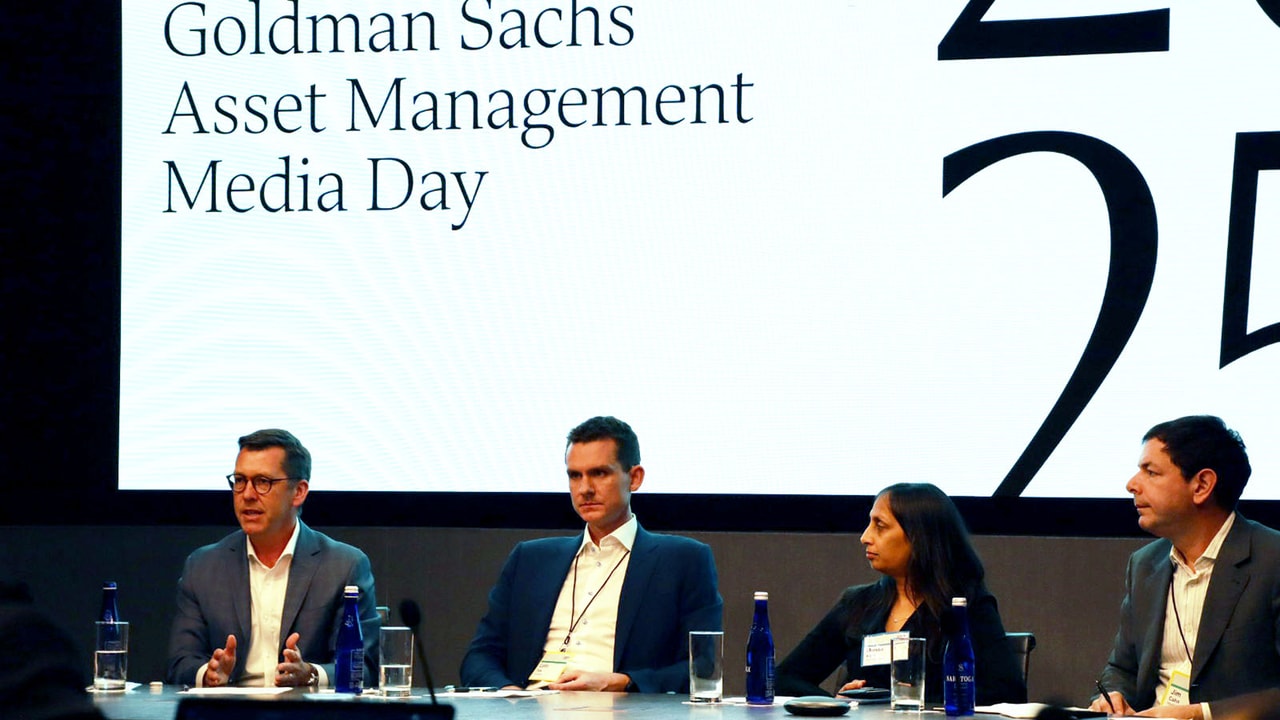
These were not merely cap-table ornaments. Each large asset manager also represented investment capabilities that GeoWealth could help advisers deliver. The platform’s unified managed account framework was being asked to hold more kinds of things at once: exchange-traded funds, mutual funds, separately managed accounts, direct indexing and private investments. The ambition sounds tidy in a diagram. In practice, each asset class brings its own data, paperwork, trading rules and tax consequences to the party. Finance is excellent at inventing complexity and then charging admission.
Reported platform assets at selected dates
Selected company-reported figures and contemporary reporting. Dates refer to the stated measurement period, not continuous annual data.
One account, many moving parts
Falls’s current argument is that advisers need a way to combine those parts without turning every client portfolio into a filing cabinet. In 2025, he described direct indexing and private-market support moving through final testing. GeoWealth had about 200 RIA firms and $35 billion in client assets on the platform at the time. Large firms could use the infrastructure to build home-office solutions; smaller firms could take a more packaged route. Different playbooks, same court.
The attraction is capacity. An adviser who assembles personalized portfolios by hand can become a victim of success. More clients create more combinations, more accounts and more chances for an operational detail to misbehave. A unified account aims to let multiple investment sleeves coexist while the platform handles much of the orchestration. Falls describes the principles as “scalability, flexibility, choice.” The order is revealing. Scale without flexibility makes a factory. Choice without scale makes a craft shop. His product thesis requires both.
The March 2026 investment from Goldman Sachs added $42.5 million to the Series C, bringing the reported round to $80.5 million. Falls said most of the new money would provide shareholder liquidity. The remainder was likely to go toward UMA development, core platform work and planning around artificial intelligence. He sounded notably unenchanted by the fashionable part. The company, he said, intended to be deliberate about AI and to ask how agent-like systems might connect automation already built into the platform.
“We’ve been very intentional about maintaining the right balance of investors.”Colin Falls, on GeoWealth’s mix of family-office control and strategic partners
Balance appears often in the Falls vocabulary. GeoWealth remains majority-owned by The Globe Resources Group while its minority investors rank among the largest names in asset management. Strategic money can open doors and sharpen products; it can also bring gravitational pull. Falls’s stated answer is a table with several powerful guests and no single guest rearranging the house. It is corporate governance as spacing.
The captain’s second locker room
GeoWealth is also a family story, though not a sentimental one. Colin’s older brother Brendan serves as chief growth officer. Brendan has joked that having his younger brother as boss means he must be out of his mind. More seriously, he describes a relationship built on trust, disagreement and the freedom to deliver hard truths. It is a useful picture of closeness at work: affection is pleasant, candor pays the bills.
Falls lives in Chicago with his wife and three children. Away from work, GeoWealth’s biography places him on the lake, on a tennis court or chasing the children. The activities sound less like escape than continuity. Motion has followed him from Park Ridge to South Bend, through Europe, Kansas City and back to Chicago. The venues changed. Sitting still never became the theme.
There is a temptation to make the athlete-to-executive story too neat, as if every pick-and-roll contains an MBA case study. Most do not. What transferred was narrower and more credible: comfort with repetition, public misses, shared outcomes and delayed reward. Falls’s business career has lasted far longer than his professional playing career. It was built in a category whose achievements happen mostly offstage, inside reconciled accounts and reclaimed hours.
The old records have moved on. Sports records tend to do that; the future is forever arriving with fresh legs. The interesting residue is the form. Falls spent his first career making room for a shot and his second making room for advisers to do the work only they can do. The ball, the portfolio, the company: each asks the same unfussy question. Where is the space, and what useful thing can happen there?