At four in the afternoon, the bottleneck at Medway was patient movement. The hospital needed people in the right beds, and someone had to get them there. In TeleTracking’s account of the trust’s improvement work, adding a porter helped create space faster than adding a doctor. It is a wonderfully unglamorous detail. It also explains what this company sells more clearly than a paragraph about artificial intelligence ever could.
- The job: coordinate hospital beds, patient transfers, cleaning, transport and discharge.
- The buyers: hospitals and health systems, with nurses and support teams doing the daily work.
- The wager: better handoffs can release capacity inside buildings that already exist.
- The next step: AI-assisted decisions about which discharge actions will relieve pressure across the hospital.
TeleTracking operates in the interval between “this patient can leave” and “the next patient can arrive.” That interval contains a small society: a nurse, a cleaner, a transporter, a placement specialist, perhaps a pharmacist or a community care provider. Each can finish a task while the larger job remains unfinished. The patient waiting downstairs experiences the combined delay.
A room is only useful when somebody can use it
There is an attractive simplicity to counting beds. A bed looks like capacity, and a building full of beds looks like a hospital ready to admit people. But an occupied bed, a dirty bed and a clean bed without the necessary staff offer very different possibilities. Treating them as one number makes planning pleasantly tidy and operationally misleading.
TeleTracking’s software gives teams a shared operational picture and helps dispatch the work that changes that picture. A discharge creates a cleaning job. A cleaned bed becomes a placement opportunity. A placement creates a transport task. Real-time updates make the relay visible while it is happening, instead of reconstructing it after the queue has formed.
The company’s origin story has the same practical instinct. TeleTracking says the spark came from software that alerted housekeeping staff when rooms in a Hawaiian hotel were vacated. A hotel wants to know when a room can welcome its next guest. A hospital has more complicated guests, stricter constraints and considerably higher stakes, but room turnover still matters.
Its initial BedTracking product arrived in 1991. The historical progression is telling: transport dispatch, electronic bedboards, location tracking and analytics followed. The company accumulated expertise in the things that happen around treatment. Its ambition grew with the number of handoffs it could connect.
The clipboard was doing too much travelling
Before Medway introduced its new system, the clinical site team visited wards and asked nurses about anticipated discharges. Pen and paper helped work out availability. The trust’s own account describes the change: staff in a care coordination centre could see admissions waiting, occupied beds, rooms needing cleaning and beds ready for allocation.
The system went live in October 2023. Automated messages reached porters’ handheld devices, and a dedicated bed-turnaround team operated around the clock. Nurses had previously done that cleaning work. Medway reported 1,500 hours a month released to clinical staff, alongside reduced turnaround time and less unused bed time.
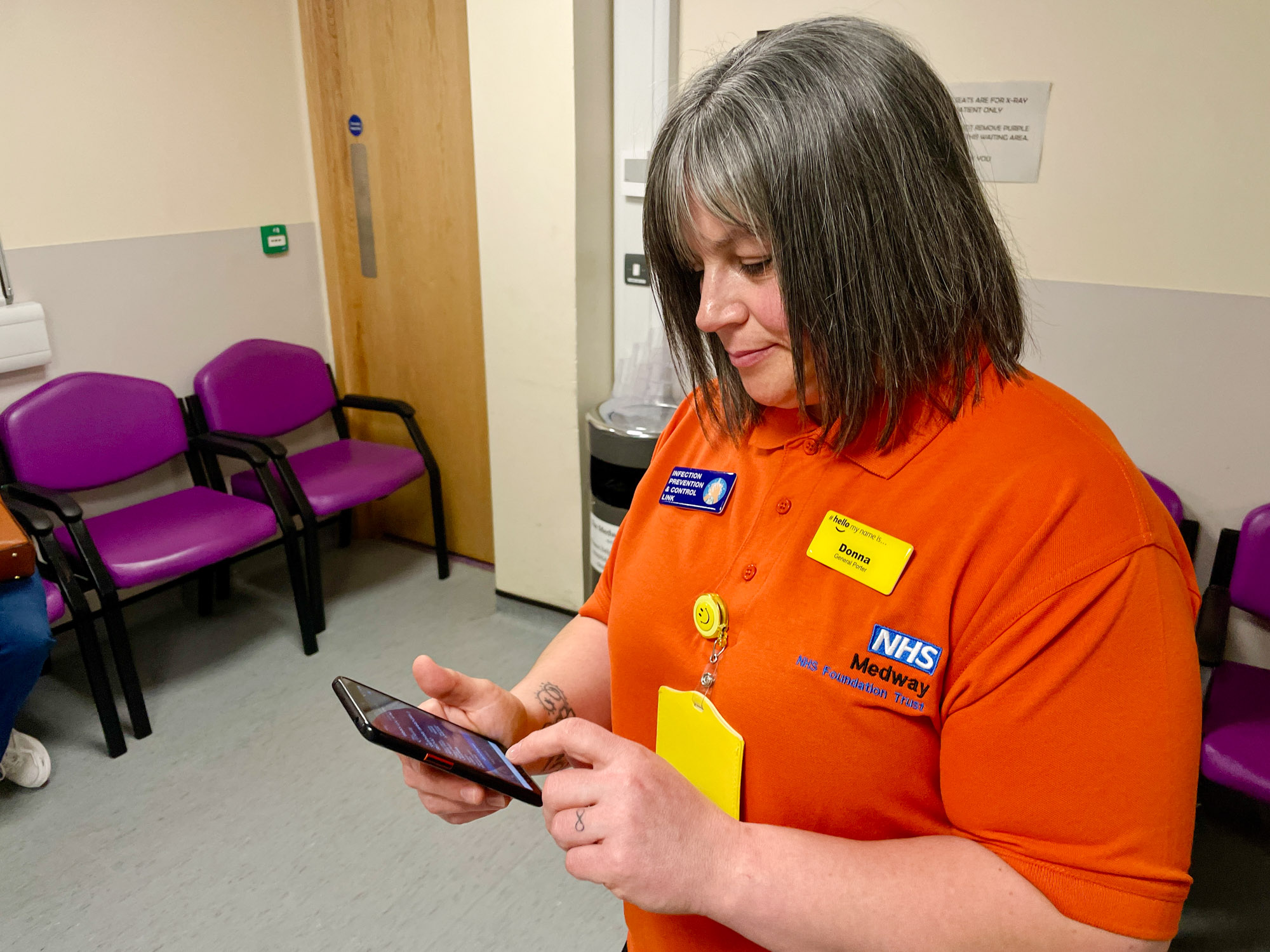
Released to clinical staff after the new bed-management system and way of working began.
That is an operational redesign with software inside it. The handheld matters because there is someone carrying it. The alert matters because a team owns the task. A useful screen can tell you where work is waiting; an organization still has to decide who will do it.
TeleTracking’s later Medway case study contains the 4pm porter example. It offers a lesson about changing one’s mind: measure where movement stalls before deciding which profession to recruit. The answer to a crowded hospital may sit in a department that rarely appears in a medical drama.
A command centre has to command something
The command centre is TeleTracking’s most photogenic expression of this idea. Shared displays bring patient demand and capacity into one room. Teams can coordinate placement across units or facilities rather than manage each ward as a separate island. Customers include Carilion Clinic, Maidstone and Tunbridge Wells NHS Trust and University of Louisville Health.
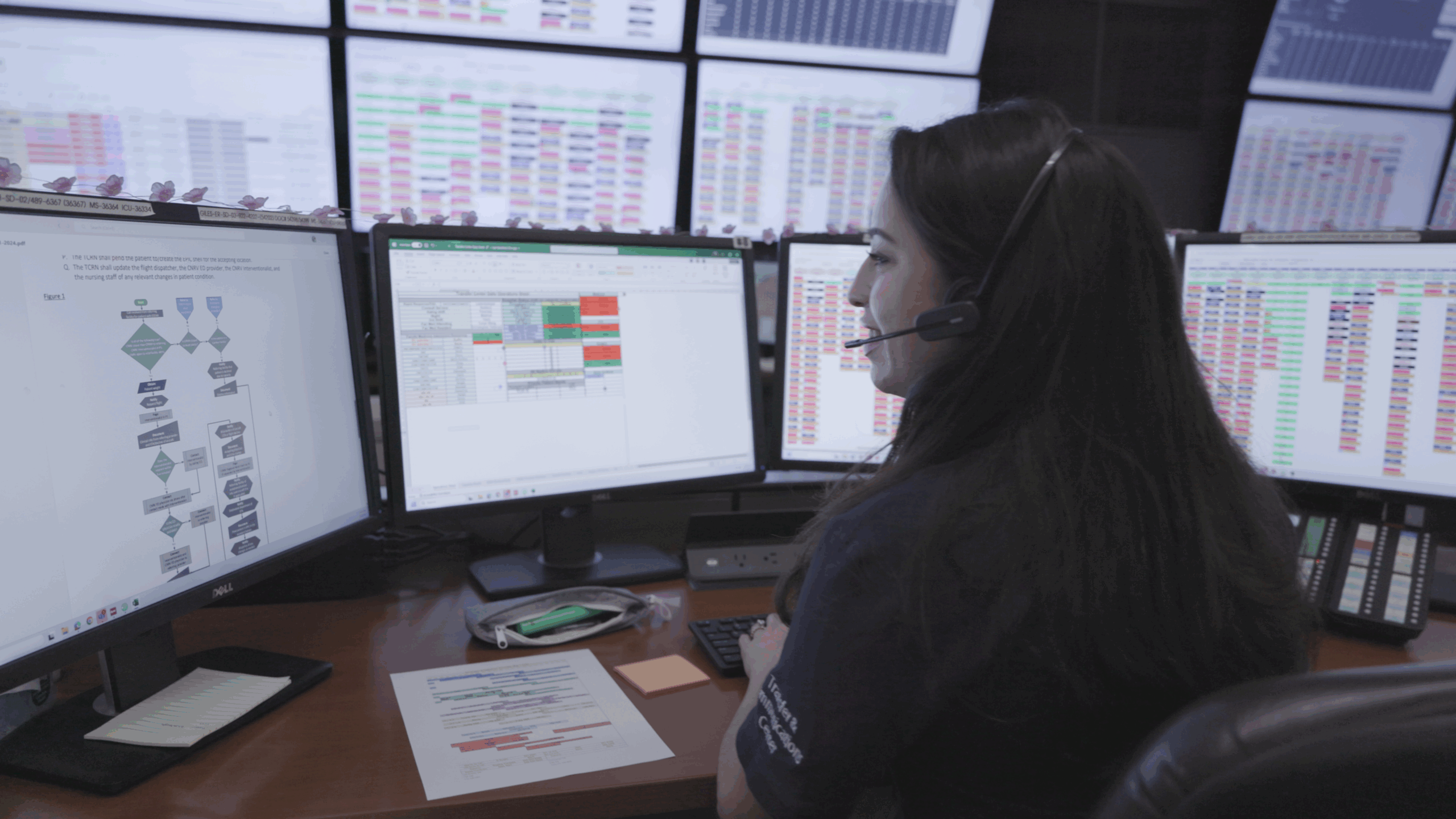
Washington Regional Medical Center’s case study makes the management component particularly clear. Executives participated in daily huddles. A monthly throughput committee identified obstacles. The hospital adjusted environmental-services and transport hours and added transport staff. The published results included a 67% reduction in emergency-department patient wait times.
Those results belong to that hospital’s combined intervention. They are useful evidence of what a coordinated programme can achieve, rather than a forecast for every buyer. The transferable part is the discipline: get leadership into the same conversation, give support departments a role in the plan, and use the data to change staffing patterns.
“Every movement affects the next.”
Michelle Skinner, TeleTracking’s Chief Clinical Executive, October 2026
The product names changed. The work is recognizable.
Operations IQ is the enterprise platform. Capacity IQ handles bed and capacity visibility; Transfer IQ coordinates movement within and between facilities; Referral IQ connects referring providers; Data IQ supplies analytics. Workflow IQ addresses operational work. These are parts of a hospital’s logistics, sold to institutions whose staff must coordinate thousands of ordinary actions.
The relationship with electronic medical records matters. TeleTracking positions its system as an operational layer integrated with EMRs. For a health system with several facilities and different records systems, a common view of available capacity can be useful even when the underlying clinical records remain elsewhere.
The market has other answers. LeanTaaS’s iQueue for Inpatient Flow offers capacity forecasting and coordinated throughput actions. ABOUT Healthcare works on patient access and transfer orchestration. Buyers can also extend existing EHR workflows. TeleTracking’s distinctive argument combines its history in bed turnover and support-service dispatch with wider transfer and command-centre coordination.
Clinical experience forms part of that argument. Chief Clinical Executive Michelle Skinner began as an ICU and emergency-department nurse. The company also sells implementation and adoption support. In 2024 it announced implementation partnerships with Evergreen Healthcare Partners and ROI Healthcare Solutions in North America, following arrangements in the UK and Germany.
£1.86 million buys a commitment
The economics are institutional. TeleTracking sells enterprise software and SaaS arrangements, supported by implementation services. A Royal Wolverhampton NHS contract register lists a “Teletracking system” at £1.86 million including VAT, covering July 2018 through June 2022. That is a specific historical contract with its own scope; it should not be turned into a per-bed price or a current quotation.
It does show the scale of the decision. A buyer is investing in integration, adoption and a different operating routine over years. The business case depends on what the hospital does with recovered time: accommodate demand, reduce delays, release staff for care or avoid unnecessary escalation capacity. An available bed creates an opportunity. Its financial value depends on what happens next.
TeleTracking has financed its own operations with debt. In August 2021, Huntington Business Credit announced a $60 million facility used to refinance existing indebtedness and provide working capital for growth. A credit facility is a financing arrangement, not evidence of the company’s valuation.
Now the software asks which patient should move next
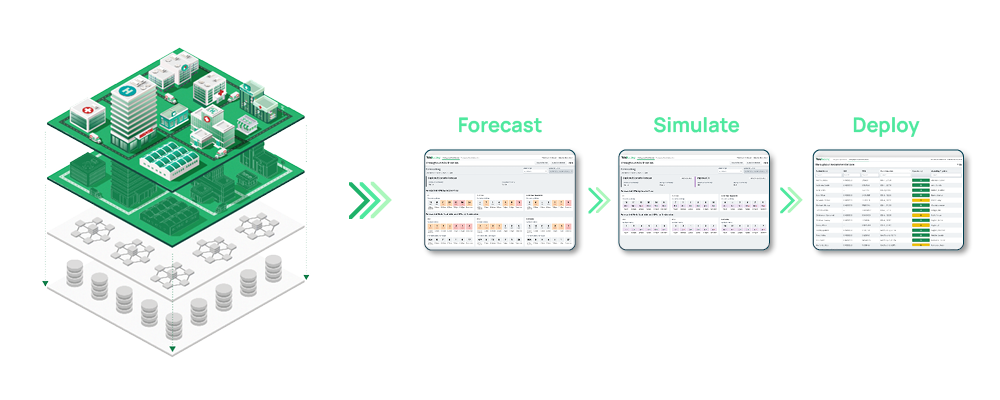
The newer question is how to choose among competing actions. TeleTracking formally launched Decision IQ in November 2025, naming UofL Health as an early adopter. It describes a computational twin that models hospital throughput, forecasts demand and tests discharge priorities. The intended output is a sequence of operational actions delivered inside existing workflows, with clinical teams in the loop.
The idea is easy to grasp. Two patients may both be ready to leave, but the beds they release may face different demand. Sequencing the work around the wider hospital can matter. Readiness remains a clinical condition; an algorithm’s operational priority cannot supply it.
The company announced a Faculty AI partnership in January 2025 and a Palantir partnership that June. The latter connects Operations IQ with Palantir Foundry and AIP. In January 2026, co-CEO Christopher Johnson described prototypes and workshops built around client data. On October 1, Skinner reported Decision IQ improvements at an unnamed health system, including reduced boarding. Those company-reported results are early evidence, with less context than a named, fully described evaluation.
Begin with the timestamp
The lesson a reader can copy is modest enough to try: record when a patient is ready, when the bed is vacated, when cleaning finishes and when the next patient arrives. Find the waiting between those events. Give each handoff an owner. Put the people responsible for the delay in the same conversation.
That approach has limits. A shared display cannot create a qualified nurse, make an unsuitable bed appropriate or arrange community capacity that does not exist. Prediction depends on timely information, and coordination depends on teams having the authority and resources to act. TeleTracking’s strongest stories contain those teams as well as the technology.
The bed hiding in plain sight is often time: the hours during which a room exists but cannot yet help a patient. TeleTracking has made those hours its business. At four in the afternoon, that business may look like a porter checking a handheld, seeing the next job, and getting on with it.
See the work in motion
Explore TeleTracking’s platform, hospital stories and conversations with the people running them.