The first version of TigerConnect was easy to explain at a party and slightly awkward to explain to your compliance officer. TigerText, launched in 2010, let people send messages that erased themselves after a set period. It arrived before Snapchat, with a name that drew accidental oxygen from a very public Tiger Woods scandal. The founders insisted the name came first. The jokes came free.
Under the novelty sat a useful mechanism. Brad Brooks, his orthopedic-surgeon brother Andrew Brooks, M.D., and Jeffrey Evans had built a consumer-style experience around controlled, private messaging. In a hospital, where clinicians were already texting because it was fast, that control answered a serious question: how do you keep convenient communication from becoming an unmanaged trail of patient information?
That was the wedge. It was not the final business. Secure text eventually became a feature that many vendors could offer, a fate Brad Brooks later described plainly: the company knew it would be commoditized. TigerConnect's consequential decision was to stay close to the hospital and move outward from the message.
The pager was only the visible problem
Hospital communication is full of tiny scavenger hunts. A nurse receives an alarm, checks who is assigned to the patient, hunts down the on-call physician, decides whether the alert is urgent, sends a message and waits. A scheduler edits a spreadsheet. An operator switches between a directory, a phone system and a protocol for activating a code. An ambulance crew calls ahead, but the right team may not see the full picture until arrival.
Consumer chat software can make the message prettier. It does not automatically know who holds the role at 2:13 a.m., which alerts deserve escalation, or how to pull clinical context from an electronic health record. TigerConnect began stitching those pieces together. Its Clinical Collaboration Platform handles secure text, voice and video. Physician Scheduling determines who is on call. Alarm Management filters and routes signals from nurse call, monitors and EHRs. Patient Engagement reaches patients by text or video without demanding another app and password.
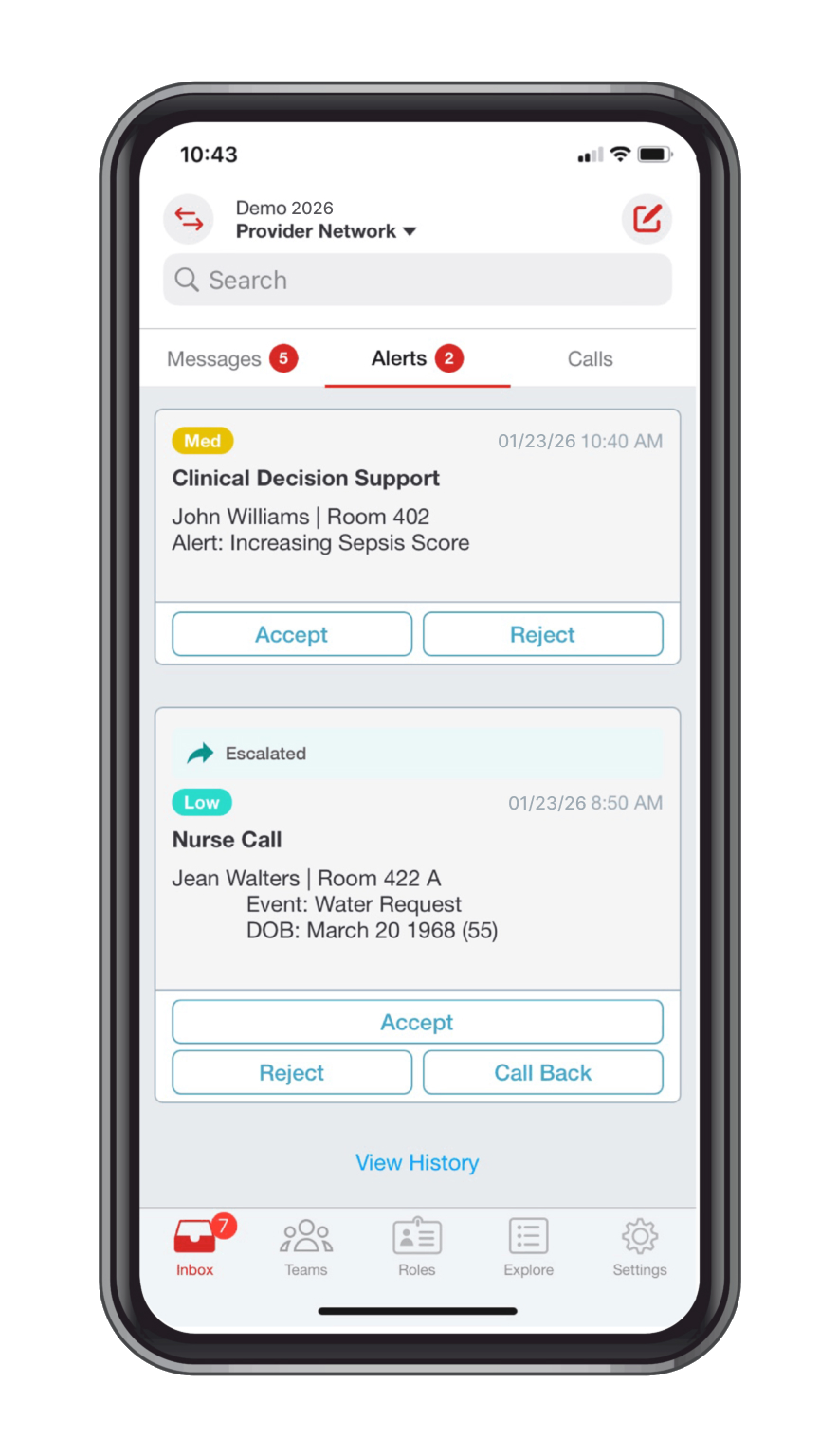
More recent products widen the route. Pre-Hospital, expanded through the 2024 Twiage acquisition, connects EMS and receiving hospitals. Transfer coordinates interfacility moves and discharge transport. CareConduit, launched in 2025, acts as a cloud workflow layer across fragmented hospital systems. The eVideon acquisition added smart-room tools, patient education and digital room displays. In 2026, TigerConnect introduced an Operator Console built for Cisco Webex Contact Center to replace the many-screen ritual of the hospital switchboard.
The product stopped being a place where clinicians talked. It became a system for deciding what should happen next.YesPress analysis
What failed first - and what changed their mind
There was no cinematic collapse. The first idea simply ran out of strategic headroom. Disappearing messages made for a sharp demo, and secure healthcare texting made for a real business. But messaging alone was becoming common. If every enterprise suite could add encrypted chat, TigerConnect risked becoming a replaceable icon on a crowded phone.

Customer behavior supplied the correction. The costly delay was rarely typing the message. It was everything around it: locating the responsible person, attaching context, noticing the unanswered alert, switching shifts and documenting the result. Brooks has said his entrepreneurial advantage was listening, asking questions and pivoting quickly. The 2018 name change from TigerText to TigerConnect was a small piece of branding with unusual honesty. Text had become the narrow noun. Connection was the larger job.
TigerConnect also bought capabilities rather than pretending every adjacency could be invented internally. In 2020 it acquired Adjuvant's Call Scheduler, after first partnering with the scheduling company, and Critical Alert, whose middleware connected nurse call, alarms, smart beds and clinical events. Twiage brought ambulance-to-hospital coordination. eVideon brought the digital hospital room. Each deal extended the same thesis: reduce the number of humans forced to act as middleware between systems.
What it cost, and how the machine earns
TigerConnect is private and does not publish standard product prices. It sells enterprise subscriptions through demos and custom quotes, so the bill depends on modules, users, integrations, implementation and support. That opacity is normal in hospital software and still worth noticing. The buyer is not choosing a $12 chat seat. The buyer is funding deployment across regulated workflows where downtime, governance and integration work carry their own costs.
The buildout required substantial capital. The company raised $1.9 million in 2010, $8.2 million in 2012, $21 million in 2014 and $50 million in 2015. Reuters reported a $45 million financing in 2020 at a roughly $370 million valuation. In January 2022, Vista Equity Partners made what Reuters reported as a $300 million growth investment; TigerConnect and Vista confirmed the partnership but did not disclose the amount or valuation.
By then, the company said it served more than 7,000 healthcare organizations and 700,000 care-team members. Its named customers include Geisinger, CommonSpirit, Trinity Health, RWJBarnabas Health, Universal Health Services, Novant Health, Corewell Health and Tampa General Hospital. That is the flywheel: land with communication, integrate with the clinical stack, add adjacent workflows and become harder to remove.

Different from Slack, but not alone
TigerConnect sits in clinical communication and collaboration, a market where the alternatives are credible and varied. PerfectServe combines secure messaging, scheduling and intelligent routing. Stryker's Vocera is strong in hands-free, voice-led clinical environments. Spok bridges paging and modern alerts. symplr, Mobile Heartbeat, OnPage, Pulsara and QliqSOFT cover overlapping ground. Epic Secure Chat can be the path of least resistance for hospitals already living inside Epic. Microsoft Teams handles broad collaboration, though it is not a purpose-built clinical orchestration system.
| Choice | Where it fits | The tradeoff |
|---|---|---|
| TigerConnect | Health systems seeking communication plus schedules, alarms, transfers and workflow routing | Enterprise deployment and quote-based pricing require organizational commitment |
| EHR-native chat | Teams wanting communication inside an existing record system | May not cover cross-system orchestration or every operational workflow |
| General collaboration | Broad employee communication and meetings | Clinical roles, alarms and governance require additional design |
| Paging / legacy tools | Reliable, familiar alerting in established environments | Limited context and more manual handoffs |
TigerConnect's distinction is breadth within healthcare, not the invention of every ingredient. Its pitch is one cloud-oriented layer across the communication chain, with role awareness and clinical integrations doing the unglamorous work. The company reports 99.99 percent average uptime for its collaboration platform. Its Alarm Management product received FDA 510(k) clearance in October 2025 and later entered Epic Toolbox. Those credentials matter because a clever notification is useless if it is not governed, available and connected to the systems a hospital already trusts.
The part readers can copy
The stealable idea is a research habit. Take the moment your customer uses your product and draw the five actions before it and the five after it. Circle the steps that involve a spreadsheet, a callback, a directory search, a handoff or a human deciding where information belongs. Those are not side quests. In vertical software, they are often the roadmap.
TigerConnect entered with a familiar behavior - texting - then added the requirements of a difficult market: privacy, auditability, availability, roles and system integrations. It expanded where delay could be measured. It used partnerships as previews of acquisition logic. Call Scheduler integrated with TigerConnect before joining the company. The rule is wonderfully practical: test the seam before buying the fabric.
There is another limit. Communication platforms do not replace medical judgment or the reliability expected of medical devices. TigerConnect's own service terms warn that some patient-engagement communications are non-critical, depend on third-party networks and can experience delays. The right conditions are high-frequency coordination, clear owners, integrated source systems and leadership willing to redesign a workflow rather than digitize its clutter.
In 2025 and 2026, TigerConnect continued moving deeper into that territory: CareConduit for automation, Transfer for patient movement, eVideon for smart rooms, FDA-cleared alarm management and an AI-assisted operator console. Sean O'Neal took over as chief executive while Brad Brooks became executive chairman. The company now describes itself in terms of orchestration and activation - language that risks becoming foggy until one remembers the concrete job underneath it.
A signal appears. A patient is waiting. Somebody owns the next action. TigerConnect wants to make the distance between those facts very short. The disappearing message was memorable. The enduring business is making the delay disappear.