The patient had a question. The telephone system had a question of its own: was this general surgery or vascular surgery? At Premier Surgical Associates, that distinction made administrative sense. To someone calling after hours, it was an unexpected examination. People selected the wrong option. Their messages went to the wrong physician. A system installed to improve communication had found a fresh way to complicate it.
- PerfectServe links clinical messages to live on-call coverage.
- Its customers include hospitals, health systems, and medical practices.
- Scheduling, answering services, and switchboards share the workload.
- The useful lesson: design around the caller, then measure the handoff.
The patient was right. The menu was wrong.
Premier changed the question. Patients could choose their doctor; the system would find the covering physician when necessary. The rollout took about four months. Matt West, the practice’s chief operating officer, described the problem with admirable economy: “Well, the patients don’t know. To them it’s all just surgery.”
That little repair is a good introduction to PerfectServe. A communication system can contain perfectly correct information and still ask the wrong person to interpret it. Premier needed customized routing, better records of after-hours calls, and an interface its physicians could use. One location’s experience helped persuade West to expand the system. The software mattered; so did the willingness to revise it.
“Well, the patients don’t know.
To them it’s all just surgery.”Matt West · Premier Surgical Associates
There is a lesson here for anyone who runs a service business. Your organizational chart may be a useful internal document. Turning it into a customer’s entrance exam is a rather less useful ambition. Ask people for what they know. Make the machinery handle the rest.
The calendar becomes a routing rule
PerfectServe sells cloud software for clinical communication, provider scheduling, hospital operators, medical answering services, and patient engagement. Its customers are the organizations delivering care. Physicians, nurses, schedulers, and operators use the tools to arrange coverage and reach each other. The patient encounters the consequences: a call that finds someone able to respond.
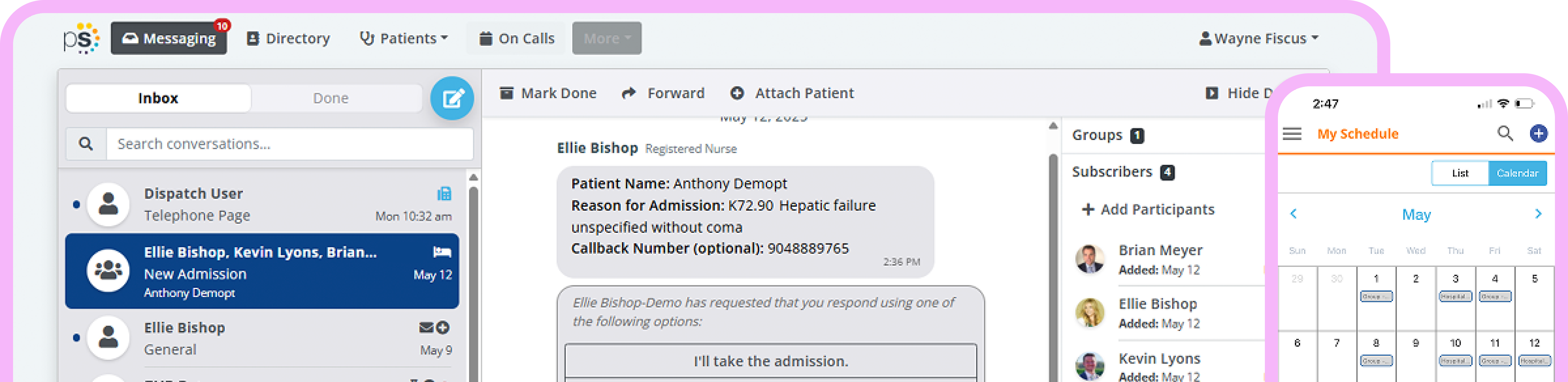
The central mechanism is Dynamic Intelligent Routing. It uses roles, coverage, schedules, and contact preferences to determine where a message should go. A name in a directory answers who a clinician is. A live schedule answers whether that clinician is responsible now. When coverage changes, routing needs to follow.
Scheduling supplies the answer. Routing puts it to work.
This makes PerfectServe an operations layer between existing systems and the people who must act on their information. The company reports more than 270 integrations across clinical, IT, and telecommunications systems. Its catalog includes EHR connections, nurse-call systems, paging networks, identity tools, and schedules. An alert is only useful when it reaches a person with the context and responsibility to act.
A portfolio built around the handoff
Founder Terry Edwards began developing PerfectServe’s original prototypes in 1997. The company’s story starts with replacing an answering service. That origin helps explain the attention to contact preferences and after-hours coverage. The problem arrives as an ordinary telephone call, long before it becomes a grand theory of hospital operations.
Investment widened the ambition. A $21 million financing round in September 2015, led by MemorialCare Innovation Fund, supported development of Synchrony. K1 Investment Management invested in 2018. PerfectServe announced the acquisition of Telmediq in January 2019, then Lightning Bolt and CareWire the following month. Communication, scheduling, and patient outreach were coming under one roof.
Unite, announced in November 2021, gave that collection a platform identity. Clinical Collaboration handles secure communication and alerts. Lightning Bolt builds provider schedules around organizational rules and individual preferences. Operator Console brings live coverage and directory information to the hospital switchboard. Medical Answering Service manages practice calls. Patient Engagement extends communication to patients and families.
AnesthesiaGo, acquired in January 2022, adds a particularly revealing detail: daily operating-room assignments for anesthesia staff. Knowing who is working a shift does not settle who should cover each case. PerfectServe announced its full integration with Lightning Bolt later that year. The calendar, it turns out, contains several different problems wearing the same neat little squares.
The switchboard bill makes the case concrete
At Munson Healthcare’s seven-hospital system in northern Michigan, a legacy on-premises platform relied on physical pagers and a mobile app the customer account describes as unreliable. Operators had limited visibility into message receipt. Clinicians struggled to connect directly, and coverage information was difficult to keep current.
Munson deployed Operator Console, Clinical Collaboration, and Lightning Bolt Scheduling. The vendor-published account reports 56,000 fewer call-center calls over 13 months and 600 retired pagers. Monthly pager spending fell from about $20,000 to $10,000. That difference annualizes to roughly $120,000 in avoided pager fees.
Operators were no longer needed for every routine connection. Live schedules and direct secure messaging gave clinicians another path. This is the useful economic argument: examine which transactions require an intermediary, then remove the unnecessary detours. A switchboard’s workload can tell you something about the systems around it.
PerfectServe prices by organization size and selected solutions. A buying decision therefore needs a scoped quote alongside the savings estimate. Pager contracts, implementation effort, integrations, training, and ongoing service belong in the same calculation. One customer’s gross saving is a starting point for questions, not a budget another hospital can simply photocopy.
An AI voice with an old address book
In August 2026, PerfectServe launched Intelligent Answering powered by ConnectiveIQ, featuring a virtual agent called Sloane. It captures caller intent through conversation and uses practice rules, directories, and live on-call coverage to route calls. English and Spanish were available at launch. Transcription and routing records make the call’s path visible afterward.
The company says Sloane identifies itself as a virtual agent and does not provide medical advice. Potential emergencies trigger direction to call 911. New deployments include a period of workflow configuration, training, and testing. Those particulars matter more than whether the voice sounds pleasantly conversational. The destination still has to be correct.
Chief Innovation Officer Ben Moore described the earlier hesitation in an August company blog: “But the models were not accurate enough or quick enough for what we needed to do.” The company’s explanation for proceeding includes improved models and engineering that uses other agents to monitor responses. Those are its claims about readiness, rather than proof of results at every practice.
The work behind the software
The alternatives depend on the job. TigerConnect competes in clinical communication; Spok serves hospital communication and contact-center needs. Provider scheduling has its own choices, including QGenda and Amion. Hospitals can also keep their existing mix of answering services, spreadsheets, pagers, and internal procedures. A fair comparison starts with the workflow being purchased.
PerfectServe’s strongest positioning is the connection between scheduling and communication. That does not make competitors incapable of integration. Its own catalog describes sending Lightning Bolt schedule data to TigerConnect. Healthcare software sometimes needs to cooperate with the very product a sales team would like to replace.
Customer support is part of the proposition. PerfectServe advertises named contacts and round-the-clock support, while its leadership materials emphasize accountability and staying close to customers. In 2026 it reported Best in KLAS distinctions for physician scheduling and ambulatory/post-acute clinical communication. These categories are specific; they should not be stretched into a verdict on every product or deployment.
For buyers, the practical test is whether coverage data will remain current and whether escalation rules reflect actual practice. A polished app cannot repair a roster nobody maintains. If responsibilities are ambiguous, connecting systems can circulate the ambiguity faster. Premier’s phone-menu repair is a reminder that implementation requires observation as well as configuration.
What the next call will reveal
In September 2026, PerfectServe outlined further investment in operational benchmarks, data infrastructure, AI, voice, and digital workflows. The announced direction is to connect operational information and help organizations decide what should happen next. It is an ambition to watch through deployment results.
The transferable method is already visible. Map a call from arrival to resolution. Identify who is responsible at each step. Join the coverage record to the routing decision. Test the choices with actual callers. Measure operator traffic, message receipt, and cost before and after the change.
PerfectServe’s business rests on the idea that a hospital’s available expertise must also be reachable. The telling detail is still that patient at the phone menu, asked to supply a distinction the organization already understood. A well-designed system spends its own knowledge generously. It does not ask the worried caller to earn admission.
Follow the conversation
PerfectServe website ↗ · Product tours ↗ · Company news ↗ · Blog ↗
LinkedIn · X · Instagram · Facebook · YouTube videos & demos · Company story video