At nine in the morning, an empty infusion chair looks like good news. At noon, a patient waiting for that same chair sees something else. Both can happen in one treatment center, on the same day, with the same staff. The daily total may look perfectly reasonable. The trouble lives in the hours between the totals.
- LeanTaaS helps healthcare teams match appointments and patient demand to available rooms, chairs, beds, and staff.
- Its iQueue software works with existing hospital systems and comes with operational support.
- The opportunity is to recover usable capacity through better timing; the reported customer gains depend on local conditions.
That is the small, consequential puzzle behind LeanTaaS. Healthcare capacity is usually discussed as a matter of counting: beds, nurses, operating rooms. But capacity also has a clock. An available chair at eight cannot simply be saved and handed to a patient at twelve. Once an hour has passed, its capacity has vanished. A hospital can own enough equipment for the day and still have too little at the moment everyone needs it.
The noon rush is a design problem
An infusion appointment is not a neat rectangle in a diary. Treatment lengths vary. A visit may depend on a clinic appointment, laboratory results, pharmacy preparation, and a nurse being available when care requires one. Filling slots in the order people call can produce a schedule that is administratively tidy and operationally awkward.
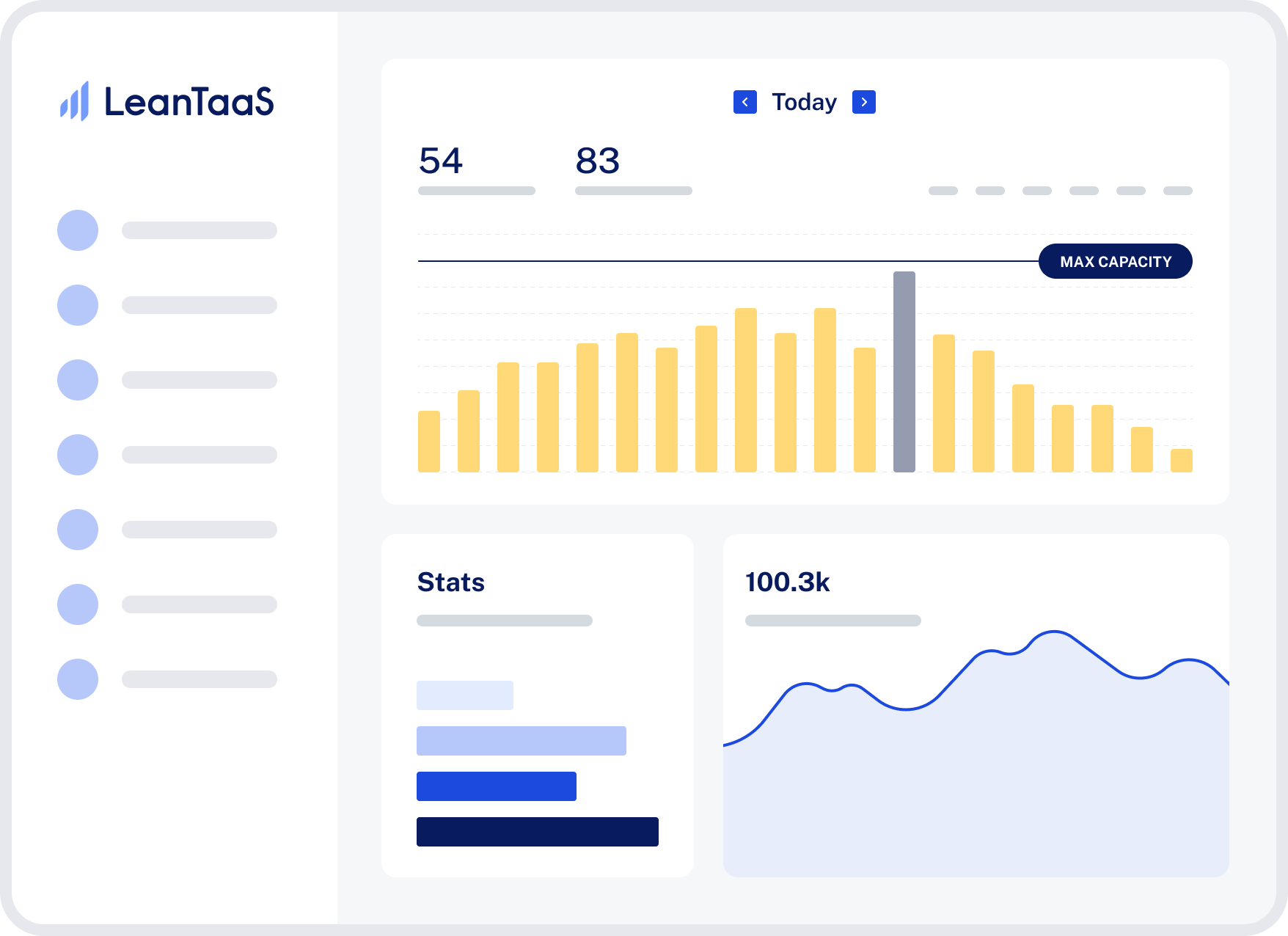
iQueue for Infusion Centers uses historical data, machine learning, and predictive analytics to build scheduling templates around those constraints. The aim is to spread work more evenly across the day. Its reports also look ahead for overbooking, underbooking, and likely pressure on resources. A scheduler gets something more useful than a retrospective account of yesterday’s misery: an opportunity to change tomorrow.
The human stakes are rather less abstract than the graph. Oregon Health & Science University reported a 31% reduction in days when its infusion centers ran past their scheduled closing times after adopting iQueue. Finishing when the shift says it finishes is an operational result that people can take home.
LeanTaaS did not begin as a hospital specialist. Founder Mohan Giridharadas had spent 18 years at McKinsey, working on operational improvement. He wanted to put more sophisticated mathematics into software that could support that work. The early business served companies across industries. A 2013 collaboration with Stanford Health Care on infusion scheduling gave it a problem worth concentrating on. By 2015, it had committed entirely to healthcare.

The calendar needed a second opinion
UCHealth offers a useful account of what changed a buyer’s mind. Its CIO, Steve Hess, described exporting deidentified Epic data into the LeanTaaS cloud, then using the analysis to adjust existing infusion templates. In a 2021 webinar account, he reported a 7% increase in patient volume within 90 days at the first large academic center, without additional staff or chairs.
The electronic health record remained part of the workflow. The additional mathematics helped the team decide how to use it. That distinction matters for a hospital already invested in a major technology system: the purchasing question becomes whether an added operational layer produces enough improvement to justify another supplier.
“We’re playing this game of Tetris”
Steve Hess, UCHealth CIO, discussing the scheduling work in 2021
The operating room offered a related puzzle with more politics attached. Surgical blocks reserve time for surgeons or groups. Time that will go unused can be valuable to someone else, provided it is released early enough and can actually be found and booked. UCHealth’s published case study says earlier improvement events focused on first-case starts and turnover times had not delivered substantial, sustained utilization gains.
Its next move was to deploy iQueue’s exchange and analysis modules across 25 inpatient and eight outpatient operating rooms at University of Colorado Hospital. The tools provided performance metrics and a simpler way to release or request time. The implementation also included introductory meetings, material in the surgeon lounge, and individual outreach. The software needed participants.
Historical customer results. Additional revenue is not net profit or the price of the software.
These changes make the story more interesting than an algorithmic victory lap. A room can be physically available while its time remains difficult to obtain. Making that time visible and shareable changes how people use the building.
Software, with people attached
LeanTaaS sells to healthcare organizations. The people using its products include operational leaders, schedulers, nursing teams, and surgeons. Its commercial proposition combines cloud software with expertise in clinical operations, data analysis, and process improvement.
A published company profile describes subscription pricing per asset per month. That connects the commercial unit to the resource being optimized. For a buyer, the sensible calculation includes the subscription, integration work, and staff time, weighed against the value of additional treatments or cases and any reduction in wasted effort. A reported revenue gain should never be mistaken for the entire calculation.
The company calls its support offering Transformation as a Service. Dedicated experts help with data quality, digitizing workflows, change management, and governance. It advertises guaranteed outcomes through that service; a buyer still needs to examine the particular commitments in its agreement. The practical attraction is continuity: someone remains responsible after the initial implementation meetings end.
This places LeanTaaS in the capacity-optimization market alongside vendors such as Qventus, TeleTracking, and Care Logistics, as well as Epic’s operational tools. Its distinctive proposition is the combination of specialist scheduling mathematics across several clinical settings and ongoing implementation support. The relevant comparison is the specific workflow a hospital needs to improve, together with the effort required to make the recommendations usable.
That mix of software and service also explains the breadth of expertise the business needs. Its careers page describes a flexibility-first organization with remote work across the United States. Clinical experience and quantitative skills both have a place: a forecast has to survive contact with the people who run the day.
Follow the patient, find the next bottleneck
The product portfolio follows several points where care gets stuck. iQueue for Operating Rooms addresses surgical access and block use. iQueue for Inpatient Flow helps teams anticipate demand and coordinate beds, discharge barriers, transfers, and staffing. iQueue Autopilot adds a conversational interface for operational questions. In June 2025, iQueue for Surgical Clinics extended coordination upstream, including case building, readiness tracking, patient outreach, and pipeline analysis.
Different products address different steps; this diagram describes the scope of the strategy.
The acquisitions make that direction visible. In January 2023, LeanTaaS bought Hospital IQ, adding workforce and workflow-automation capabilities. A bed and the staff needed to care for its occupant have to be available together. Combining the two kinds of optimization is a logical response to that dependency.
Then, on September 1, 2026, LeanTaaS announced its acquisition of Aidin. The care-transition platform serves more than 200 hospitals and coordinates referrals to post-acute providers. It brings work outside the hospital into the picture: arranging the next setting of care can hold up discharge even when a patient is ready to leave. The acquisition connects another operational bottleneck to the existing inpatient-flow business.
Capital has helped fund the expansion. A $130 million Series D in December 2020 was led by Insight Partners with Goldman Sachs participating. Bain Capital Private Equity announced a majority-stake growth investment in 2022. A 2023 strategic relationship with Siemens Healthineers added a route to hospitals through its network and operational expertise.
Borrow the question before buying the software
The transferable lesson is to examine the shape of work before assuming the only remedy is more resources. Measure the day in intervals. Ask when demand, treatment duration, staff availability, and linked appointments collide. Choose a manageable pilot and identify who has authority to change the schedule. Judge it by patient access, waits, overtime, and financial results together.
There are limits to that approach. As an operational inference, better timing offers less help when every safely staffed hour is already used, when appointments cannot move, or when the underlying data misdescribe reality. Teams also need the authority and willingness to act. Siemens Healthineers explicitly cautions that results from its LeanTaaS collaboration depend on each customer’s setting.
LeanTaaS gives those teams tools for a deceptively simple question: is the hospital short of capacity, or is its capacity arriving at the wrong time? An empty chair cannot answer. The schedule sometimes can.