Consider the modest medical chart. The coding team wants it to support a diagnosis. The quality team wants it to establish whether a screening happened. Months later, an auditor wants the evidence behind a submission. Each request sounds perfectly reasonable. Together, they can produce an absurd itinerary: the same record collected again, reviewed again and filed somewhere another department cannot conveniently reach.
Reveleer has made a business of that journey. Its latest proposition is simple enough to sound overdue: retrieve the record, organize the evidence and let several teams use it. In a system that prizes specialist expertise, the expensive oversight may be that specialists keep doing the same preliminary work.
The story in four lines
- The buyer: health plans and providers carrying financial responsibility for patient care.
- The job: turn scattered records into usable coding, quality and clinical evidence.
- The bet: one shared record can support several programs.
- The test: a human must be able to inspect why the software made a suggestion.
A billion pages, and a very small window
In April 2026, Reveleer reported handling more than 1.2 billion pages of clinical data annually for over 55 health plans. Its broader customer base exceeded 80 organizations. Those are company-reported figures, but they establish the scale of the task. A chart is manageable. A billion pages require an industrial method.
The buyers inhabit value-based care, where payment arrangements take account of quality, costs and the health needs of the population being served. A plan needs reliable documentation of those needs. A provider needs useful information before a patient encounter. A quality team needs evidence that recommended care has occurred. Reveleer occupies the administrative space connecting these jobs.
Its homepage names customers including HCSC, Arkos Health and Upward Health. The users are more varied than the purchaser: coders, abstractors, clinicians, quality managers and enrollment staff. For them, the product’s value depends on whether it removes a task, surfaces a relevant finding or makes a review easier to defend.
pages processed, according to Reveleer’s April 2026 announcement
The chart gets a permanent address
The Clinical Data Repository, introduced in April 2026, gives the record a home at the member level. Charts can be indexed and searched by member, provider and date of service, then reused across risk adjustment, quality and audit projects. AI helps extract identifying metadata from documents that arrive in inconvenient forms.
Think of the practical difference. When an audit request arrives, a team can look for the documentation already collected for another program. The repository is designed to make that reuse possible through a shared, searchable record. Access controls and audit trails matter because easier access to health information still requires accountability.
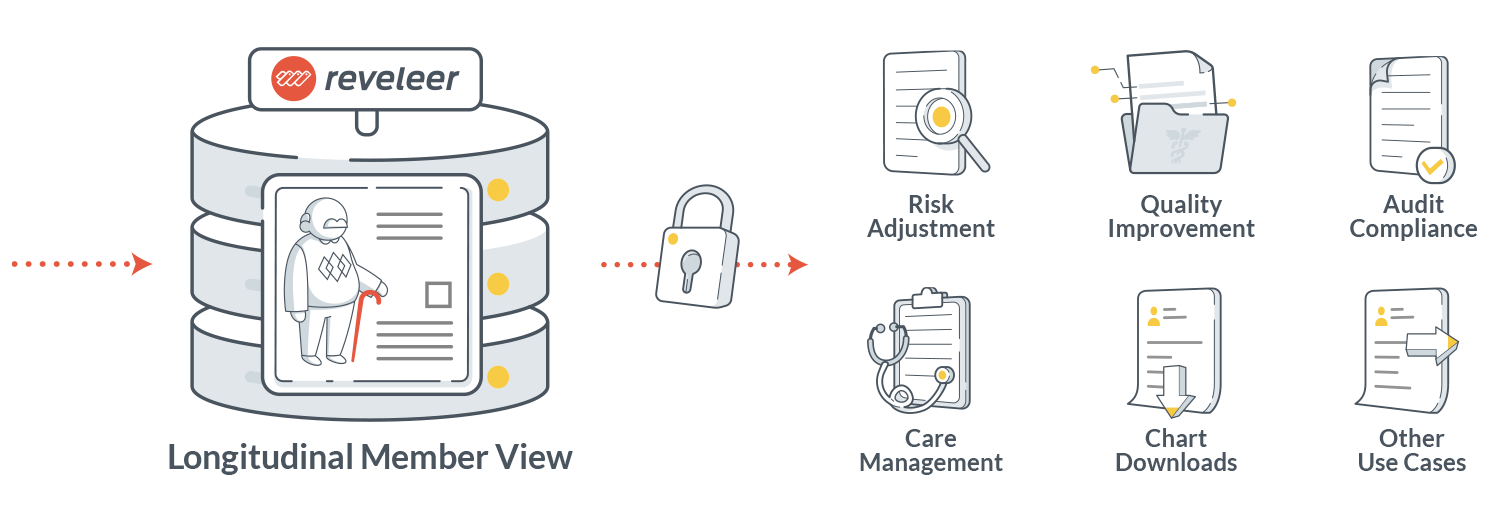
This is also a positioning choice. Reveleer sells a connected set of workflows: retrospective coding, prospective clinical intelligence, quality improvement and member management. An organization can buy separate tools for those functions. Reveleer’s argument is that the effort of reconciling them has become a product problem in its own right.
EVE reads the evidence; the rules narrow the list
The AI assistant is called EVE, short for Evidence Validation Engine. In the hybrid architecture announced in January 2026, generative AI extracts evidence from clinical records. A separate library of more than 3,300 clinician-authored deterministic rules supports diagnosis suspecting. A possible condition travels with its supporting documentation and the logic behind the suggestion.
That separation makes the system interesting. Clinical notes are untidy prose. Rules need consistent inputs. The language model’s job includes translating the former into evidence the latter can use. Clinicians and coders remain involved; an evidence-backed suggestion still needs judgment.
- 01GatherRecords from across care settings
- 02ExtractAI organizes clinical evidence
- 03EvaluateClinical formulas surface suspects
- 04ReviewPeople inspect evidence and act
Google Cloud’s case study describes why Reveleer moved beyond its earlier natural language processing approach: better interpretation and fewer false positives. After testing models, the team selected Gemini for its balance of language understanding and cost, using different model versions for different tasks. General comprehension proved useful even in a specialized medical setting.
The cost question appears twice. There is the expense of processing records, and there is the expense of a person attending to an irrelevant suggestion. A cheaper model producing a noisier list can merely move the bill onto the clinician’s calendar. The architecture is designed to reduce that burden; a buyer still has to measure the result in its own workflow.
The revealing experiment happened in the handoff
A company-published case study describes a 2022 pilot at a national health network facing a shortage of clinical documentation integrity professionals. Three cohorts compared the existing review process, a technology-only approach and selective human review. In the selective group, straightforward visit briefs went directly to physicians while harder cases went to documentation specialists.
The selective group performed best overall on the reported HCC capture measure. The network also kept post-visit coding review in place. It is a bounded case study, rather than proof for every organization. Its useful lesson is about routing work: expertise goes further when it is directed toward the cases that need it.
Buying the next job
Reveleer’s company history begins with retrieval services in 2009. When Jay Ackerman joined in 2016, he told Healthcare Innovation, the business was focused on software for annual health-plan HEDIS audits. The subsequent expansion moved it toward year-round quality work, member operations and clinical information at the point of care.
Four additions to the workflow
Dynamic Healthcare Systems
Enrollment and risk-management operations
MDPortals
Prospective risk intelligence and clinical data access
Curation Health
Clinical rules and electronic record integration
Novillus
Provider engagement and care-gap management
Each acquisition addressed an adjacent task. Dynamic broadened member operations; MDPortals helped bring a patient summary into clinical workflows. Curation contributed clinical rules and EHR integration expertise. Novillus extended provider engagement and care-gap management. The sequence explains how a company associated with looking backward at records gained more ways to support work before and during care.
In a March 2024 interview with Nathan Latka, Ackerman described acquiring companies that had already been partners and filling gaps for familiar buyers. He also described hiring integration advisers to establish a repeatable process. The acquisition work included finance, people and sales as well as technology. A signed deal does not merge those departments by itself.

The capital had a price; the customer had a voice
Oak HC/FT led a $65 million funding round in December 2021, alongside existing investors. In February 2024, Reveleer announced more than $65 million in financing led by Hercules Capital. Ackerman subsequently described it as debt for expansion through acquisitions. That choice carries repayment obligations alongside the opportunity to widen the product set.
Ackerman reported approximately $51 million in 2023 revenue and positive cash flow in the March interview. By September, he was projecting roughly $100 million for 2024. These are historical management statements. They explain the ambition behind the borrowing without turning a forecast into an audited result.
The growth account contains a sharper episode. Ackerman said that in 2018 he pledged his house as collateral when the company could not make payroll. He also recalled treating a major customer’s complaints as unreasonable and increasing its price. The customer sent a non-renewal notice on July 3. Potential layoffs loomed before a much larger new customer was signed within about sixty days.

“In 2018, I put that house up as collateral”
Jay Ackerman, recalling a payroll crisis in his September 2024 interview
There is something worth copying here beyond the acquisition strategy: complaints from a large customer belong in the operating discussion. Enterprise contracts can make a revenue chart rise quickly, and a single departure can undo the comfort it created.
Ask the software to show its work
Reveleer offers self-service software, collaborative support and fully managed retrieval and review services. Ackerman described per-member-per-month pricing, billed quarterly, in 2024. For a buyer, the relevant comparison includes the people, integrations and review work required alongside the contract.
The sensible evaluation is concrete: use representative records, inspect the original evidence behind suggestions and count the work saved across departments. Compare results with the current process. Track rejected suggestions as well as accepted ones. Confirm that the quality team can reuse what the coding team collected.
Those questions become decisive where source data is incomplete, teams cannot share documentation or clinicians cannot accommodate another workflow. Reveleer’s technology needs usable inputs and an organization willing to act on its outputs. A platform purchase alone cannot supply those conditions.
The company’s July 2026 report supplies an apt closing detail. In a Harris Poll survey of 200 senior U.S. payer and provider decision-makers, analyzed independently by Mathematica, only 35% reported a documented process for catching incorrect AI outputs. The survey was commissioned by Reveleer. Its finding reinforces the company’s commercial argument while also setting a demanding test for its customers.
The next chapter of healthcare AI may be decided in a very ordinary exchange: someone asks why a condition was flagged, and someone else can open the right page.