The founding office was a Starbucks on Mall Road outside Boston. The equipment was a laptop and a briefcase. The assignment was less romantic: help healthcare organizations install electronic health records and make the data behave. Arcadia began there in 2002, years before “healthcare AI” became a conference genre, and stayed in implementation work for most of a decade.
That origin now reads like field research. Every stubborn interface, duplicated patient and incompatible clinical code taught the company where healthcare software actually breaks. Arcadia eventually moved from installing other companies’ systems to building its own data and analytics layer. Today it connects more than 2,600 sources and manages over 170 million patient records. The product takes claims, EHR, pharmacy, admission, discharge, transfer and social-determinants data, then turns the pile into a linked patient history that can support a decision.
01 / The useful scarThe consultancy was the product lab
Arcadia’s first business was service-heavy. It helped providers deploy and optimize EHRs. That is slower and harder to scale than software, but it created an advantage that cannot be generated in a strategy retreat: the company learned how dozens of clinical systems represent the same patient differently. After a 2012 acquisition, Arcadia leaned toward population health analytics. By 2015, investors were funding its EHR aggregation technology and Arcadia Analytics. Peloton Equity later described the arc plainly - a services-heavy company became a recurring-revenue SaaS platform.
The distinction matters. A general cloud warehouse can hold hospital data. Arcadia sells the healthcare-specific work around it: patient matching, normalization, measure logic, validation, benchmarks and delivery into clinical or financial workflows. Its alternatives include Innovaccer, Health Catalyst, Clarify Health, Optum, Cedar Gate and the analytics modules inside major EHRs. A health system can also build. Arcadia’s pitch is that buying two decades of accumulated rules is faster than rediscovering them.
A prediction that never reaches a care manager is decoration. The product is the cleaned record and the next action.Why the workflow layer matters
02 / The tighteningSell the service arm. Rebuild the machine.
Arcadia’s sharpest strategic chapter began in 2023. Vista Credit Partners supplied $125 million in financing. In December, Arcadia sold its managed-services organization and value-based-care services division to Guidehealth. That business included the people and processes that performed care management, referrals, utilization management and other operational work. Guidehealth kept using Arcadia’s data platform.
The divestiture clarified the boundary: Arcadia would provide the data, analytics and software; partners and customers would operate the care programs. Two months later, it launched a cloud-native lakehouse platform that it said was nearly twice as fast and agile as its predecessor. Fifteen customers were already deployed. In June 2024, Arcadia acquired CareJourney, adding national cost, quality, provider and episode benchmarks built from more than 300 million patient histories.
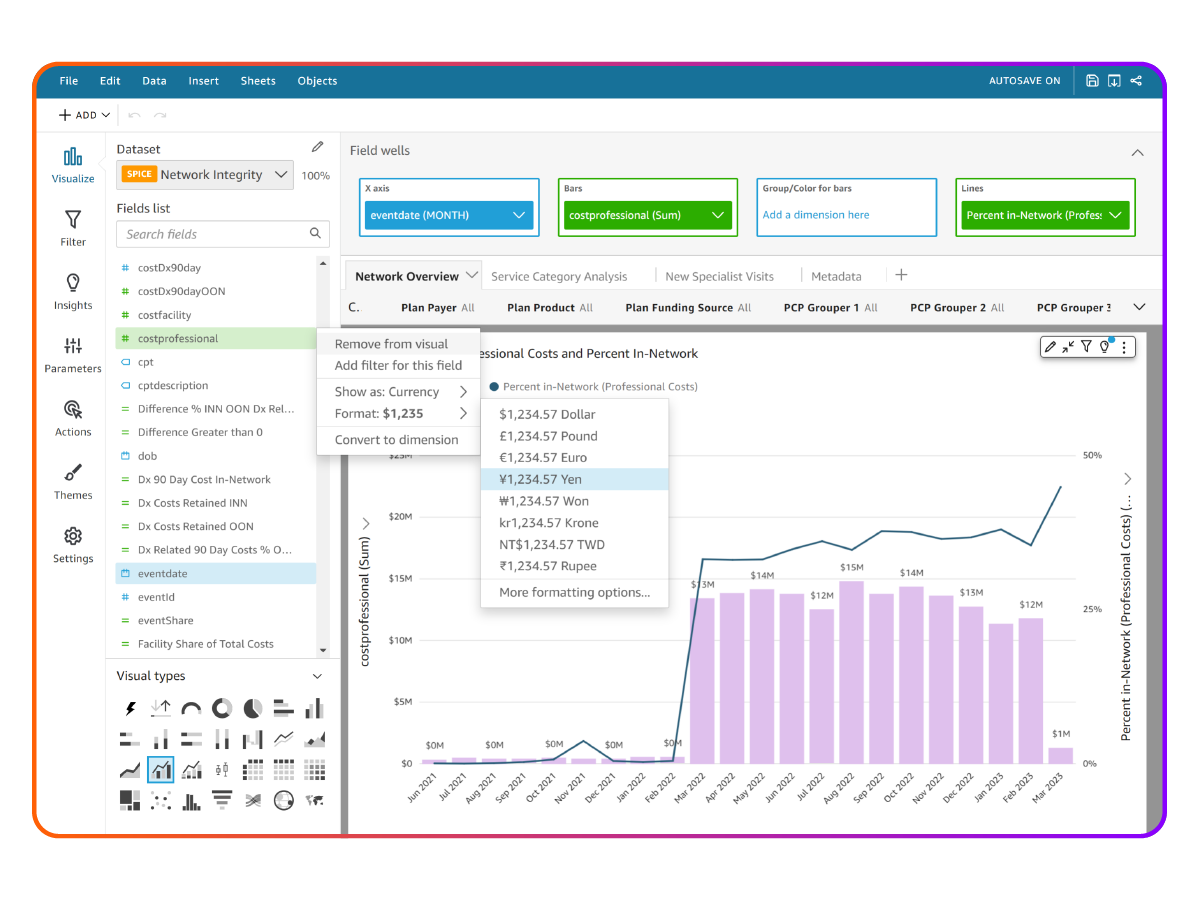
CareJourney filled a strategic blank. A customer’s own data can show what happened inside its network. National benchmarks show whether that performance is good, which providers to recruit and where a new network might work. Arcadia now sells Network Modeler for those choices, Contract IQ for value-based contract scenarios, Provider Intelligence for episode-level decisions, and AI Factory for analysts who want to train models against the curated data.
What Arcadia kept
Data integration, healthcare models, analytics, benchmarks, dashboards, point-of-care intelligence and automation software.
What Arcadia sold
The labor-intensive managed-services operation that ran care, referral, utilization and administrative programs for clients.
The products are sold through negotiated enterprise contracts, not a public price card. One number reveals the commercial method: Arcadia says Contract IQ can reduce third-party actuarial spending by up to $60,000 a month. It is an outcome attached to a line item, not a promise to “transform” a department. The company’s revenue was estimated near $100 million in 2023, while its 2022 annual recurring revenue grew more than 35 percent.
The buyer is usually an enterprise, but the user changes by the hour. A data analyst can query Foundry and publish a Vista dashboard. A finance leader can model a contract. A network executive can compare specialists by cost and quality. A care manager can receive a ranked worklist, while a physician sees a gap prompt inside the EHR rather than opening another application. This tiered delivery is one of Arcadia’s more practical design choices. The same patient record does not need to look the same to everyone. It needs to preserve the same definition while answering each person’s next question.
Security and governance sit underneath that convenience. Healthcare customers are not merely importing sales leads; they are combining protected clinical and financial records across organizations that may compete, contract and share risk with one another. Arcadia advertises ISO 27001 certification, SOC reporting, NCQA validation and row-level controls. Those badges do not guarantee a correct decision, but they lower a real adoption barrier: the platform must prove who can see a record, how a measure was built and whether the incoming data survived validation.
03 / The proof$1.2 billion is impressive - and not a magic trick
Arcadia serves health systems, payers, accountable care organizations, government and life-sciences companies. Named customers include Aetna, Cigna, Highmark Blue Cross Blue Shield, Intermountain Health, Ochsner Health, Rush, Beth Israel Lahey Health, Merck and California’s Department of Health Care Services. The CareJourney deal brought the combined portfolio to nearly 200 organizations.
Its headline result is $1.2 billion in Medicare Shared Savings Program savings generated by Arcadia customers in performance year 2024, roughly 30 percent of the national total. The careful reading is “customers,” not “software.” An analytics platform can identify a rising-risk patient or a wasteful referral pattern. Clinicians, care managers, contract design and local execution determine whether the insight becomes savings.
Company-reported measures use different populations and baselines and should not be compared as one controlled study.
Smaller stories make the machinery visible. Beth Israel Lahey and Blue Cross Blue Shield of Massachusetts sent 17,000 texts to people with a colorectal-screening gap. After shared decision-making was introduced, the share choosing an at-home FIT screening rose from 5 percent to 20 percent. In another Arcadia campaign, 5,000 diabetic patients received targeted outreach and 12 percent of identified gaps closed. These are not science-fiction interventions. They are lists, messages and follow-up made more precise by connected data.

04 / The first failurePerfection became the bottleneck
One early Arcadia customer waited a long time to launch analytics after implementation. The team wanted the data to be perfect. That instinct is understandable in healthcare, where a bad denominator can undermine trust for years. It also kept every useful insight off the field.
Arcadia’s data team pushed through validation and encouraged the organization to start when the system was 80 to 90 percent ready. The customer began using evidence to judge programs and provider incentives. Six months later, it rolled out a hospice program using data-driven patient identification. It also analyzed another proposed program and decided the investment would not pay off. The first win was not more activity. It was an avoided mistake.
“Waiting for perfection can actually delay real, tangible gains.”Jake Hochberg / Arcadia chief data officer
What changed the customer’s mind was not a broader dashboard. It was a specific operating question, an executive champion and enough validated data to act. That is the copyable part of Arcadia’s playbook. Begin with one decision that already has an owner and a financial or clinical consequence. Publish the measure logic. Let users challenge it. Put the answer inside the workflow they already use. Expand only after the first loop closes.
05 / Copy thisA field guide for the data you already own
- Name one decision. “Improve population health” is fog. “Find discharged heart-failure patients who need contact within 48 hours” is a product brief.
- Give the metric an owner. Technical, clinical and financial teams need one accountable executive who can settle definitions and fund adoption.
- Launch before immaculate. Validate the dangerous fields first, label limitations and let real use expose the next quality problem.
- Deliver into the work. A prompt in the EHR or an assigned care queue beats another destination dashboard.
- Measure the closed loop. Count contacted patients, completed visits, avoided admissions, retained referrals or contract dollars - not logins.
The model breaks under predictable conditions. It will not rescue an organization with no trusted data owner, no executive sponsor or no capacity to act on the result. It is expensive overkill for a small practice with a simple stack. It can also fail when teams import a benchmark without adjusting for local patient mix, or when model output is treated as a clinical verdict rather than decision support. Clean data does not remove judgment. It makes judgment inspectable.
Arcadia’s 2025 majority investment from Nordic Capital gives the company another well-funded growth chapter. Its newest language emphasizes agentic AI, precision medicine and automation. The sober reason to watch is older. Arcadia spent 24 years moving down the stack, from helping install the record to cleaning it, analyzing it and sending an action back. In healthcare, the dull layer is often the defensible one.