The most expensive moment in healthcare can look embarrassingly ordinary. A patient leaves a hospital. The discharge notice lands in one system. The primary-care team works in another. Nobody calls soon enough. Medication instructions get fuzzy, a follow-up slips, and the patient returns through the emergency department. The failure is not that the hospital lacked data. The failure is that the data never became somebody’s Tuesday-morning task.
Lightbeam Health Solutions has spent more than a decade selling a fix for that messy middle. The Dallas company pulls together claims, electronic medical records, quality measures and thousands of social-risk factors. It then organizes patients into cohorts, ranks risk, flags gaps and routes work to nurses, care managers, physicians or financial teams. Around that core sit remote monitoring, HCC coding, referral management, actuarial modeling and advisory services. The ambition is broad; the unit of value is wonderfully small: one useful action, assigned to one person, early enough to matter.
The first thing that broke was the handoff
Consider a Florida management services organization supporting several ACOs. Its problem was avoidable readmissions. Lightbeam’s case study says the group connected a health-information-exchange feed, identified discharged patients each day, sorted them with a Johns Hopkins risk score and assigned outreach automatically. A staff member still had to make the call, review medication and discharge instructions, and book a follow-up. The program spread to more than 90 percent of practices. The group reported readmissions per thousand falling from 41.7 to 35.7 - a 14 percent year-over-year drop - and estimated $4.3 million in annual savings.
That sequence explains the company better than an AI diagram can. Data opened the loop. A human closed it. Lightbeam did not replace care; it made scarce care less random.
The operating loop
A customer crossed the table
Lightbeam’s product instincts have an unusual source. Erin Page, later the company’s president and chief operating officer, had been president of its first customer. She described that customer’s original challenge as taking all available data, normalizing it and making it actionable for everyone from a clinician to an actuary. Her move from buyer to operator is more than a tidy origin anecdote. It suggests what changed Lightbeam’s mind about the category: analytics by itself was not the finish line.
“Healthcare organizations have no shortage of data, but too often it is fragmented and difficult to operationalize.”Ben Stilwill, Lightbeam president
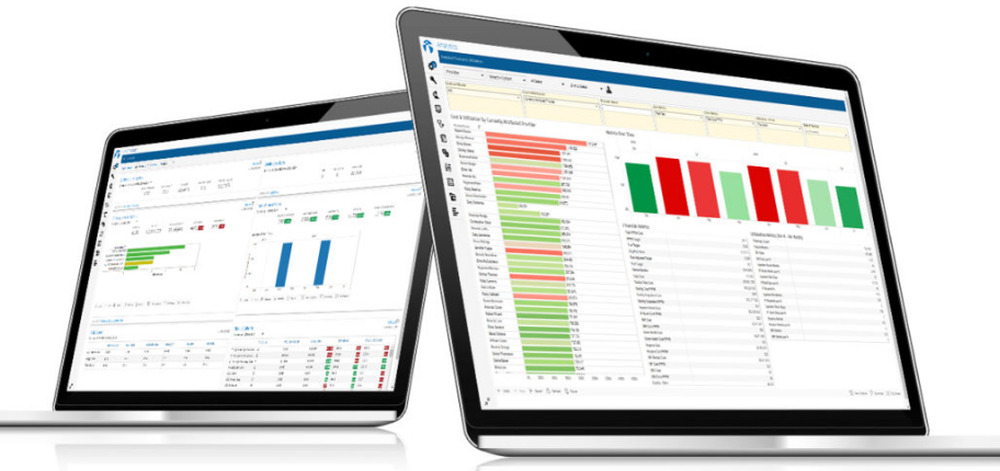
The company now calls its product an operating system for value-based care. That phrase risks sounding like trade-show fog, but the parts are concrete. A payer can model risk. An ACO can find a care gap. A medical group can detect referrals leaking outside its network. A nurse can manage a list of rising-risk patients. Executives can compare contract performance against benchmarks. Lightbeam sells enterprise SaaS contracts plus implementation, clinical, financial and actuarial expertise. There is no public menu price; this is negotiated infrastructure, bought by organizations with populations and downside risk, not downloaded by individual patients.
No box on the porch
In 2021, Lightbeam bought CareSignal, a St. Louis company built around “deviceless” remote patient monitoring. The word is a small piece of smart positioning. Traditional RPM often begins with shipping a connected scale, cuff or sensor. CareSignal starts with the phone a patient already has, using text messages, interactive voice response and conversational agents across more than 30 condition-specific programs. There is less hardware to lose, charge or explain.
That matters when the people most worth monitoring are older, rural, chronically ill or digitally excluded. CareSignal’s partnership with the Texas Association of Community Health Centers was designed to reach the association’s 73 member centers and their 1.6 million patients. Forty-one percent of those centers were rural. The company’s Harris County maternal-health work targeted roughly 15,000 community members. Distribution, in this corner of healthcare, can be more important than novelty.
Customers liked it. CareSignal earned Best in KLAS for remote patient monitoring in 2024 and again in 2025, with reported satisfaction scores rising from 91.1 to 93.6. Lightbeam’s broader population-health product has faced more mixed evidence: KLAS’s 2023 overview noted that customers of Lightbeam and several rivals sometimes felt they had to build out functionality before seeing results. In the 2025 population-health rankings, Lightbeam’s score was 82.7, below Azara, Epic and Innovaccer. The lesson is useful because it punctures the polished platform story. Breadth creates setup work.
The acquisition map is the strategy
Lightbeam was founded in 2012 by Patrick Cline, who had previously founded NextGen Health, an early electronic health-record company. Its acquisitions read like a checklist of what an accountable-care organization needs after it buys analytics. Dynamic Vault added hosting, backup and data infrastructure in 2014. CareSignal added patient monitoring in 2021. Jvion’s assets added prescriptive AI and social-determinants models in 2022. Syntax Health added contract modeling and actuarial incentive design in 2025. Deal prices were not disclosed.
With Syntax, Lightbeam moved upstream. Before care teams manage a contract, somebody has to design it, forecast it and persuade payers and providers to accept the same assumptions. Syntax says its collaborative software can cut contracting time by up to 40 percent. A separate partnership with Wakely Consulting Group adds benchmarking and network scenario modeling. Lightbeam now wants a seat from the negotiation table to the patient phone call.
Microsoft supplies another route in. Lightbeam launched a transactable Azure Marketplace offer in 2024, letting eligible customers count purchases toward Azure commitments. Microsoft named it the 2025 Healthcare and Life Sciences Partner of the Year and included it among partners extending clinical insight into Dragon Copilot. In 2026 Lightbeam showed Analytics Copilot, for conversational questions over population data, and Cohort Copilot, for building patient groups without wrestling through every dashboard filter.
What can be copied before the software is bought
The company’s most portable ideas do not require a licensing agreement. They require operational honesty.
The five-part Lightbeam playbook
- Start with one expensive, observable failure - a readmission, an unclosed referral or an avoidable emergency visit.
- Join only the data needed to identify that failure reliably.
- Turn the signal into a named person’s task, with a deadline.
- Use the least demanding channel that reaches the patient - often a call or text.
- Measure against a credible baseline or matched control, then expand.
The measurement point deserves emphasis. In a study of a Southwest integrated delivery network, Lightbeam compared 1,226 intervened Medicaid patients with matched controls of the same age, gender and risk level. The intervention group had 85 admissions within 30 days, versus 150 in the control group - a 43.3 percent relative reduction. Using a $9,800 national average cost per Medicaid admission, the case study estimated $637,700 avoided over 12 months. That is more informative than dropping a savings number without showing the denominator, but it is still an observational impact analysis, not a randomized trial.
Where the beam goes dark
Lightbeam’s model is strongest when five conditions line up: dependable feeds, a definable population, clinicians who trust the ranking, staff with authority to intervene, and a contract that rewards lower utilization or better quality. Remove one and the chain weakens quickly.
Late claims, broken patient matching or incomplete EHR feeds can make precise-looking priorities unreliable.
An alert without a care manager, escalation path and time budget is just another inbox decoration.
Fee-for-service organizations may bear the cost of outreach while another party captures the savings.
Savings claims can overreach when patient selection, concurrent programs or cost assumptions are not controlled.
Lightbeam is not alone. Buyers can choose Epic Healthy Planet, Innovaccer, Azara, Arcadia, NextGen, HealthEC, Oracle or a home-built stack. Its differentiation is the attempt to connect a wide product surface with hands-on advisory work and low-friction patient engagement. Its biggest competitor may be less glamorous: the spreadsheet nobody trusts, the queue nobody owns and the referral nobody closes.
By 2025, Lightbeam had made the Inc. 5000 seven times; that year’s listing reported 51 percent growth over three years. The company says it serves more than 45 million patients, supports 490,000 physicians and has helped generate more than $5 billion in gross customer savings since 2014. Those are company-scale claims, not audited financial statements. The sharper proof lives closer to the ground: fewer admissions in a defined cohort, a referral completed, a patient called.
Healthcare technology loves the grand reveal. Lightbeam’s work is more persuasive when it stays small. Find the person likely to fall through the crack. Put that person on the right list. Give someone the job of calling. Then check whether it worked.