An estate plan has an awkward relationship with time. The signatures belong to one afternoon. The instructions may have to survive a new marriage, a business sale, another child and a move across the country. The document stays perfectly still. Everything it describes keeps moving. Wealth.com has built its business around that mismatch, selling financial advisors software that helps them turn legal paperwork into something they can examine with a family.
- Advisors use it to create documents, interpret existing plans and show how assets could pass to heirs.
- Ester AI handles document extraction; modeling tools compare estate and tax scenarios.
- The business sells software subscriptions and enterprise access, with current prices quoted on request.
The afternoon that keeps expiring
Wealth.com’s origin account begins after the March 2020 sale of fraud-prevention company Emailage to LexisNexis. Rei Carvalho, Emailage’s founder, encountered an estate-planning process that felt fragmented and static. He joined forces with former Emailage CTO Rafael Loureiro. Their eventual founding team included Danny Lohrfink, whose background spans Goldman Sachs and SoFi, and Tim White, another Emailage veteran.
That combination helps explain the product. Estate law supplies the rules; software organizes the information; financial-services experience supplies a route to the customer. The recurring problem is easy to recognize: having a plan does not automatically mean someone understands it, or remembers to revisit it.

First, find the person who sees the changes
The company’s March 2022 public launch came with $16 million in seed funding and an initial proposition aimed at employers: offer estate planning as a financial-wellness benefit. By its September 2024 Series A, Wealth.com described a platform serving more than 500 wealth management firms. The center of gravity had moved toward advisors.
There is a practical logic here. An advisor already has reasons to ask about an asset sale, a growing family or retirement. Those conversations create opportunities to notice when the estate plan needs attention. For someone building a business, the transferable lesson is distribution: put an ongoing service beside an existing relationship that makes returning to it useful.
A signed plan records a decision.
A useful planning process makes room for the next one.
Wealth.com’s customers now include advisory practices, broker-dealers and private banks, serving households from emerging wealth to complex family fortunes. On its website, Archer Investment Management planner Emily Rassam reports helping 35 clients start documents in 35 weeks. The small, steady rhythm is more revealing than a promise of instant transformation.
Teach the PDF to answer back
The starting point can be an existing trust. Ester, Wealth.com’s AI assistant, extracts provisions, appointments and asset information into structured summaries. It can turn the results into visualizations and answer questions about the uploaded document. An advisor can move from reading clauses to discussing who has authority, who receives assets and when.
- 01Upload
the documents - 02Structure
the details - 03Compare
the possibilities - 04Review
with the family
For clients starting from scratch, guided workflows create state-specific wills, revocable trusts, health care directives, powers of attorney and guardianship nominations. The platform also tracks progress toward signing and offers access to attorney consultations and mobile notary services. That last stretch matters. A document waiting for execution is still unfinished work.
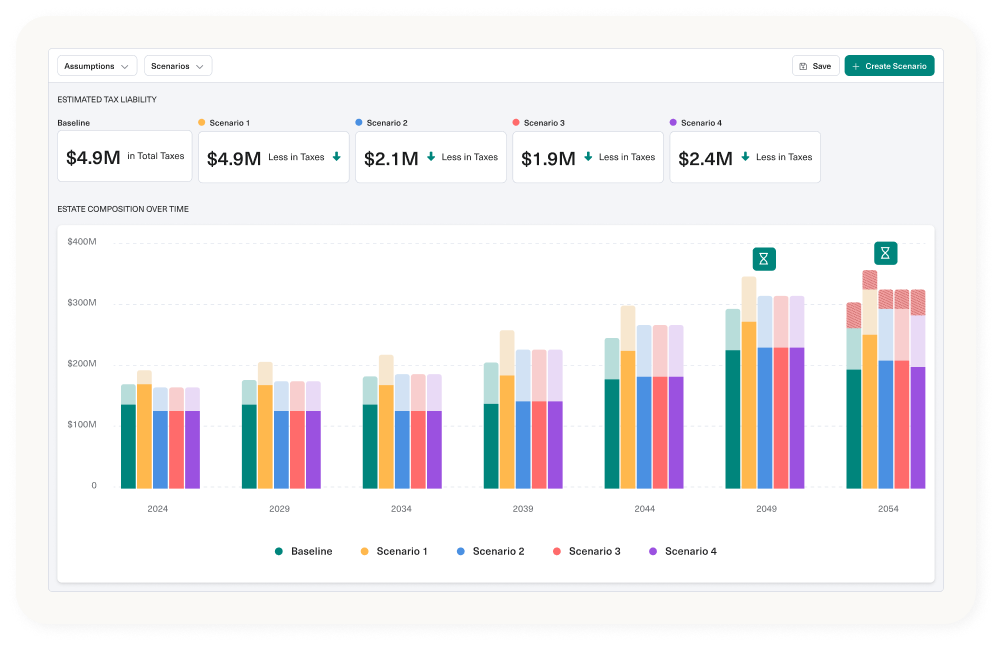
Scenario Builder handles a different question: what would change if the family acted differently? Advisors can compare gifting, trust strategies, asset sales and relocation against a baseline. For complicated estates, Family Office Suite adds tools such as Heritage Map and EstateFlow. Relationships and distributions become visible enough to discuss across the table.
The expertise behind that interface matters. Chief legal officer Anne Rhodes previously practiced estate planning at McDermott Will & Emery and Perkins Coie. Her presence alongside engineers and product specialists reflects the work involved: legal concepts have to become usable software without losing the distinctions that make one family’s arrangements different from another’s.
The tax return joins the conversation
The tax-planning product, introduced in 2026, extends the same logic. Advisors can upload tax documents, establish a baseline and model changes across years and states. A Roth conversion, for example, can be examined for its immediate tax cost and its implications for what beneficiaries eventually receive. The appeal is coordinated analysis rather than another disconnected calculation.
Pricing reflects a professional software business. Wealth.com currently asks buyers to inquire for estate, tax or combined packages. At the tax launch, WealthManagement.com reported estate subscriptions around $5,000 annually for core access and $7,500 for the family-office package. Its tax example was about $1,785 a year for 80 households. Those are dated buying references; a firm needs a current quote for its scope.
Go where the advisor already works
Distribution has become a product feature. A March 2026 agreement put Ester document intelligence on the roadmap for Dynasty Desktop, across a network then representing more than 600 advisors. In September, Wealth.com became a launch partner for Claude for Financial Advisors, bringing document questions, page-level citations and tax modeling into the conversational interface.
Series B announced April 16, 2026. New investors included Titanium Ventures, Pruven Capital, The K Fund and Dynasty Financial Partners.
The company competes with estate-planning platforms such as Vanilla and EncorEstate Plans, and adjacent analysis tools such as FP Alpha. Its pitch combines creation, interpretation, visualization and tax modeling. That breadth is useful when a practice wants a shared workflow; a firm with established specialist systems may value a narrower tool.
The boundary remains professional judgment. Wealth.com’s terms say it is not a law firm, and summaries depend on the information supplied. An incomplete document set or unreviewed assumptions can weaken the resulting picture. Advisors still need to check outputs and involve appropriate legal and tax professionals. The useful idea to copy is simpler than the technology: give an important decision a reason to be reviewed while there is still time to change it.
Open the next tab
Explore the platform, pricing options and company news. Follow LinkedIn, X or Instagram.
Watch: Wealth.com on YouTube · Tax-planning demo · The builders on AI and review.