Edmond Walters had a fairly good explanation for his interest in inheritance software. He had ten brothers and sisters. Standing in front of financial advisors in Austin in 2019, demonstrating tools for dividing a family’s assets, he observed that his parents could have used them. The arithmetic was the easy part. Anyone who has tried to divide a restaurant bill among relatives can appreciate the distinction.
By then, Walters had already founded eMoney Advisor, watched it become part of Fidelity Investments, left the company, and returned with another venture. His new project, Apprise Labs, included tools for evaluating trusts and equalizing inheritances. These were features he had wanted to build during his eMoney years. A sale had interrupted the work. It had evidently failed to exhaust his interest.
His career makes more sense when viewed from the family’s side of the meeting table. Financial software can produce a beautifully organized answer to a question nobody quite asked. Walters kept returning to the untidy questions: What do we own? Who understands it? Can we change our minds? And can the people affected by a plan have a hand in making it?
The leather binder had a short shelf life
Before he made software, Walters gathered statements. He began his advisory career in 1983, working with Kistler, Tiffany & Company in Wayne, Pennsylvania, through 1992. That year, he helped establish Wharton Business Group. His working education came from advising wealthy clients, whose finances rarely arrived in a single, convenient pile.
He had attended Villanova University from 1979 to 1983. There was a local network before there was a technology company, too. At the Haverford School, he played basketball with Steven Siegfried. Years later, Siegfried’s son Cory would work for him at eMoney and then Apprise. In this corner of Pennsylvania, a school connection could have a surprisingly long working life.
The frustration that led to eMoney was specific. Clients wanted a complete view of their net worth and the consequences of their decisions. Their advisor needed the same view. Walters looked for an existing solution, encountered resistance when he asked institutions to create one, and decided to build it. The company was founded in 2000.
By 2005, he was describing the old routine in terms almost calculated to embarrass an internet connection: assembling a client’s records could take as long as twelve weeks. The traditional leatherbound presentation had a certain dignity. It also demanded considerable patience from anyone hoping to discover what had changed since it was printed.
Version 4.0 of eMoney’s platform added ways for advisors, planners and assistants to delegate work and share selected information with accountants and attorneys. It also accommodated clients who needed simpler goal planning. Walters listened to requests from advisors who wanted to serve a broader range of people. His product grew through those practical adjustments, one awkward handoff at a time.
Bring holdings togetherClient portal
Let the family seeDocument vault
Keep records accessiblePlanning
Explore decisions
An art with a calculation engine
Walters’s argument about technology was already recognizable in 2009. At an industry conference, he described financial planning as an art, something customized to the person receiving it. Software should free advisors to spend more time on that work. Back-office efficiency mattered because of what it made possible across the desk.
He also noticed that possession of a sophisticated tool did not guarantee its use. Advisors had Monte Carlo simulations available, yet many were uncomfortable using them because they did not understand them. A capability buried in software might as well be absent during a conversation. Education and usability belonged in the product discussion alongside calculation.
There was a revealing moment in 2013. Financial-planning commentator Michael Kitces admired eMoney’s client portal but offered a more restrained assessment of its planning software. Walters agreed with the criticism. He acknowledged that he had not yet devoted the resources he wanted to that part of the product. A founder willing to argue for his software was also willing to admit where it needed work.
That distinction matters to his personality. He could be forceful about the direction of travel without insisting that every piece had arrived. The portal’s visual appeal was doing something useful: making clients more willing to look, ask, and participate. The calculations still had to earn their place in that experience.
“I would never have given up my planning career for a calculator.”
Edmond Walters, on WealthTech on Deck
A larger checkbook, then a departure
By early 2015, eMoney employed about 270 people, with most in the Philadelphia area and another office in San Diego. It had 25,000 financial professionals and roughly a million end users on its software. Fidelity announced an agreement to acquire the business in February. The transaction’s terms were not disclosed; contemporary reporting put the price above $250 million.
Walters spoke about the deal as a way to accelerate development and hire more people locally. The initial arrangement kept him leading the business, while Guardian retained a minority interest. For an advisor who had turned a service problem into a software company, it was a substantial change in the resources available.
His public manner remained less institutional than his new ownership. At the T3 technology conference that February, he introduced emX Select with an explosion-filled video and promised an aggressive response to consumer-facing robo-advisors. There were integrations with other tools, a shared dashboard and a single login. The presentation had theatrical touches; the problem underneath was the familiar nuisance of moving among disconnected systems.
The economics were less theatrical. Walters explained that expanding the product cost serious money, comparing eMoney’s technology budget with Fidelity’s much larger spending. More engineers and stronger infrastructure could support the next phase. Then, in September 2015, he resigned. Michael Durbin took over as interim chief executive. Walters’s fifteen-year run leading the business had ended.
Founds eMoney Advisor
Fidelity acquires eMoney; Walters later leaves
Envestnet buys Apprise technology; VillanovaTech follows
Back at the screen, with unfinished business
He remained involved in the industry through board appointments. AdvisorStream added him in October 2018, and Professional Capital Services announced his appointment that December. His appeal to those businesses included experience with advisor technology and the relationships accumulated while building it. The work kept him close to the people who would use his next ideas.
In January 2019, Envestnet and PIEtech announced their collaboration with Walters on Apprise Labs. PIEtech made MoneyGuide, a competitor to eMoney. The partnership joined people with different positions in the planning market around a shared project: more detailed cash-flow, tax and estate-planning capabilities.
The arrangement was a useful reminder that the financial software business is a small room with many doors. A former competitor could become a collaborator. Walters brought his interest in the advisor-client experience; the partners brought planning technology and distribution. The next product would reach advisors through relationships already in place.
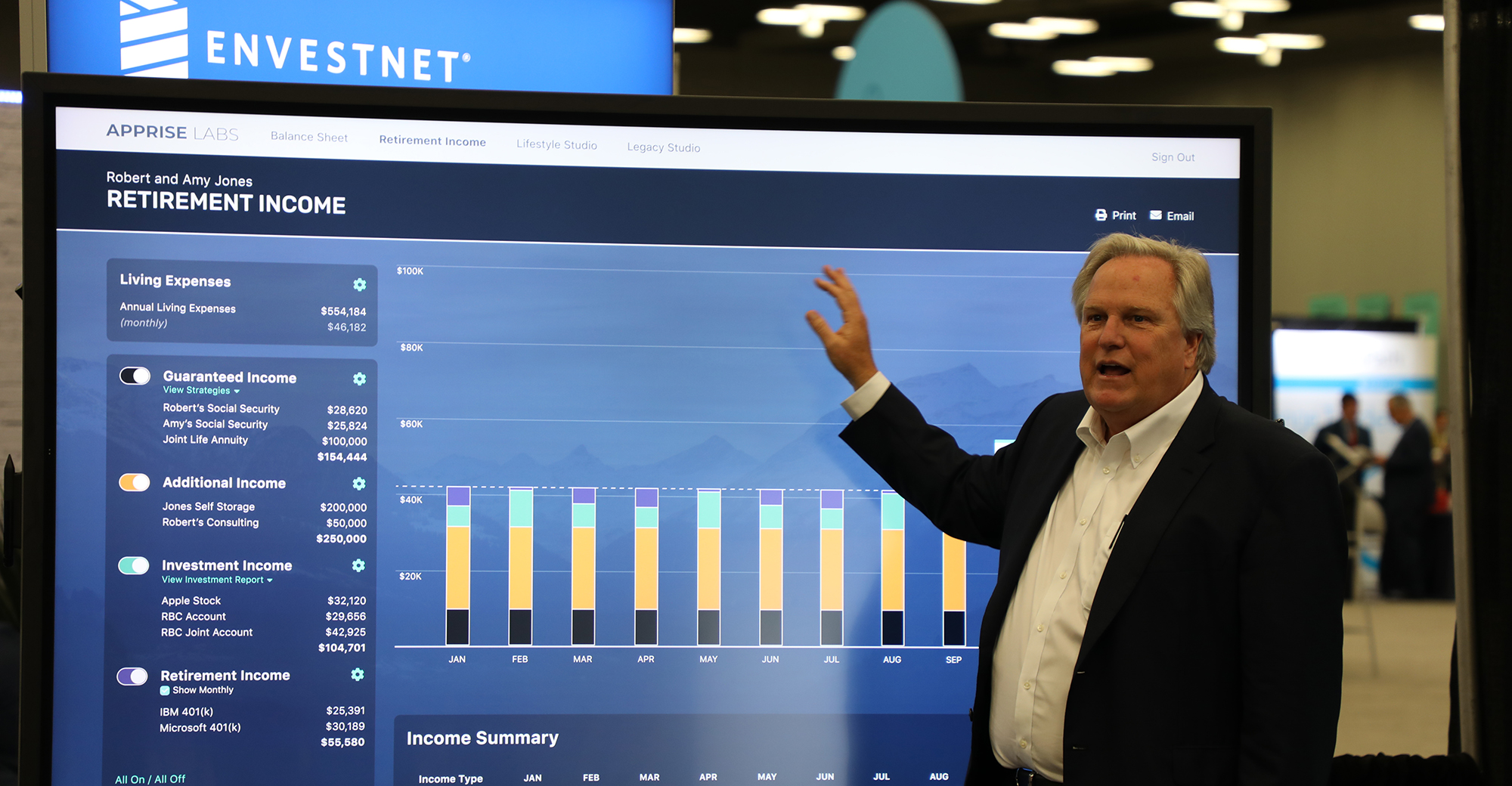
In a 2020 conversation with Jason Pereira, Walters explained Apprise through collaboration: advisor and client designing a plan together. Clients could explore spending scenarios at home. The work was meant to feel like something they had helped create, rather than an elaborate presentation delivered to them. A household’s decisions would have an interface.
There is a demanding product idea inside that apparently friendly invitation. Once a client can change an assumption, the software has to make the consequences understandable. The advisor has to explain the choices. The meeting can become more candid because the client is able to try an idea before committing to it.
Another sale did not empty the notebook
In March 2021, Envestnet acquired technology from Apprise Labs. The assets included cash-flow planning and advanced estate-planning capabilities, with trust modeling and inheritance-fairness planning becoming part of MoneyGuide’s Wealth Studios. The terms were undisclosed. The technology had found a new home, but Walters was already moving toward another project.
The transaction involved intellectual property rather than the Apprise name. He retained ownership of that business and moved his subsequent work under VillanovaTech. In a March email, he described starting the new firm during the week the deal closed. His explanation was characteristically direct: he liked building things that did not yet exist.
His enthusiasm could also make him an impatient customer. After seeing YieldX’s fixed-income software, he contacted his own advisors at RBC and urged them to use it. They were already discussing a deal. YieldX added him to its advisory board in February 2022. The builder still wanted a better tool on his own side of the desk.
By August 2023, he was discussing VillanovaTech with Mark Dorman, including work on a trust tool and ways for advisors to engage entire families across generations. He appeared as VillanovaTech’s founder and CEO, still discussing the next tools he wanted to build. The subject had widened from a collection of accounts to the relationships surrounding them.
Who gets to touch the plan?
eMoney celebrated its twenty-fifth anniversary in 2025. Its history records an early platform combining an advisor dashboard, client portal, account aggregation and a vault, followed by mobile access and the Decision Center. Those milestones show how an idea born in advisory meetings could become part of the everyday machinery of financial planning.
Walters’s own story keeps returning to a smaller scale. One advisor, a family, a screen, a decision that changes the next few years. His companies have changed ownership, and his collaborators have included former competitors. The recurring concern has been who can see the picture and who can help alter it.
A family fortune can be described in numbers. A family’s intentions require conversation. Walters has spent much of his working life trying to give that conversation better equipment. With ten brothers and sisters, he had reason to suspect that getting everyone onto the same page would require more than a handsome binder.