The spreadsheet was large, shared and already losing the argument. Fahad Hassan and his wife had spent two years updating their family finances in it, emailing versions back and forth, then discovering that the numbers had gone stale. Planning had become clerical. The couple spent as much time establishing a common picture as deciding what to do next. This was adulthood by attachment: FINAL, FINAL-2, perhaps FINAL-really-this-time.
Hassan had a better résumé for fixing the problem than many frustrated spreadsheet owners. He had founded two education-technology companies, led business operations at freight startup Convoy and worked as an investor at Activant Capital. Products, teams and capital were familiar ground. Yet the available personal-finance tools still left him with pieces rather than a plan. He tried dozens. None joined live information to the sort of broad guidance a complicated household needs.
So he called David Cusatis, a longtime friend and engineer then working at Amazon. The invitation was not to make a prettier ledger. Hassan wanted a system that could see accounts together and help a family reason across years. Cusatis left what the founders’ letter dryly calls his “thrilling corporate work environment.” Range took shape between the domestic irritation and the technical dare.
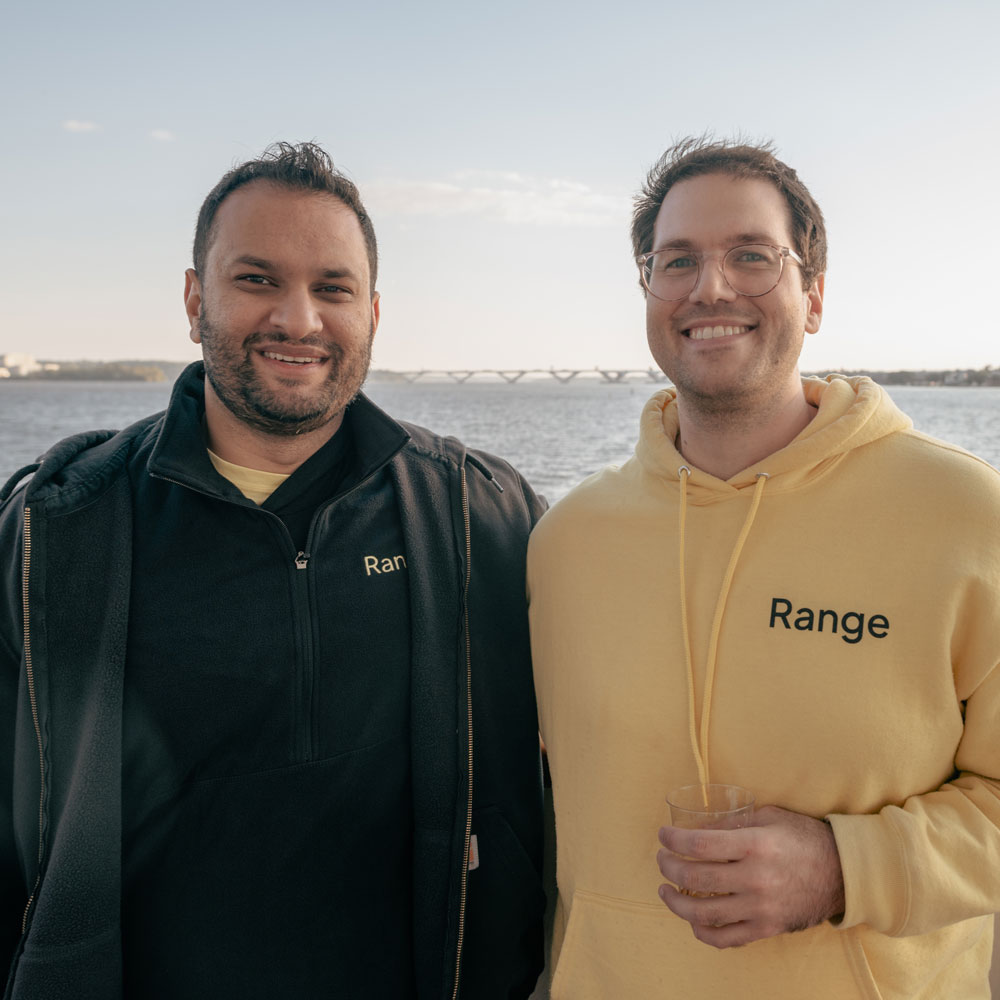
A founder who kept changing chairs
Range is Hassan’s third founding act, but his first two explain the instincts behind it. In 2006 he started Daylert, a college-focused calendaring and text-messaging service. Intelliworks acquired the company, and Hassan stayed in business development. He later founded Always Prepped, which pulled school data into analytics for teachers and administrators. In 2015, Always Prepped joined another education company, Alma.
The next job put him inside a different machine. At Convoy, the digital freight marketplace, Hassan led the supply side and broader operations as the company grew from a small group to roughly 200 employees, according to his professional profile. It was a lesson in the unromantic middle of scaling: marketplaces need both software and people, and a clever interface is merely where the operational trouble becomes visible.
At Activant Capital, he moved to the investor’s side. Founders pitched him. He studied companies rather than only running one. By 2020, when the household-finance problem arrived, Hassan had occupied three useful chairs: founder, operator and investor. Range would require all of them. It would sell a regulated service, build consumer software, coordinate specialists and persuade capital providers that a slow industry could move differently.
The early Range team learned that aggregation was not enough. Customers did not simply want a dashboard on which all their anxieties could gather. They wanted financial planning: investments considered beside taxes, equity compensation, retirement, insurance and estate documents. They wanted a view with a verb attached.
Software speed, fiduciary stakes
Range’s commercial argument is easy to state. Traditional wealth managers commonly charge a percentage of assets under management, a fee that grows as the client’s portfolio grows. Range sells planning through flat-fee memberships, connects a household’s financial information in one platform, and combines software with access to licensed advisers. Hassan’s grievance is not subtle: he regards the old model as slow, costly and built for people who are already very wealthy.
The company’s more consequential wager is Rai, its AI adviser. Hassan describes the ambition with a transportation metaphor: “We think of this as Waymo, not Uber.” Uber finds a human driver; Waymo attempts the driving. In his telling, financial software should not merely route a question to a professional. It should examine accounts, assets and opportunities together, produce recommendations quickly and eventually carry out more of the work.
That analogy is memorable precisely because it exposes the difficulty. Money is not a frictionless test track. Tax rules change. Estate documents have legal consequence. An investment recommendation must survive more than a fluent paragraph. Range says Rai is trained against regulatory standards and uses connected customer data, while human advisers remain part of the service. In 2025, Hassan told Fast Company that the system’s broader context is its advantage: real estate, retirement accounts, investments and private holdings can be considered together.
A dashboard tells you where the money is. Hassan wants Range to help decide what the money should do next.
The future tense matters. Range has spoken about Rai eventually taking actions such as helping file taxes or develop an estate plan; those are ambitions, not blanket descriptions of present capability. The company’s task is to make automation useful without allowing confidence to outrun accountability. In finance, a speedy wrong answer is not a feature.
The visible habits of urgency
Hassan has supplied an unusually revealing document for anyone trying to understand his management style. Inspired by Duolingo co-founder Severin Hacker, an angel investor in Range, he wrote a public “how to work with me” guide and asked every Range employee to create one during onboarding.
His instructions are practical and delightfully specific. He is a morning person; he prefers deep thinking before noon Eastern. Bring him possible solutions, not a naked problem. He dislikes open-ended meetings. If a colleague is remote, a Slack huddle or direct call is welcome. For a casual one-to-one, choose breakfast or a long walk. Email functions as his to-do list. He does not work at lunch. Good food is not an accessory.
Then comes the operating temperature: “Speed is everything to me.” Hassan writes that 90 percent of tasks can be completed the same day, that momentum should be found and doubled down upon, and that he tends toward all-in or all-out. The note could sound exhausting if it did not also draw crisp boundaries. Family time is sacred. More recently, he told employees that vacation means being completely detached from email, Slack and work communication, including for himself.
This is not balance so much as segmentation performed with a ruler: urgency here, absence there, lunch inviolate. The style maps neatly onto Range. The product attempts to turn an open-ended, fragmented process into a clear set of decisions. Its founder likewise prefers defined problems, prompt responses and no ceremonial fog.
Capital, customers and the harder chapter
Range’s financing arrived in three conspicuous steps. A $12 million Series A led by Gradient Ventures was announced in May 2023. Cathay Innovation led a $28 million Series B in November 2024. One year later, Scale Venture Partners led a $60 million Series C. Range said the last round brought total capital raised above $100 million.
The company also reported strong operating figures with the 2025 round: more than 5,000 customers in all 50 states, $400 million in assets under management, $9.5 billion in assets under advisement and 300 percent year-over-year revenue growth. Those numbers came from Range, not an independent audit in public view. They nevertheless show the scale of the claim Hassan must now make real.
Money makes the next experiment possible; it also removes several excuses. Range said it would deepen Rai, hire in AI, product and go-to-market roles, expand on the West Coast and work toward broker-dealer services. A later company update linked from its site said assets under management had passed $1 billion. Growth has moved the business beyond the charming phase when a founding spreadsheet can carry the whole story.
Hassan knows less linear chapters. In a post marking Range’s fifth birthday, he recalled rebuilding budgeting, estate-planning, investing and tax tools, asking friends and family to test them, then throwing the work out and doing it again. Investors once told the founders they could return nearly all the money and restart later. They declined. His compact verdict on those years was “Never straight - always forward.”
The old problem inside the new machine
The question following Hassan is no longer whether people dislike financial paperwork. Civilization settled that one shortly after inventing paperwork. The useful question is whether Range can turn a complete picture into consistently good action, at a price more households accept, while maintaining the judgment that regulated advice demands.
His career has prepared him for the contradictions. Education software taught him that data requires interpretation. Convoy showed him that a digital marketplace still depends on operational muscle. Investing taught him how a promising narrative is interrogated. Family life supplied the original user test: can two people look at the same current picture and make a decision without first excavating an inbox?
Range is a much larger proposition now, dressed in AI, capital and compliance. Yet its appeal remains almost embarrassingly ordinary. People would like their financial lives to be understandable. Hassan began with the stale spreadsheet because it made that failure impossible to ignore. The company he built is still trying to make the numbers agree long enough for life to proceed.