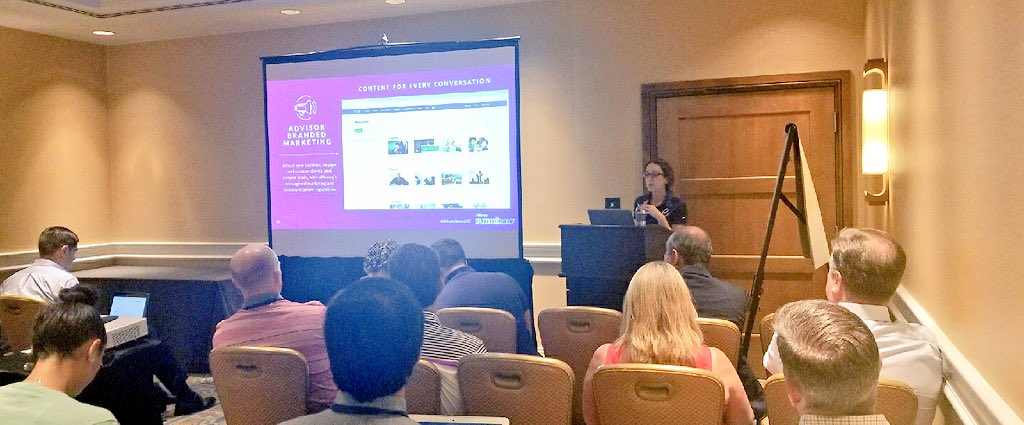
In September 2017, Rachel Eccles stood at a lectern in a beige conference room in Scottsdale, Arizona. Behind her, a slide promised “content for every conversation.” In front of her sat financial advisers with open laptops, watching a demonstration of eMoney Advisor’s new marketing product. The room was not glamorous. The proposition was. Give advisers a library of useful material, let them tailor it to their clients, and make the financial relationship continue after everyone leaves the meeting.
Eccles had joined eMoney that year. The product she was helping present, Advisor Branded Marketing, arrived with more than 2,000 pieces of customizable content and tools for measuring what people actually read. It was software, certainly. But its deeper wager was editorial: the adviser who keeps offering something relevant earns another conversation.
The editor enters the ledger
The tidy version of Eccles’s career begins with a bachelor’s degree in English from the University of Massachusetts Amherst. The more revealing version begins with what English majors are trained to notice: audience, sequence, motive, and the sentence that makes someone turn the page. Those skills travel surprisingly well into financial technology, an industry abundant in precise answers to questions that many people feel embarrassed to ask.
Her public trail reaches back at least to 2009, when she published a MeetingsNet article about companies replacing ordinary recreation at corporate gatherings with community-service activities. Later, as Director of Content at Skyword, she managed writers and marketers in the expanding business of branded storytelling. A former direct report remembers her as both manager and mentor - someone who empowered the team, asked hard questions, and pushed people beyond the easy answer. Another colleague emphasizes the combination of passion, ethics, and close attention to the customer.
These are not ornamental compliments. They describe the operating requirements of her later job. A marketing leader at a financial-planning company has to make a promise vivid without making it reckless, make data useful without turning people into rows, and make expertise approachable without pretending it is simple.
Marketing stops being the lobby
At many companies, marketing is treated as the decorated lobby outside the serious rooms. Eccles’s path at eMoney suggests a different architecture. Her progressive roles touched demand generation, events, marketing operations, retention, corporate communications, content, creative development, product marketing, and market research. In September 2022, eMoney appointed her Senior Vice President of Marketing and placed her on the senior leadership team. The company now lists her as Head of Marketing, responsible for brand awareness and demand generation with acquisition, retention, and revenue growth in view.
The list matters because it collapses the usual partitions. A conference is not separate from the product story. Retention is not separate from the first promise. Research is not separate from the creative. In Eccles’s writing, marketing and planning become a single client journey: a person searches for help, encounters a firm, forms an impression, begins a plan, returns to it as life changes, and perhaps tells someone else.
“That you need to be considered ‘wealthy’ in order to benefit from financial planning.”Rachel Eccles, on the most common misconception about planning
That sentence is the fulcrum of her public philosophy. Financial planning is often pictured as a service that begins after prosperity, like tailoring a suit once the fabric is expensive enough. Eccles argues that the plan should evolve with the person - from accumulation, through changing goals, and eventually toward distribution. Advice is not a trophy for having arrived. It is equipment for moving.
Her favorite early money lesson is pleasingly untheoretical: never put something on a credit card unless you can pay the bill in full. Finance charges add up quickly. The remark has the compact durability of family advice because it names an action, a deadline, and a consequence. No funnel. No flourish. The professional marketer’s most memorable line is a household rule.
Measured, but never mechanical
Eccles is a performance marketer, and her prose likes evidence. In a 2024 essay she used “mindshare” - the portion of attention a brand occupies - to ask a warm question in chilly language: when clients need financial guidance, do they think of their adviser first? She describes data as a way to anticipate needs, personalize outreach, find gaps in service, and make operations more consistent. Account aggregation and client portals give adviser and client a shared picture instead of a drawer full of fragments.
The risk in “mindshare” is that it can sound like conquest. Eccles’s version is closer to earned recall. The adviser becomes memorable by knowing more, responding better, and staying present. More data should produce more relevance, not simply more messages. A portal matters when it saves time and supports collaboration. A piece of content matters when it gives somebody a useful next question.
This is where the 2017 conference-room demo looks less like an artifact and more like a blueprint. The content library solved an immediate problem for advisers who knew communication mattered but lacked time, material, or a compliant process for doing it consistently. Analytics showed which subjects resonated. Customization kept a firm’s voice intact. The product joined editorial judgment to operational discipline, then put both inside the adviser’s existing dashboard. Eccles would later write about websites, search, email, portals, and predictive data, but the underlying design stayed remarkably stable: reduce the friction around being helpful, learn from the response, and make the next contact more specific than the last.
A machine with manners
When ChatGPT became the office fascination of 2023, Eccles wrote a practical guide for financial professionals. She saw obvious uses: brainstorming social posts, improving drafts, proposing keywords, and helping a busy adviser escape the terror of the blank page. She also drew a bright perimeter. The tool should not answer a client’s questions, determine the firm’s marketing strategy, act as the personal writer, or generate financial recommendations.
“You will be most successful using ChatGPT to enhance and augment your skills, not replace them.”Rachel Eccles, 2023
Her position avoids both fashionable extremes. The machine is neither oracle nor menace. It is an assistant whose work needs context, correction, and accountability. The adviser remains the in-house expert because the adviser knows the clients, their preferences, and the stakes. Eccles welcomes efficiency while keeping authorship attached to a person.
Her practical AI boundary
- Use the tool to generate options and relieve routine drafting work.
- Give it detail, then revise what comes back.
- Keep strategy, client answers, and financial recommendations human.
The hard question is a form of care
Public recommendations from former colleagues repeat a revealing phrase: Eccles asks the tough questions. In a weaker manager, that quality can become theatre - difficulty performed for its own sake. The rest of their descriptions changes the meaning. They call her empowering, ethical, customer-focused, detail-oriented, and willing to lead by example. The difficult question is there to improve the work and enlarge the person doing it.
That balance also appears in how she talks about the industry. Client expectations keep evolving, she has said, and professionals have to adapt. Yet adaptation is not a euphemism for chasing every novelty. eMoney’s annual Summits under her marketing leadership have paired product previews and data with adviser education, client stories, and the psychology of financial decisions. The software gets a roadmap. The human relationship gets the main stage.
By the company’s 25th anniversary in 2025, Eccles framed its Summit as a meeting of “the evolution of planning” and “the future of advice.” In 2026, her public activity turned toward the next cycle: promoting CoPlanner, opening registration for another Summit, and recruiting a growth-marketing leader focused on acquisition, engagement, and retention. The verbs are corporate. The continuity is personal. Find people, understand them, give them a reason to remain.
Before the plan, a sentence
The arc from English classroom to fintech leadership is tempting to describe as an unlikely turn. It is more coherent than it looks. Financial planning is made of numbers, but participation begins in language. Someone must be able to say what matters, what changed, what they owe, what they want, and what they are frightened to lose. The best system in the world waits for those sentences.
Eccles’s career sits at that threshold. She markets the tools, studies the journey, measures the response, and insists that planning should admit people before wealth does. Her work is not the plan itself. It is the invitation that makes the plan possible - clear enough to enter, useful enough to revisit, and human enough that somebody answers.