Donna Parent went to college expecting that the story would end in law. Then she interned at a newspaper for two summers and discovered the velocity of a newsroom: people to interview, facts to sort, a blank page with an appointment at the printing press. The law could wait. A good lead could not. She fell for writing, reporting, and the peculiar satisfaction of making a complicated subject legible before deadline.
Her first job after college seemed to have respectable momentum. Parent worked in financial-services consulting, traveled around the country, and documented workflows during large software migrations. It was useful work. It also made one thing plain: she needed more pace, more people, and more room for story. After roughly a year and a half, she found an opening in event management. Events led to public relations and communications, communications led to product marketing, and the remit kept widening until she was leading the function.
The route is less a reinvention than a long edit. Reporting taught her to ask. Consulting taught her to map a system. Events taught her to orchestrate moving pieces while the clock ran. Marketing gave all three habits a commercial home.
The newsroom survived the career change
Parent spent nine years as vice president of marketing at Aternity, an enterprise-software company focused on monitoring how applications performed for employees. She had already worked across emerging vendors, including StreamBase Systems and Salesnet, learning the central difficulty of technical marketing: the machinery may be elaborate, but the story still has to land in a human brain.
At Aternity, her work ranged from integrated campaigns to a content-curation initiative called EndUserExperience2Day. The project treated a narrowly technical field as an editorial beat, collecting and organizing useful material for a professional audience. It grew newsletter subscriptions, earned industry recognition, and offered an early glimpse of an idea that would recur throughout her career: a brand can earn attention by becoming a reliable interpreter of its market.
In 2016, Parent joined IdentityForce as senior vice president of marketing. Two years later, after EZShield acquired the company, she became chief marketing officer of the combined business. The portfolio expanded, the names multiplied, and Parent helped guide the transition to Sontiq, a new parent brand for identity-security products. TransUnion completed its acquisition of Sontiq for $638 million in December 2021.
Rebrands are sometimes discussed as if the work were a matter of selecting a noun and arguing about blue. This one involved acquired products, consumer trust, enterprise relationships, and a category in which clarity carries consequences. Parent’s contribution sat where she has often worked best: between complicated systems and the people who must decide whether to believe them.
A question the market had not answered
Parent arrived at Dynamo Software in April 2022 as the company’s first chief marketing officer. Dynamo builds cloud software for the alternative-investment ecosystem, serving general partners, limited partners, hedge funds, fund accountants, and other professionals whose working lives include deals, portfolios, relationships, reporting, and a formidable quantity of data.
She began looking for current research on those specific audiences. Much of what she wanted was missing, too broad, or already aging. So she proposed making it. Dynamo would survey clients, prospects, and market participants, then turn the findings into visual, accessible reports. The work would recur quarterly rather than appear as an occasional grand gesture.
The resulting Frontline Insight program brings a newsroom cadence to corporate research. Roughly two months go to survey distribution and data collection, followed by a month of analysis, writing, design, and publication. Foundational questions stay in rotation so the team can compare change over time. Fresh questions enter to catch what the market is discussing now. By February 2026, the program had produced 14 in-depth reports with a marketing team of fewer than ten people.
Speed matters, though Parent is careful about what kind of speed. A survey response cannot become a claim merely because a deadline is approaching. She personally oversees survey design, validation, and report development, and she has stressed that the findings must be defensible. The tension is productive: current enough to matter, careful enough to trust.
Once published, each report keeps working. A finding can become a press release, webinar, infographic, executive article, social campaign, or conversation for the sales team. One substantial asset creates a family of useful material. The multiplication works because the original contains evidence. A dozen distribution tactics cannot give an empty idea a spine.
The team is bigger than the org chart
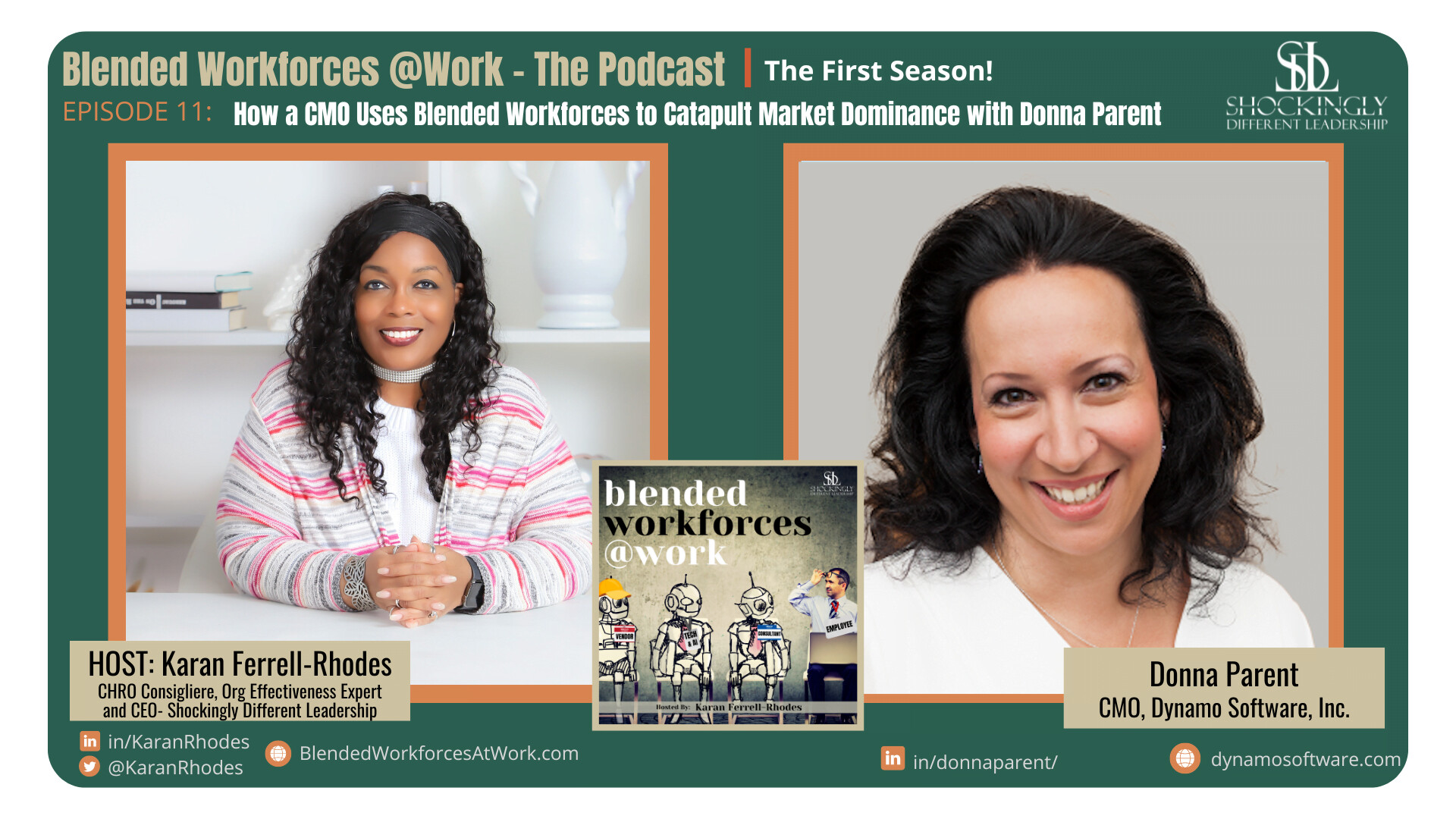
A quarterly publishing schedule needs more skills than a small internal team can comfortably house. Parent’s answer is a blended workforce: employees working alongside outside writers, designers, and communications partners. She learned the model early from Christine Ferket, who founded a fully virtual PR agency in 1998. Parent saw how external specialists could bring expertise into an internal operation without becoming a distant vendor waiting for an assignment.
At Dynamo, she applies that lesson literally. Outside partners are treated as part of the team, with access to context, clear objectives, and frequent communication. Roles are designed to avoid turf fights, while enough fluidity remains for people to help one another. Parent describes herself as transparent, communicative, direct, and possessed of very high expectations. The combination sounds bracing because it is. Warm collaboration does not require fuzzy standards.
She runs teams through objectives and key results, asking in advance how a campaign will define success and how an individual contribution connects to the larger business. The point is partly accountability and partly dignity. People want to know that their work matters. A designer refining a chart, a writer tightening an argument, and a marketer preparing a webinar should be able to see the same destination.
There is still a decision-maker. Parent invites expertise, accepts that she can be wrong, and then makes the final call because accountability cannot be crowdsourced. Her compact motto, “It’s better to get it right than to be right,” is an antidote to the meeting where everyone protects a position after the evidence has packed its coat and gone home.
What she wants young marketers to learn
Parent has spoken candidly about the distance between marketing education and marketing work. A conversation with an intern about college and MBA programs left her saddened by how little some curricula seemed to prepare students for the actual profession. Her preferred syllabus is practical: cross-functional communication, comfort moving through marketing technology, emotional intelligence, planning, execution, data fluency, and writing.
Especially writing. Parent argues that every marketer should write something every day and learn to address different audiences across long and short forms. The reporter is still in the room, tapping a pencil against the desk. Tools change. The obligation to notice, clarify, and persuade survives every software update.
Her advice also includes asking questions, seeking feedback from subject-matter experts, and reserving time for continuous learning. Curiosity is not decorative in her version of the job. It is the mechanism that lets a marketer understand product, sales, customers, and a market in motion.
At home, the lesson once arrived as comedy. Parent recalled the first time her youngest son grasped what marketing might mean. After each dance move, he promised a better one if she kept watching. She admitted that she bought whatever he was selling. A clean hook, a retention strategy, and an irresistible spokesperson had appeared in the living room.
Beyond work, Parent has described an energetic family life with her husband, two sons, and a goldendoodle named Dusty, plus cooking, baking, interior design, antiquing, theater, workouts, and long walks. These details fit the professional portrait without polishing it into mythology. She likes movement, making things, and discovering what comes next.
Credibility compounds
Parent’s career has crossed application monitoring, identity protection, and private-market software. Each category comes with its own language and anxieties. Her method has remained consistent: learn the system, find the consequential question, gather credible material, and make the answer travel.
The current chapter at Dynamo adds repetition to that method. A single report can win attention. Fourteen reports begin to create an institutional memory. The quarterly rhythm gives a small team permission to improve the instrument, compare the answers, and become more useful with every cycle.
That may be the most stealable part of her playbook. Content does not have to begin with a demand for content. It can begin with a genuine gap in what a market knows. Fill the gap carefully. Publish before the knowledge goes stale. Then let the story do more than one job.