erp-integration
(51)
Agave Built the Pipes Before It Turned On the AI
Construction's back office runs on software old enough to have a mortgage. Agave's clever move was not to replace it, but to teach it how to talk - then put AI to work on the conversation.
The Fine Print Behind PayEm's $247 Million Headline
PayEm set out to turn every company purchase into a controlled, traceable decision. Its journey from expense-report frustration to a $500,000 acquisition is also a lesson in reading fintech's biggest numbers carefully.
Praxedo UK wants the paperwork to finish when the repair does
A completed repair can still leave a service business waiting to bill. Praxedo connects the dispatcher, the technician and the office - and its customers show why those missing handoffs matter.
B2BE makes the paperwork move. The hard part is getting the rules right.
Orders arrive as PDFs. Suppliers want different formats. Finance wants to get paid. B2BE has built a business in the gaps between those demands - and its customer stories show why automation starts before the software.

The $800 Million Bet on Making the Invoice Disappear
Thomson Reuters bought Pagero for roughly $800 million because Europe’s invoice is becoming a live tax report. The prize is not prettier paperwork - it is a network that makes the paperwork vanish into the workflow.

The Website Is the Easy Part: TSD Makes Commerce’s Messy Plumbing Pay
From a converted farmhouse in Herefordshire, TSD takes on the work hiding behind the word ‘just’: live pricing, ERP connections, awkward migrations and software that cannot afford a bad week.

SourceDay Built a Control Room for the 52% of Purchase Orders That Refuse to Sit Still
A purchase order looks final right up until a supplier changes the date, quantity or price. SourceDay built its business in that unruly gap between the ERP's plan and the factory floor - then started teaching software to resolve the safest changes on its own.

eOne’s 25-Year Bet: Move the Data, or Leave It Where It Is
The Fargo software company spent two decades making old business systems talk. Its latest trick is knowing when data should not move at all.

SugarCRM Put AI in Its Name. Now It Has to Make Salespeople Love CRM.
The 22-year-old CRM company has renamed itself around a bet: sales software should stop asking reps for updates and start telling them where the money is hiding.
Inside the 63-Person Company Rewiring Caterpillar’s Parts Pipeline
FDC Solutions picked a narrow, unglamorous problem - getting the right heavy-equipment part to the right place before downtime becomes expensive. Twenty-four years later, its software sits between dealer ERPs, warehouse workers, robots and customers across more than 80 Cat dealer organizations.

The Payroll Company Betting Your Weirdest Pay Run Should Stay In-House
Greenshades spent two decades turning tax software into a control panel for messy American payroll. Its best customers are not looking for fewer knobs - they need the right ones.

The $2.9 Million Reason Field Service Teams Stop Trusting Paper
Service Pro sells a decidedly unglamorous promise: make every truck roll legible, billable and visible. Its best case studies show why that can be worth seven figures - and its roughest reviews show why integration discipline matters just as much as the app.

The Parts Manual Was Wrong Before Delivery. GenAlpha Turned It Into a Store.
A Wisconsin team of former manufacturing insiders built Equip360 around an unglamorous truth: the hardest part of selling a replacement part is often identifying it. Their answer connects exploded drawings, serial numbers and live ERP data to the buy button.
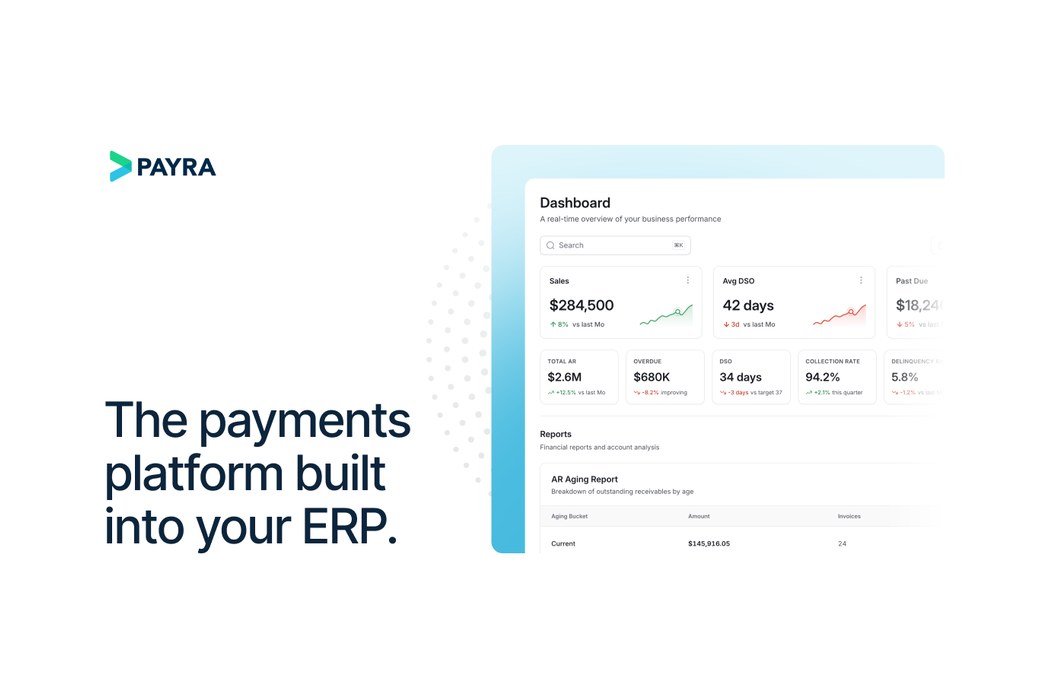
The startup teaching 30-year-old concrete ERPs to take a credit card
Payra bootstrapped its way into a $200 billion corner of the economy that still runs on paper checks and spreadsheets - then took $15 million to speed it up.

The Internet’s Checkout Counter Has a Back Room. TrueCommerce Runs the Paperwork.
TrueCommerce turns the purchase orders, invoices, inventory updates and shipping notices behind modern trade into an automated conversation - then keeps that conversation compliant when partners, systems and borders change.
Blockskye Wants to Make the Corporate Travel Expense Report Disappear
Most business trips still move through a thicket of cards, agencies and expense reports. Blockskye is betting that one shared record - from booking to reimbursement - can make the whole trip cheaper, clearer and strangely uneventful.

MHC
For more than two decades, a quiet company in the Minneapolis suburbs has been running the paperwork that keeps large enterprises moving - the invoices, statements and payments most people never see.

Cardda
Cardda is a Chilean fintech (YC W22) building all-in-one spend management for Latin American businesses. It combines virtual and physical corporate cards, automated local and international transfers, reimbursements, and accounts payable in one dashboard, plus a payments API for mass payouts. It plugs into Chile's SII tax service and ERPs like SAP, Oracle, Defontana and Nubox, giving finance teams real-time control over company spending.

Cifrato
Cifrato is a Colombian, Y Combinator-backed (W25) startup building an AI accountant for accounting firms and retail businesses across Latin America. Its AI agents run end-to-end accounting workflows - pulling electronic invoices straight from tax authorities like Colombia's DIAN, classifying them, applying taxes, reconciling payments, and pushing accounting-ready data into ERP and POS systems. Founded in 2025 by Juan Pisco and Yerson Cacua, the company reached roughly $1M ARR and processed over a million invoices for 270+ clients within its first year.
Definite
Definite is a Y Combinator (S26) startup building the data layer for finance agents. It plugs read-only into a company's ERP, ledger, payroll, and payments systems and compiles everything into one clean, always-current model of the books. Finance teams can then build back-office agents in plain English on top of that model - without engineers or data pipelines. The system reads and reconciles, but never writes back and never moves money.

Mercura
Mercura is a Munich-based YC W25 startup building AI software that turns messy sales requests - emails, tender specs, phone calls - into structured, spec-compliant quotes and orders for industrial distributors and manufacturers. It reads unstructured inquiries, matches them to catalog products, prioritizes margin, and pushes the result straight into a customer's ERP.

Pairio
Pairio is an AI mobile app that helps factory technicians fix broken machines. A technician speaks into their phone or snaps a photo of a faulty machine, and Pairio searches thousands of pages of OEM manuals and past repair records to return step-by-step fixes on the spot. After each repair, the technician talks through what they did and Pairio structures the learnings into shareable know-how, so institutional knowledge outlives the workers who retire. Founded in 2025 by Tim Zinkl and Matthias Wolf and backed by Y Combinator (P26), Pairio is already cutting repair times by roughly 25% across four manufacturing plants in Germany.

Peakflo
Peakflo is a Singapore-founded, Y Combinator-backed (W22) finance automation platform that puts B2B accounts receivable and accounts payable on autopilot. It connects to accounting systems and ERPs to automate invoice collections, bill payments, expense reimbursements and reconciliation, helping finance teams get paid faster, cut vendor payment time and reclaim thousands of hours a month. Positioned as the AI-native alternative to legacy AP/AR tools for the mid-market and Southeast Asia.

Spaceflow
Spaceflow is a San Francisco startup (Y Combinator S26) that makes enterprises 'agent-native.' Instead of selling companies another dashboard, it turns the systems they already run - ERP, email, spreadsheets - into a 'company brain' that AI employees and any MCP agent can read and operate securely, with a human keeping the final say. It starts with procurement and supply chain, where it has processed roughly $400M in annual supplier spend and reached six-figure ARR while in early stage.
Concourse
Concourse builds enterprise-grade AI agents purpose-built for corporate finance teams. The platform connects directly to a company's existing financial stack - ERPs, accounting systems, data warehouses and billing platforms - and lets finance, accounting and data teams query, analyze and report on their numbers using natural language. Every result is traceable back to the underlying SQL and Python logic, addressing the accuracy and audit demands that generic LLMs cannot meet. Founded in 2023 by former Jeeves operators Matthieu Hafemeister and Ted Michaels, the New York company raised a $12M Series A in January 2026 and counts Palo Alto Networks, Front and Tecovas among its customers.

Hyperbots Inc.
Hyperbots is an agentic AI company building finance and accounting co-pilots for mid-market enterprises. Its platform automates core workflows - procure-to-pay, order-to-cash, expense management and analytics - by converting unstructured financial documents into structured, ERP-ready data. Founded in 2023 and headquartered in Dover, Delaware with engineering in Bengaluru, the company reports 99.8% document accuracy and up to 80% straight-through processing, and in 2025 raised a $6.5M Series A co-led by Arkam Ventures and Athera Venture Partners to expand in the U.S. and launch HyperLM, a large language model trained specifically on finance data.

Jones
Jones is a New York-based vertical AI software company that automates insurance compliance for commercial real estate and construction. Its platform collects Certificates of Insurance (COIs), endorsements and policies, verifies coverage against requirements using AI agents, chases down gaps with vendors and tenants, and integrates bi-directionally with property and construction ERP systems. Founded in 2017 by Omri Stern and Michael Rudman, Jones manages insurance risk across roughly 2.7 billion square feet of properties and construction projects.

WizCommerce
WizCommerce is an AI-native B2B sales and ecommerce platform built for wholesalers, distributors, and manufacturers. It unifies field-sales order taking, buyer storefronts, catalog and product imagery, ERP-connected back-office workflows, and embedded B2B payments in one system. Its products - WizShop, WizOrder, WizStudio, and WizPay, plus the Kai AI assistant - help wholesale businesses replace spreadsheets, PDFs, and manual order entry with automation. Founded in 2020 (originally as SourceWiz) and based in Bengaluru with US operations, the company raised an $8M Series A led by Peak XV Partners in 2025 and processes over $100M in GMV annually.

Conexiom
Conexiom is a Vancouver-based B2B software company that automates the capture, correction, and analysis of sales orders and trade documents for manufacturers and distributors. Its AI-powered platform turns unstructured purchase orders arriving as PDFs, emails, spreadsheets, faxes, and even handwritten notes into 100% accurate, ERP-ready data, removing manual keying and the errors that come with it. Backed by roughly $170M in growth investment from Warburg Pincus, ICONIQ, and Luminate Capital, Conexiom processes hundreds of thousands of orders representing billions of dollars in transactions each year for customers such as Fastenal, Graybar, Parker Hannifin, and Arrow Electronics.

Amper Technologies
Amper Technologies is a Chicago-based industrial IoT company that helps manufacturers see and improve what happens on their shop floors in real time. Its FactoryOS platform pairs non-invasive sensors that clip onto any machine - regardless of age or brand and install in about ten minutes - with AI-driven analytics that track machine utilization, OEE, downtime, labor and job performance. Founded in 2016, Amper turns legacy factory equipment into a source of live production data without expensive retrofits or complex IT integrations, and was acquired by ECI Software Solutions in December 2025.