The oldest joke in sales software is that the salesperson works for the CRM. Every call becomes a form. Every promising conversation produces another field to update. The rep supplies the facts; management gets the dashboard. In April 2026, SugarCRM made that sour bargain the premise of a corporate rename. The company became SugarAI and argued that a modern system should return the favor: read the account, spot the risk, find the opportunity and suggest the next move.
That is a larger claim than the new green logo suggests. Sugar has been around since 2004, when John Roberts, Clint Oram and Jacob Taylor began building an open-source alternative to expensive, closed CRM suites. Twenty-two years later, the company is private, backed by Accel-KKR and headquartered in Denver. It says more than 4,000 companies and one million users in over 120 countries rely on its software. This is not a fresh AI startup pretending the past began with transformers. It is an enterprise-software veteran trying to turn its installed history into an advantage.
The rename is the argument
SugarAI still sells recognizable CRM machinery. Sugar Sell handles accounts, opportunities, pipelines, forecasts and workflows. Sugar Market runs B2B campaigns and lead nurturing. Sugar Serve manages customer-service cases. Sugar Predict supplies scoring, summaries and recommendations. The acquired sales-i product studies purchasing history from enterprise resource planning systems. Cloud hosting, migration, integrations, support and professional services complete the package.
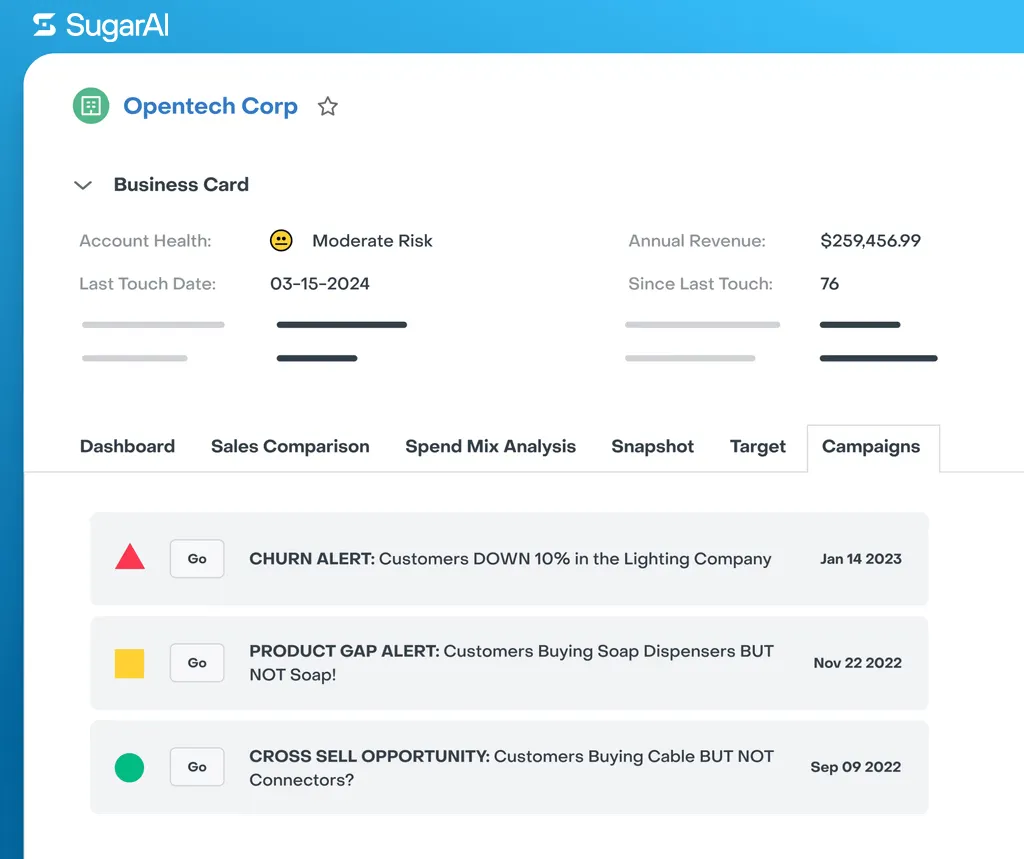
The difference Sugar wants buyers to notice is where the work begins. A conventional CRM starts with what a rep entered: an opportunity stage, meeting note or expected close date. SugarAI wants to combine that record with invoices, product mix, order frequency, email and conversation history. Then it looks for changes. A regular order vanished. A customer buys cables but never connectors. An account has not been touched for 76 days. These are small facts with a cash value.
“CRM must do more than store information; it must help teams take the right action at the right time.”David Roberts, CEO of SugarAI
The seam where revenue hides
SugarAI's clearest market is not every company with a contact list. It is the B2B business with complex accounts, repeat purchases and an ERP full of transactional truth - manufacturers, wholesalers, distributors, financial-services firms and field-service operators. These organizations may sell thousands of products through a few account managers. The relationship lives in CRM; the receipts live somewhere else.
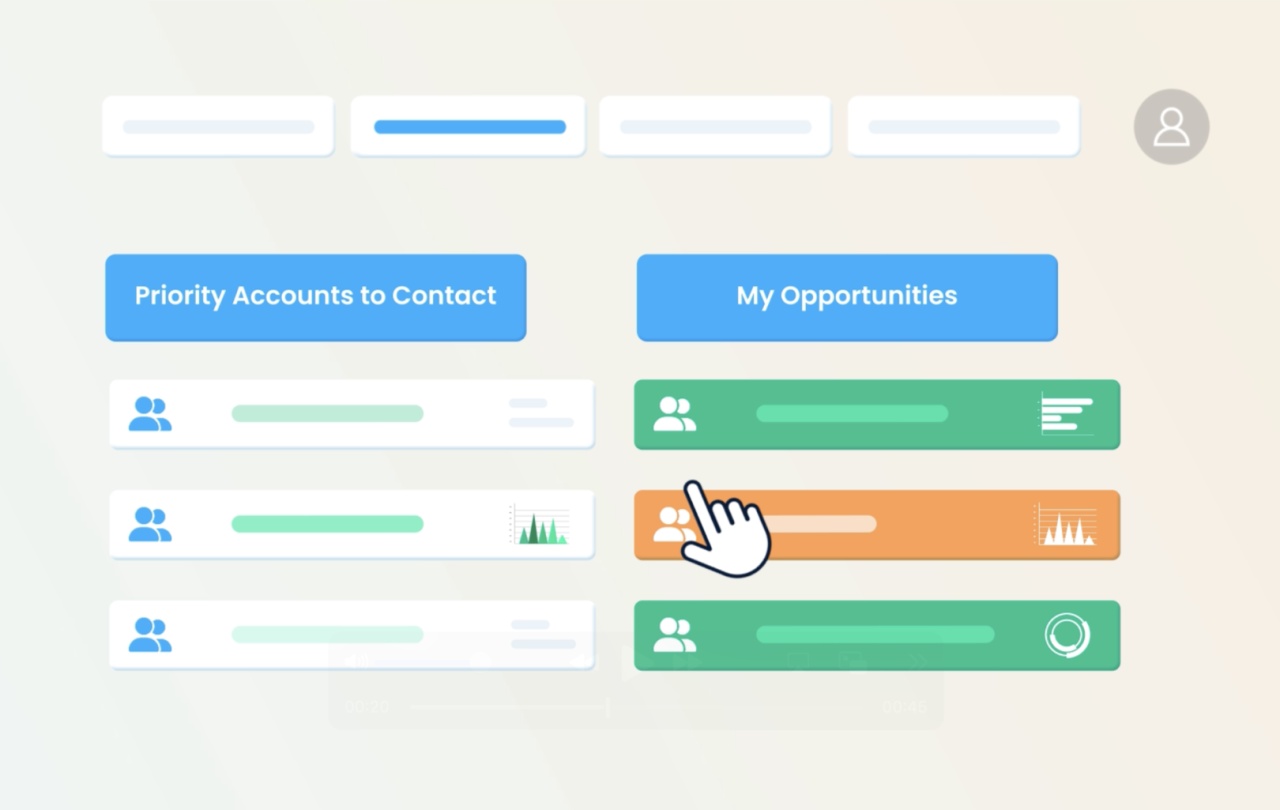
That gap matters. In subscription software, churn can announce itself with a cancellation. In manufacturing, it can arrive quietly: a customer keeps ordering, just less often and from fewer categories. The rep may still have a pleasant conversation while one line of business leaks to a competitor. An ERP sees the drop first. SugarAI's pitch is to carry that signal into the seller's daily queue before the polite relationship becomes an empty account.
Where the product earns its keep
Illustrative model: more relevant account signals can produce better prioritization, provided the data is accurate and connected.
That positioning separates Sugar from lighter tools optimized for small teams and quick setup, and from broad platforms such as Salesforce, Microsoft Dynamics 365, HubSpot, Zoho, Creatio, Oracle and SAP. SugarAI competes on customization, deployment choice, account intelligence and the marriage of CRM with ERP. Its disadvantage is the same sentence read backward: integration and flexibility demand decisions, clean data and someone capable of owning the system.
Three acquisitions explain the pivot
The new name arrived after the technology. In 2019, SugarCRM bought Salesfusion because building serious marketing automation would take longer than buying it; the product became Sugar Market. In 2020, it acquired Node, whose machine-learning platform predicted lead conversion, churn and likely outcomes. In 2024, Sugar bought sales-i, a specialist in reading ERP and order data for manufacturers and distributors. By May 2025, sales-i recommendations were integrated into Sugar Sell.
The stack was bought in layers
This sequence matters. A logo can be changed over lunch; merging customer histories, product catalogs and workflows cannot. Sugar's pivot took years of purchases and integration. The company also kept the legal plumbing deliberately dull. It told customers their contracts, pricing, users, data and configurations would not change because of the rename. The brand moved; the obligations stayed put.
What customers actually changed
The useful stories begin before the software. Ex-Cell Kaiser, a maker of customized waste and recycling receptacles, had customer facts scattered across email folders, shared drives, Teams chats and even paper. Sugar migrated historical CRM data, connected the platform to Syspro ERP and synchronized orders and invoices. The result was not magic copywriting. It was one opportunity-to-invoice flow and a shared version of the account.
Pennine Lubricants gives the sharper scale test: four sales representatives managing more than 1,000 active customers. The company tried to analyze sales through SAP and found it too clumsy for field work. It also tried Salesforce, which did not synchronize with the back-office system in the way Pennine needed. Sugar Predict plus ERP data put records and AI reports on reps' tablets. The first failure was not intelligence; it was access.
At Argentina's UNIRROL, customer details lived with individual sellers, so a vacation could hide an account from management. The company centralized the data, updated to Sugar Sell, introduced AI capabilities and automated an external WhatsApp marketing process. It now reports roughly 200 new leads a month and a 45 percent lead-to-opportunity conversion rate. Colombia's Kreato moved from spreadsheets and manual pivot tables to reports that cover all 700 active clients and surfaced 8,800 opportunities.
SugarAI highlights other outcomes: Country Fare says it grew its business 21 percent and raised revenue from existing accounts 40 percent after correlating CRM and ERP data. Those figures are customer-reported, not promises. They show the conditions, though. There was historical purchasing behavior to analyze, repeat revenue to recover and a sales team able to act on the alerts.
The bill includes the unglamorous work
What did it cost? SugarAI's current public pages send buyers to a quote request rather than displaying a simple checkout price. The final number can include edition, seats, AI capabilities, storage, sandboxes, support, migration, ERP integration, configuration and training. Acquisition prices for Salesfusion, Node and sales-i were not publicly disclosed. The honest answer is that the visible subscription is only one line in an enterprise CRM budget.
The hidden expense is organizational. Somebody must decide which system owns which field, reconcile duplicate customers, map products, define a meaningful decline and persuade sellers that the alerts deserve attention. Bad inputs do not become wise because a model read them. A team that skips data cleanup can automate confusion at impressive speed.
The playbook worth stealing
The part another company can copy is not the SugarAI name. Start with one repeated decision that has a measurable cost: which account is quietly shrinking, which complementary product is missing, which quote has stalled. Connect only the sources necessary to answer it. Deliver the answer inside the tool where the employee already works. Let a person accept, reject or correct the recommendation. Measure recovered revenue, time saved and false alerts before adding another model.
The conditions are equally important. This approach works best when the business has enough clean historical transactions to establish a pattern, meaningful repeat purchases, account owners who can intervene and margins large enough to justify integration. It is less compelling for a five-person team with twenty customers, a one-off transactional business, a company with no usable order history or an organization unwilling to maintain its records. In those cases, a simpler CRM and a disciplined weekly review may beat an ambitious intelligence layer.
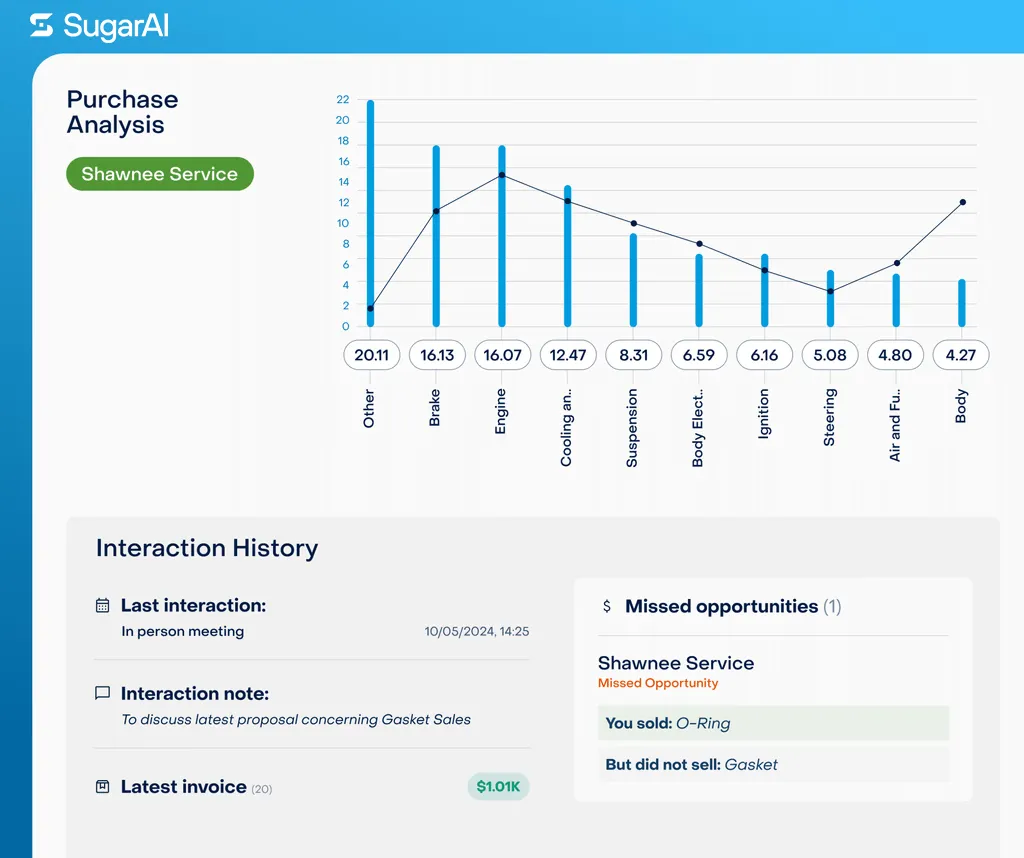
SugarAI now has to prove that “precision selling” changes Tuesday morning, not just conference language. The company has assembled the ingredients: a long-lived CRM, marketing and service modules, predictive models, ERP intelligence, cloud infrastructure and an implementation network. It has also chosen a bracingly testable promise. If sellers still spend their day feeding reports and hunting through tabs, the rebrand is decoration. If the system reliably notices the missing gasket, the slowing order and the neglected account first, SugarAI has earned its new two letters.