The most expensive word in a small business may be “later.” A customer asks a question on WhatsApp. Someone answers between meetings. The inquiry sounds promising. Then the phone changes hands, the salesperson opens a spreadsheet, and the follow-up becomes a faint intention rather than a task. Clientify, a software company from Almería, Spain, has spent more than a decade selling a cure for that little disappearance. Its proposition is plain: if the conversation is where a sale begins, the conversation belongs inside the system that manages the sale.
- Clientify joins customer messages, a sales pipeline and marketing automation in one subscription platform.
- The company says more than 5,000 businesses and 50,000 users in 25 countries use it.
- Its published starting price is €39 a month with annual payment; add-ons and message charges can raise the bill.
- The useful idea to copy: give every inquiry an owner, a source and a next action.
A record of the first hello
A conventional CRM begins with a record: name, company, deal size, stage. Clientify begins closer to the actual daily work of a small team. Its shared inbox brings WhatsApp together with Instagram, Facebook Messenger, live chat and email. A conversation can be assigned to a colleague, tagged, linked to a contact and carried into an opportunity. The customer’s history remains visible when another person takes over. It is a modest-sounding change, and precisely the sort that saves a promising lead from a second, awkward “remind me what we discussed.”
The platform has three broad modules: Communication, Sales and Marketing. Sales includes customizable pipelines, lead assignment, quotes, appointment scheduling and electronic signatures. Marketing adds forms, landing pages, email and WhatsApp campaigns, segmentation and automated workflows. The pitch is one connected path, from first inquiry to follow-up to signed proposal. Clientify also lists AI-assisted proposals, contact enrichment and chatbots. The invoice feature, according to its price page, applies only in Spain.
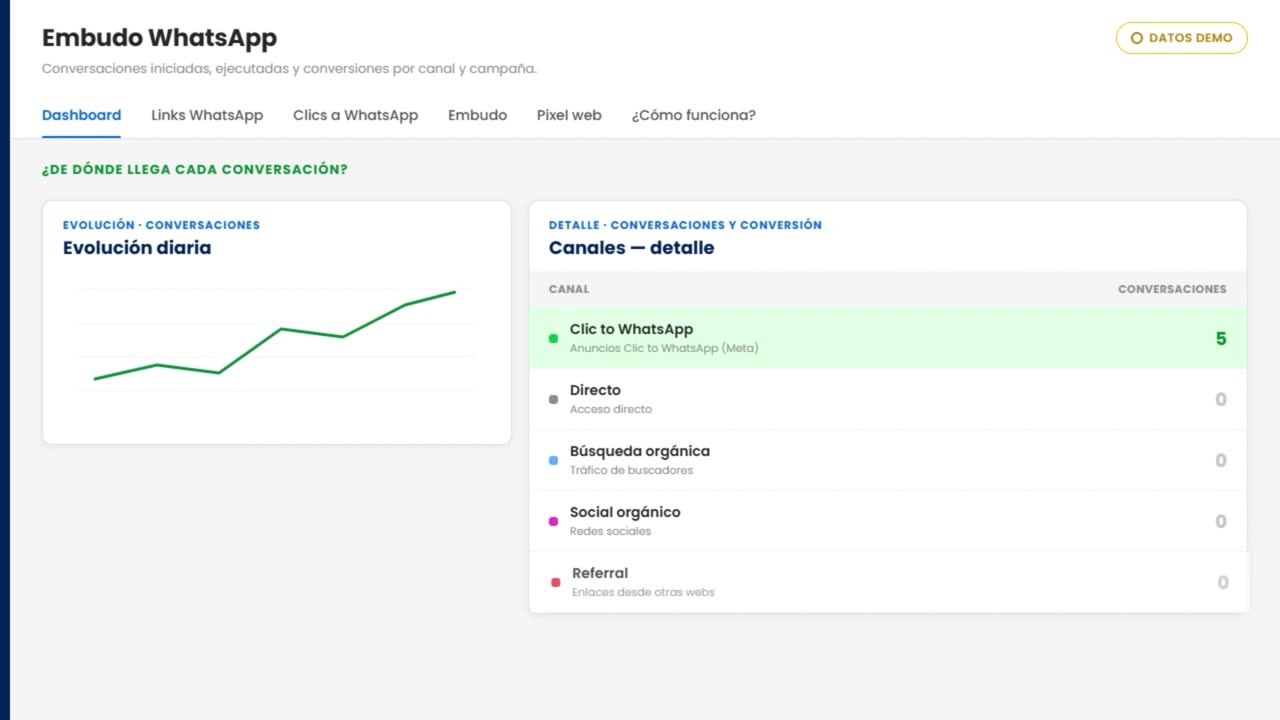
In August 2026, Clientify documented a WhatsApp funnel that goes one step back. It records where an incoming conversation came from: a click-to-WhatsApp ad, a website widget or a trackable link. For an owner buying ads, this is more than tidy bookkeeping. It is the difference between knowing that the phone rang and knowing which sign persuaded someone to call.
Built for the company with too many tabs
Founders Fran López and Jesús Cuadrado came to this from different disciplines: economics and engineering. Clientify says it has served businesses since 2014. López describes seeing small firms fall behind because accessible tools were scarce. Their answer was a CRM intended for teams that do not have a systems administrator on hand, or the appetite to assemble several specialist products before lunch.

“I have seen small businesses fall behind for lack of accessible tools.”Fran López, founder · translated from Spanish
That audience explains the company’s geography as well as its feature list. Clientify says its users work across 25 countries, with an emphasis on Spain and Latin America. Spanish-language support is part of the product offer. Its site gives examples for agencies, education, property, health and professional services. These are not all the same business, but they share a common scene: a lead arrives through a familiar channel, and a small team must decide who responds and what happens next.
The price of having everything together
Clientify sells subscriptions. In September 2026, its published starting figure was €39 per month when paid annually, or €468 for the year before local taxes. That entry plan showed one user and 1,000 marketing contacts included, with unlimited sales and communication contacts subject to fair use. It also offered a seven-day trial. Teams can pay for extra users and capacity, and the price page lists paid extras such as additional inbox channels and API access.
The sticker price is only a first line on the invoice. WhatsApp Business messaging has its own rules and charges, and the company’s documentation flags changes due in October 2026. Clientify also says its AI application is free through September 30, 2026, while some AI uses and integrations may carry extra fees. Anyone comparing CRMs should price the actual number of teammates, marketing contacts, channels and messages, then check the current terms. A low subscription is less interesting if a team cannot see its real monthly total.
Where it sits in the CRM crowd
Clientify operates in a market full of capable alternatives. HubSpot and Pipedrive offer established sales systems; Kommo makes a strong case for conversation-led selling. Clientify’s particular combination is its native WhatsApp workflow, Spanish-language service and the breadth of marketing and sales tools in one place. It is strongest on paper for a small or medium team that uses several communication channels and wants the work after a message to stay attached to the customer record.
There is a cost to breadth. Every extra module asks someone to set it up, decide who owns it and keep its data clean. A team that needs only a simple pipeline might prefer a narrower tool. A larger organization with elaborate permissions or unusual integrations may need to test the edges carefully. Clientify’s “more than 15,000 apps” claim is about available connections through services such as Zapier and Integrately, not 15,000 individually built native integrations. The distinction matters when a crucial workflow depends on one of them.
The newer platform, documented in 2026, added 24 functions relative to its version through 2024, including electronic signatures, AI-assisted proposals, contact enrichment and new productivity dashboards. That product expansion tells its own story. The first problem was remembering the conversation. The later ones are recognizing its source, making the next offer and finishing the paperwork without losing the thread. The company has not publicly framed this as a dramatic pivot. It looks more like an accumulation of the small chores that surround a sale.
The idea worth stealing
A business does not need Clientify to learn from Clientify. Take one week of incoming inquiries. For each, record the source, the person responsible and the next promised action. Look for the moment the conversation leaves one person’s head and becomes shared knowledge. If that handoff never happens, a new dashboard will merely make the confusion prettier. If it does, automation can begin to earn its keep.
That is the quiet logic behind Clientify’s busy collection of features. A message is cheap to send and easy to forget. A sale depends on the work after it.