A neighborhood café knows the names of its regulars. Its card processor knows something else: whether they returned on Tuesday, spent less this month, or vanished after a competitor opened across the street. For years, those facts lived in separate places. Womply's opening wager was that the café owner might make better decisions if the facts were assembled before breakfast.
Founded in San Francisco in 2011, Womply turned payment transactions, customer signals and online reviews into software for local merchants. It sold business intelligence without requiring a business analyst. Then the pandemic arrived, and the company moved from helping shops interpret sales to helping their owners apply for emergency loans. That second job made Womply far bigger, far faster - and exposed the difference between making a form quick and making a promise true.
- Womply's paid tools helped small merchants track sales, reviews, customers and marketing.
- Payment-processor partnerships supplied both data and a route to merchants.
- PPP Fast Lane handled applications for partner lenders; Womply did not make the loans.
- The company wound down in 2022. A 2024 FTC settlement over its PPP advertising cost $26 million.
The receipt was the original product
The earliest Womply was a card-linked local-offers venture. By 2013, the proposition had become more useful and less flashy: show merchants what their card transactions said about revenue, average purchases and customer behavior. A partnership with Pivotal Payments put Womply's Insights dashboard and optional Loyalty Cloud in front of businesses already using the processor. The merchant could see trends without changing the till or persuading customers to download another app.
That route to market mattered. A national software company can spend heavily to find every florist, mechanic and dentist. A payment processor already has the relationships. Womply used the processor's distribution and, with permissioned transaction data, made the ordinary card payment the beginning of a customer record. It later added review monitoring, marketing automation and competitive comparisons. In 2017 the company said more than 100,000 businesses in 18,000 U.S. ZIP codes had activated paid accounts. These were customers, not a vague count of people who had once visited a website.
Womply CRM, launched in 2018, pushed the idea further. Conventional CRM asks a merchant to collect contacts and fill fields. Womply offered a system pre-populated with consumer records and enriched with transactions. Its practical pitch was almost impolite: the owner of a bakery has no appetite for the elaborate sales pipeline of a corporate software team. The bakery needs to know who came back and who might come back if reminded. That was Womply's difference from general-purpose CRM, and its expertise lay in joining messy offline payments to usable customer signals.
Then the shops closed
When COVID-19 restrictions hit local businesses, Womply's customer base faced the very problem its dashboards could describe but not solve: disappearing revenue. The company says its core software revenue fell by more than 30 percent almost overnight. The U.S. Paycheck Protection Program, meanwhile, was built around lenders whose incentives favored larger, established borrowers. Sole proprietors and gig workers often had the thinnest bank relationships, the smallest potential loans and the least time to spare.
Womply changed its product accordingly. In February 2021 it launched PPP Fast Lane, a system to take in applications, check identity and eligibility documents, screen for fraud and route qualifying files to partner lenders. The lenders approved and funded the loans. For a self-employed driver or a one-person salon, this was a potentially valuable doorway. For Womply, it was a different business model: lenders paid processing fees tied to the emergency program, while the older product had been paid software for merchants.
There was real scale. Womply says roughly 1.4 million PPP loans were funded through its platform in 2021, totaling about $19.6 billion. Researchers also used Womply's transaction data to track which businesses were open during the pandemic. The same pipes that made a merchant dashboard useful had become part of a national picture of economic distress.
The five-minute door led to a longer hallway
Fast Lane's marketing made speed its attraction. One promotional message said an application could take as little as five minutes. That statement concerned the act of applying, but a desperate applicant could hear a larger promise: that money would arrive. The Federal Trade Commission later alleged Womply made misleading claims about applicants' likelihood of funding, processing speed and customer support. Its complaint said more than 60 percent of roughly 3.25 million applications submitted through Womply did not result in funding.
“As little as five minutes” is a small sentence with a very large shadow.On the gap between a fast form and a funded loan
The consequences were not merely rhetorical. PPP was time limited and first come, first served. An application stranded in a queue could cost a business its chance to try elsewhere. The FTC said known technical problems and inadequate support slowed or blocked applicants. A House investigation separately criticized fraud controls at Womply and other fintech intermediaries; partner lenders complained about the quality of some files. Womply disputes much of that account and says it flagged suspicious applications and cooperated with investigators. The FTC's 2024 case was about advertising claims, not a charge that Womply itself committed PPP loan fraud.
Womply and founder Toby Scammell agreed to a $26 million stipulated order to settle the FTC charges without admitting the allegations. The amount is an unusually concrete answer to a vague product question: what does it cost when the marketing moves faster than the operation? The company had raised about $50 million in equity by 2016, including a $30 million Sageview-led round. The House staff report said PPP processing brought Womply more than $2 billion in 2021 net revenue. Those numbers belong to different chapters, but together show how sharply the stakes changed.
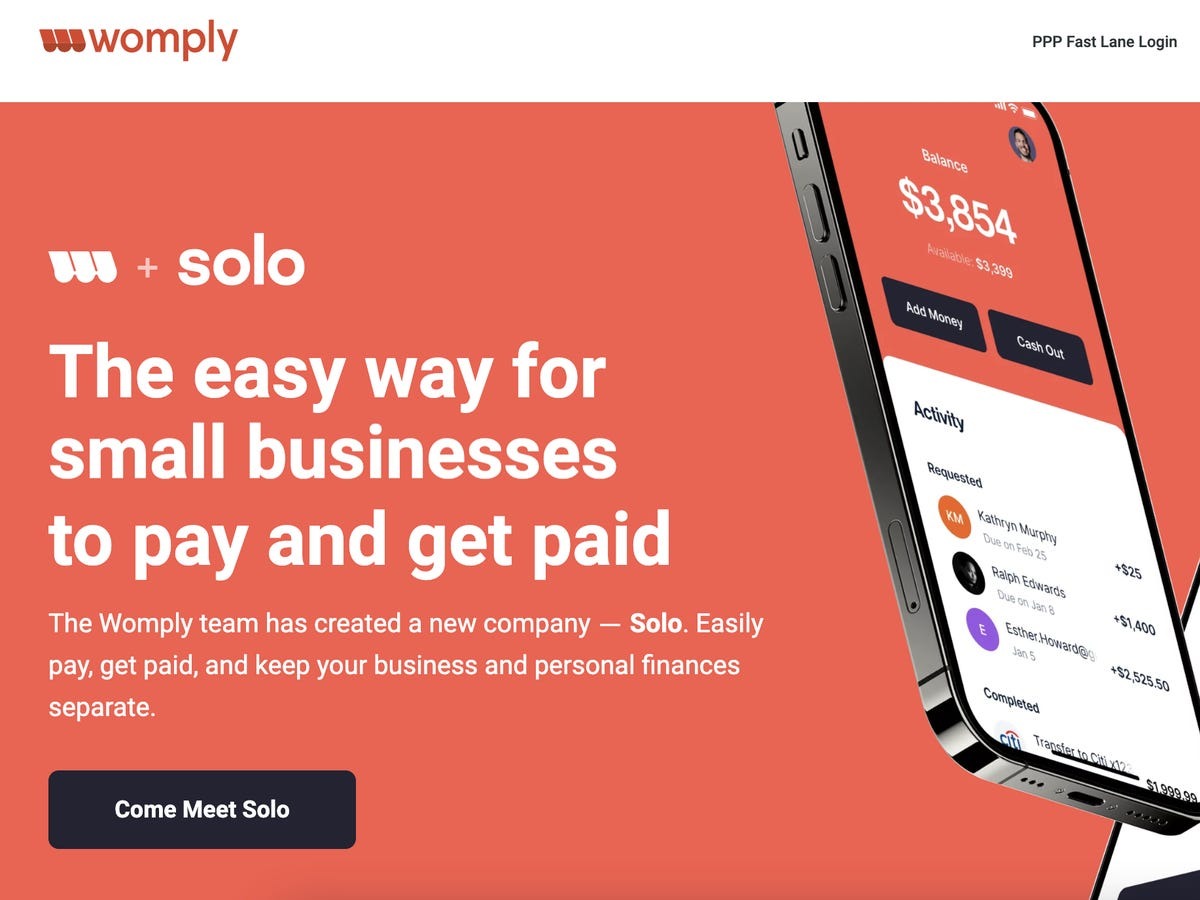
A new sign in the window. A historical Womply screen promoted Solo, a separate payments venture from the Womply team. The PPP login still sat in the corner, a reminder of the audience that had gathered around Fast Lane.
What survived the company
Sageview records its exit from Womply in December 2021. Womply says it was sold that month and wound down operations in 2022. Its site now directs former PPP applicants to their lender or the SBA for forgiveness, servicing and records. There is no active CRM to subscribe to, no Fast Lane account to recover. The product story has an ending; the design lesson does not.
Womply understood something worth copying. Start with data a customer already generates, translate it into one decision they can act on, and distribute the tool through a partner the customer already trusts. Insights did that with card transactions. The CRM tried to do it with customer records. Such a model works when the data is reliable, the rights to use it are clear and the merchant has a simple action to take.
The useful rule: If a product shortens one step in a longer process, name the step. “Five-minute application” describes an interface. “Fast funding” describes an outcome controlled by verification, lenders and program rules. The distinction matters most when users have no spare time.
That is also where the model can fail. Automation cannot wish away missing documents, fraud checks or a lender's credit decision. A payment-data advantage does not automatically become lending expertise. At ordinary software speed, a confusing dashboard wastes an afternoon. In a public relief program nearing its deadline, confusing certainty with convenience can change whether a shop survives. The little business Womply set out to help deserved the same precision in the promise as in the data.