The most dangerous sound in a one-person business is not an alarm. It is a phone ringing while both hands are occupied. A therapist is with a client. An electrician is inside a wall. A tutor is explaining fractions. Answer, and the customer in front of you feels ignored. Do not answer, and the next customer may disappear. Somewhere nearby, an unpaid invoice waits with the patience of a houseplant.
vcita has spent 16 years collecting these small, uncinematic disasters. The company began in 2010 as an online scheduler, founded by Itzik Levy and Eran Utmazgin. The premise was wonderfully narrow: let clients see availability and book without an email relay. Then the booking created a contact. The contact needed a record. The appointment needed a reminder. The completed work needed an invoice. The invoice needed a payment. The happy client might need another nudge three months later.
Follow that chain long enough and a calendar becomes a business-management platform. vcita now combines lead capture, CRM, scheduling, estimates, invoices, online payments, a client portal, email and SMS campaigns, reporting, mobile access and AI assistants. The company says more than 150,000 small and medium-sized businesses use its technology across eight languages. Its customers include coaches, clinics, consultants, lawyers, home-service operators, tutors, fitness studios and beauty businesses - jobs in which the person doing the work is often also the receptionist, marketer and accounts department.
The first product became the first constraintA scheduler with ambitions
The first thing to fail was not scheduling. It was scheduling as a complete description of the company. Even the name carried the old boundary: “cita” means an appointment or meeting in Spanish, and the V originally nodded to “virtual.” By 2013, vcita says it had already evolved from a tool into a fuller platform. Staff accounts followed, then a mobile app in 2015, email and SMS marketing in 2017, deeper payments in 2022 and an app market between them.
In 2020, the company made the identity catch up. Its new logo placed a little human figure inside an open V, arms reaching outward. The rebrand was playful - company copy mentions foosball, salted peanuts and mandala coloring - but the strategic admission was serious. A successful first feature had become too small a box. The company was no longer selling an appointment. It was selling the handoffs around the appointment.
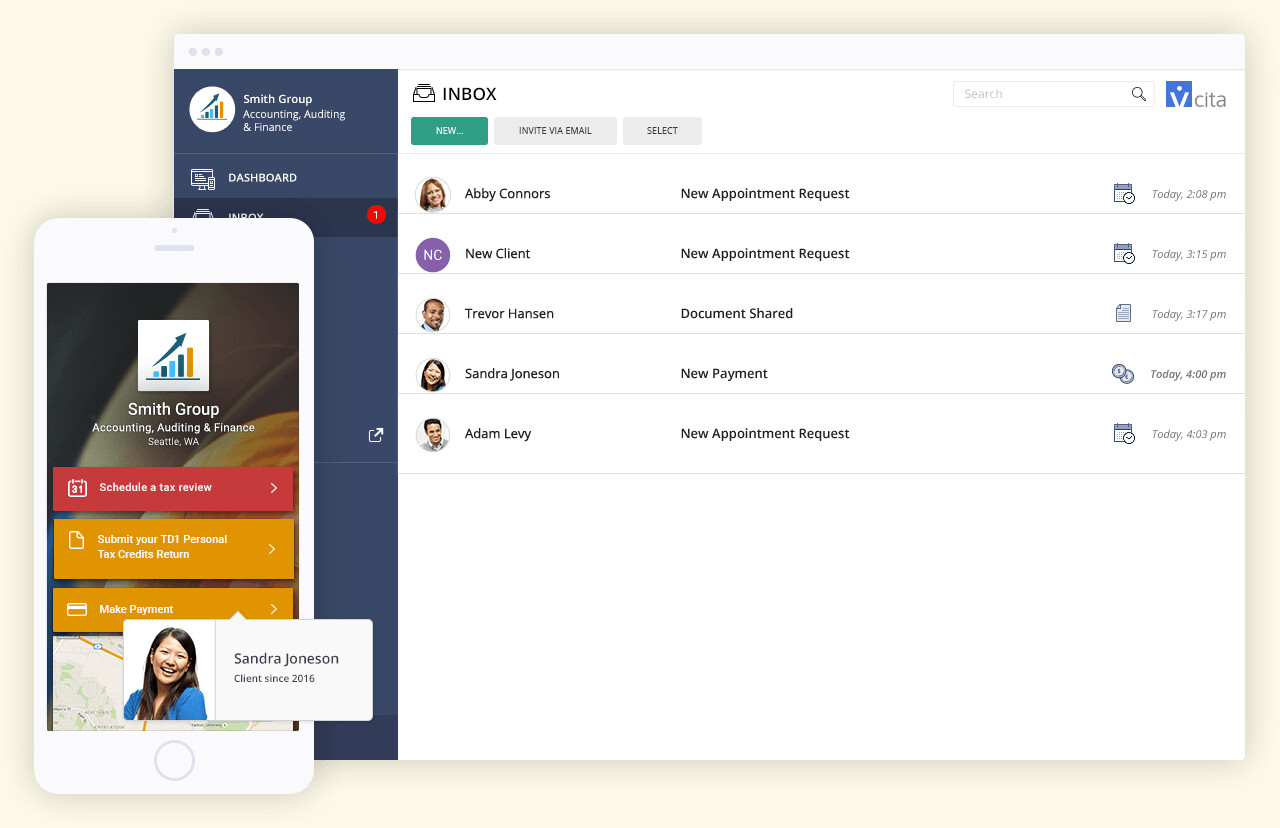
That expansion sounds inevitable only in retrospect. All-in-one software is full of traps. Every added feature can make the product harder to learn, while a specialist competitor has the luxury of polishing one thing. vcita’s response has been fast iteration and a deliberately approachable interface. In a 2024 awards interview, the company described the central problem plainly: small businesses perform an enormous variety of functions, but their software still has to feel simple.
The business has two front doorsMain Street in front, enterprise in back
One vcita customer buys a subscription with a credit card. Another is a bank, telecom, publisher or marketing company that already serves thousands of small firms and wants software under its own proposition. vcita formalized that second route as inTandem, a modular, customizable, white-label platform. Direct SaaS brings the company close to daily users. Enterprise distribution gives it reach that a direct sales team would struggle to buy economically.
The partner list explains the model better than a pitch deck. Vodafone Business launched “Vodafone CRM by vcita” in Italy in 2024, combining scheduling, client management, billing, payments and campaigns for freelancers and smaller firms. Mastercard selected inTandem technology to help power Biz360, its small-business platform for customer engagement, payment collection and time management. PickMyCall supplies the voice technology behind vcita’s AI Receptionist. Earlier collaborations included NorthOne, Next Insurance, Lendio and Italian business association Confcommercio.
These are not decorative integrations. They solve an awkward distribution problem: small businesses are numerous, diverse, budget-conscious and prone to churn. A trusted provider already has the relationship. vcita supplies the operational layer. The partner gets a stickier service; vcita gets a route to market; the business owner gets fewer logins - at least in theory.
The funding history is unusually spare for a software company of this age. In July 2019, vcita announced a $15 million growth round led by Forestay Capital. At the time it said it had more than 100,000 paying users worldwide. No public valuation accompanied the deal. The money backed international growth, the platform and its enterprise relationships rather than a dramatic reinvention.
What the bundle costsThe bargain depends on subtraction
As of September 2026, one-seat annual pricing begins at $35 a month for Kickstart, $54 for Manage and $93 for Manage + Grow. There is a 14-day free trial. Monthly billing costs more; extra seats change the math; some apps carry additional fees. The AI Voice Receptionist is listed at $30 a month, and SMS use beyond the included allowance costs extra. Setup can cost $150 on the entry plan, while higher plans include sessions.
The useful comparison is not $35 versus free. It is $35 versus the scheduler, lightweight CRM, invoice app, email tool and pile of manual glue it might replace. A business that actually uses the connected sequence can save money and, more importantly, avoid losing context at each handoff. A solo consultant who needs only a clean booking link may see the opposite: more menus, more setup and a higher bill than a specialist scheduler.
Public reviews land in roughly the same place. Users often praise the convenience of keeping scheduling, records and invoicing together, along with ease of use and support. Complaints tend to gather around price, advanced-feature costs and the fact that a broad suite inevitably carries more surface area than a single-purpose app. Capterra listed vcita at 4.4 out of 5 from 292 reviews in late August 2026; G2 showed 4.5 from 81 reviews. Review-site numbers move, but the pattern is more useful than the decimal.
AI arrives after the dataThe assistant knows what Tuesday looks like
vcita introduced BizAI as a business advisor in 2023 and rolled it out broadly in 2024. The first version could use account context and external knowledge to answer questions, suggest strategy and generate content. In 2025, the company pushed it toward action: draft replies to client inquiries, propose appointment times and prepare estimates. The system works in the background, surfaces an action and allows the owner to review it. Control matters when the AI is touching a price, calendar or customer relationship.
The 2026 version aims to make conversation the main interface. An owner can ask which clients owe money or what is scheduled today, then instruct BizAI to move a booking, resend an invoice or message a client. This is vcita’s strongest point of difference from a general chatbot. The model is not visiting the business as a clever stranger. It is already beside the client record, services, hours, payments and permissions.
Adoption figures published by the company are promising but should be read as company-reported evidence, not a controlled trial. vcita said BizAI adoption rose 225 percent year over year, 85 percent of surveyed users considered it extremely useful, and 43 percent returned within a week. Nine in ten people who used it to generate content reportedly copied that content into their business. The new AI Receptionist extends the same thesis to phone calls: answer around the clock, capture the lead, send a booking link and save the transcript inside the CRM.
The decision ruleCount the handoffs before you buy
The vcita playbook is copyable. Begin with one frequent, expensive annoyance. Make it self-service. Store the resulting data in a durable record. Then expand only into the next job created by that first action. The booking produces a client; the client produces work; the work produces a bill; the bill produces follow-up. This is more disciplined than announcing an “operating system” before earning a single workflow.
There is a second lesson in the partner business. If your end market is fragmented and costly to reach, sell through organizations that already have trust and distribution. But white-label software raises the bar: the product must be modular, secure, supportable and flexible enough to disappear inside someone else’s brand. It works best when the channel partner can add a service its customers will use repeatedly, not merely bundle another forgotten perk.
vcita fits when…
- Leads become bookings, bills and repeat work.
- Client history is scattered across inboxes and apps.
- No-shows and late follow-up have a visible cost.
- A small team needs one shared operational record.
Look elsewhere when…
- You need only a simple scheduling link.
- Retail inventory or field dispatch drives the business.
- Deep accounting or enterprise CRM is non-negotiable.
- Your team will not maintain the shared workflow.
vcita will not repair a broken service, invent demand or make an unwilling team enter clean data. Automation amplifies the workflow it is given. A specialist vertical platform may also win when industry-specific details - dispatch routes for contractors, chairs for salons, insurance claims for clinics - matter more than a general client journey. And the all-in-one advantage evaporates if a business continues paying for five old tools while adding vcita as a sixth.
Still, the company’s long arc is coherent. It found a humble entrance into the small-business day and kept walking through the doors that opened next. The latest door happens to be conversational AI, but the underlying business is reassuringly unglamorous: catch the call, book the hour, remember the person, collect the money. Software has made grander promises. Few are more useful before lunch.
Go deeper
Visit vcita, explore current plans, see the customer cabinet, follow the company on LinkedIn, X and Facebook, or watch product explainers and interviews on YouTube. Enterprise partners can visit inTandem.