Consider a salon with an awkward fifteen minutes between clients. The chair is available. The stylist is available. But the next service takes an hour. Those fifteen minutes cannot be boxed up and sold tomorrow. They simply disappear. For Boulevard, the software company serving beauty and wellness businesses, that small hole in the calendar helps explain a much larger opportunity.
- The job: connect bookings, client records, payments, and follow-up.
- The insight: appointment placement changes what a business can sell next.
- The lesson: learn the front desk before trying to automate it.
The front desk was the laboratory
Matt Danna and Sean Stavropoulos started with the customer’s irritation: why did making an appointment require a phone call? Why carry cash for a tip? Their answer became Boulevard, founded in 2016. But spending time inside salons widened the question. An appointment was attached to a professional, a service, a checkout, and a relationship that might last years.
In a 2020 company essay, Danna described working the front desk while Stavropoulos built features in back offices and break rooms. Early customers tolerated bugs and supplied immediate feedback. The useful detail is the proximity. A confused receptionist could become a product lesson before the next client arrived.
“For us, salons were our ‘startup garage.’”Matt Danna · company essay, 2020
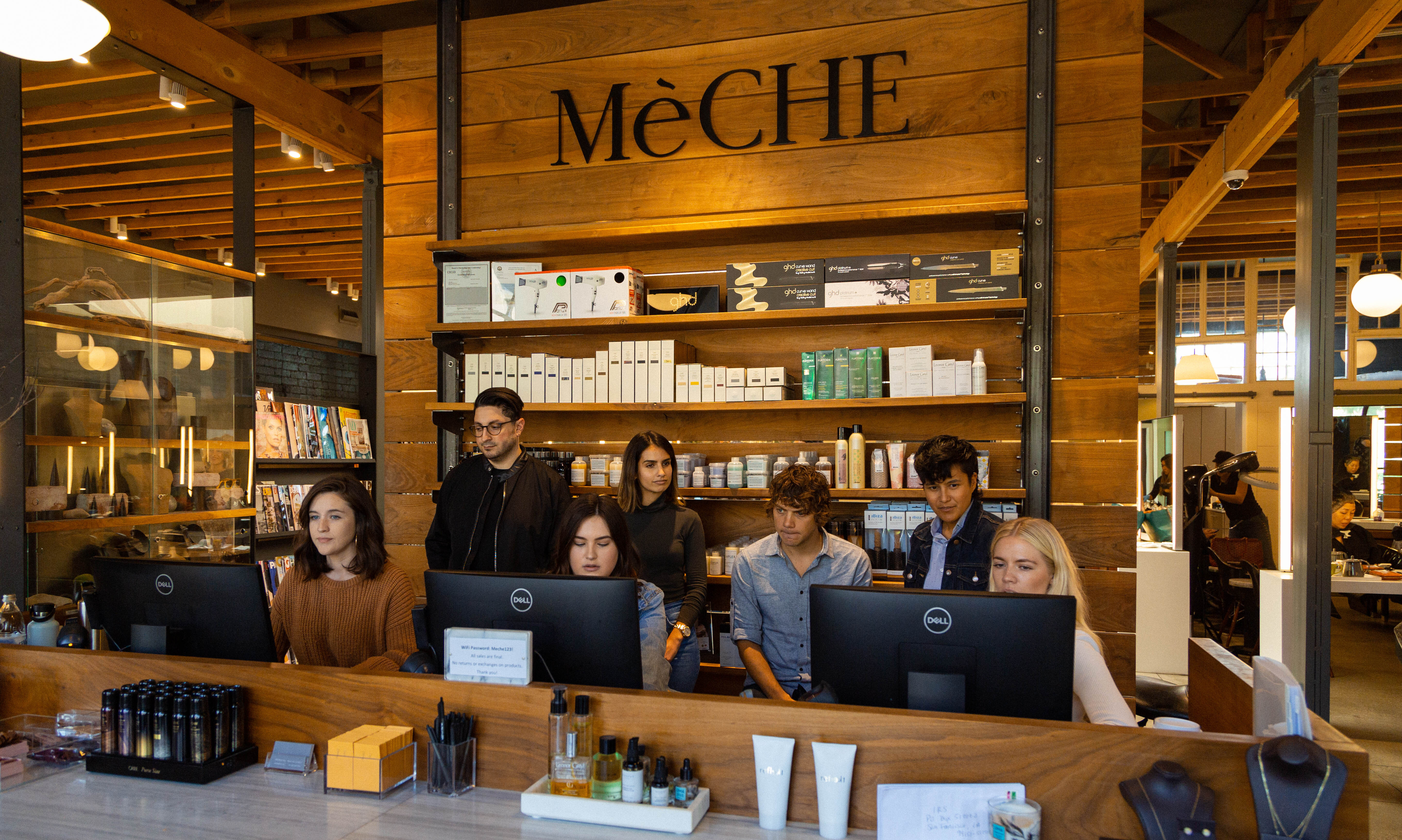
That experience also changed the scope. Danna wrote that spas, nail salons, and medspas shared problems the founders had encountered in hair salons. Today, Boulevard sells business management software across those categories, from single locations to franchises. Customers include Spoke & Weal, Fellow Barber, RUMA Aesthetics, and SAUNA HOUSE.
Money was part of the education. In his 2025 retrospective, Danna recalled bootstrapping with the founders’ savings and retirement accounts, then hearing an investor dismiss the market during seed fundraising. It is his account, but it captures the bet: businesses already spending on software might still be poorly served by it.
An empty slot has a price
The distinctive mechanism is Precision Scheduling. Boulevard ranks possible appointments using common services, their duration, and their price. Its support documentation describes a rolling ninety-day service history, refreshed every two weeks. Provider changes, equipment, and rooms also influence suggestions. The aim is to leave useful stretches of availability rather than fragments that are difficult to sell.
Imagine a two-hour window and a one-hour service. Put the booking in the middle and two thirty-minute pieces remain. Put it at one end and another hour-long service fits. Same appointment. Same employee. Different inventory. This is an illustration, not a measured customer result, but it makes the scheduling problem visible.
Assumes the next service needs one uninterrupted hour.
The practical lesson travels beyond beauty: inspect the shape of unused capacity. Counting empty minutes alone misses whether anyone can actually buy them. Owners can audit their own calendars this way. The calculation still depends on accurate service lengths, realistic resource settings, and customers who want the remaining appointments.
The switch happens at checkout
Businesses rarely change software because a diagram looks tidy. They change when daily friction becomes expensive. In Boulevard’s Skin House Facial Bar account, founder Shireen Mustafa’s problem was checkout: the previous system could not store payments. The company’s accompanying case study reports a 56% increase in monthly booking volume and 35% growth in product sales after switching. Those are customer-case figures, not a promise for the next buyer.
SAUNA HOUSE offers another revealing example. Its company-published story describes earlier software that struggled with unusual services, onboarding, and even gratuities. A sauna exposes the limits of generic categories. If the system cannot represent what the business sells, staff inherit the translation work.
Boulevard’s competitive case rests on joining those details: self-booking, client profiles, messages, memberships, inventory, reporting, and integrated payments. Zenoti, Mangomint, Vagaro, and Meevo offer alternatives in the same buying conversation. Boulevard’s industry focus is meaningful, but a buyer still needs to test the actual service menu and checkout workflow.
One subscription, several meters
The business model combines location-based software subscriptions with payment processing and additional features. On the pricing page viewed for this profile, the annual-billing salon and spa view displayed Essentials at $143 a month, Premier at a promotional $234, and Prestige at a promotional $328. Categories, billing terms, and offers change the quote. Forms, accounting integration, messaging usage, and other additions can change the bill.
That makes the relevant comparison total operating cost. Saije Esthetics’ customer story describes consolidating three separate platforms for client information, payments, and marketing, saving hundreds of dollars monthly. A small operator using little of the platform may reach a different conclusion. Migration and staff training belong in the calculation, too.


A sensible trial starts with an ordinary busy day: a client reschedules, a provider changes, a room is unavailable, and someone buys a product at checkout. Ask the vendor to demonstrate that sequence. The test is whether the staff can complete familiar work without inventing a workaround.
The next appointment looks different
In July 2025, Boulevard announced an $80 million Series D led by JMI Equity, with Index Ventures and VMG Partners participating. It earmarked the money for enterprise capabilities and AI research. The company reported more than two million monthly appointments and nearly $5 billion in annual payment volume. Payment volume is money moving through the platform, not Boulevard revenue.
The expansion follows work customers still do elsewhere. April 2026 brought ScriptSure-powered ePrescribe, putting prescriptions inside medspa patient profiles. Boulevard Capital offers eligible businesses funding repaid from a share of daily sales. Both extend the relationship beyond getting someone into a chair.
Then there is Beau, the AI receptionist in beta. The current guide describes answering questions, sending booking links, routing callers to people, and taking messages. Group appointments and consultative staff matching remain outside its capabilities. A useful boundary: some calls require judgment, not simply availability.
The beta FAQ lists free usage through November 2026, followed by $125 per location for 200 minutes, plus overage and text charges. Answering the phone introduces another meter to watch.
The enduring idea is wonderfully ordinary. Watch where the receptionist pauses, where the client waits, where information gets typed twice. Those interruptions are clues. Boulevard’s story suggests that a business can grow by taking the small mechanics of somebody else’s working day seriously.