A million-dollar machine can be stopped by a part you could lose under a car seat. That is the small, expensive absurdity behind FDC Solutions. Somewhere between a dealer’s ERP, a warehouse bin and a technician waiting at a jobsite, a bearing is miscounted, a package loses its status or an urgent order joins the wrong queue. The software problem looks microscopic. The bill for downtime does not.
FDC is a privately held software and consulting company in Peoria, Illinois, with 63 employees visible on LinkedIn as of September 2026. It has spent almost its entire life inside one peculiar operating environment: Caterpillar dealerships. The company says it has worked with more than 80 Cat dealers around the world since 2002. Rather than sell a broad warehouse package and ask customers to bend around it, FDC builds around the daily collisions among parts counters, service bays, regional distribution, emergency orders, supplier programs and old dealer-management systems.
That narrowness is the story. FDC’s staff includes people who, according to the company, helped write core Dealer Business System code and the DBSi interface while working as Caterpillar contractors. They know the plumbing because some of them helped install the pipes. In a market crowded with generic ERP and warehouse suites, that background reduces the time spent explaining why a dealer workflow behaves differently from an ordinary ecommerce warehouse.
The first failure is usually boring
Before the dramatic failure comes an ordinary one. A spreadsheet is one refresh behind. “On hand” includes a part already promised to a work order. A counter employee has a promotional code on a sticky note. A package is delivered, but nobody can prove who signed for it. A stock order reflects last year’s demand while a planned rebuild is about to consume this year’s supply. These are not cinematic software disasters. They are small errors that compound into emergency freight, excess inventory, slower repairs and irritated customers.
FDC’s product line maps almost exactly to that sequence. WMSv2 controls how parts enter, move through and leave a warehouse. K*Track follows packages and sends event-driven notifications. Inventory Capital Solutions, or ICS, recommends what to buy, move, retain or return. Portal Suite gives parts-counter and shop staff a browser-based layer over familiar DBS and DBSi functions. A long tail of supplemental applications tackles freight recovery, promotional pricing, reservations, warranty paperwork and other dealer chores too specific to excite a horizontal software giant.
A second-generation warehouse system
WMSv2 is the center of gravity. The name is a small joke about dealers moving to a second generation of warehouse management after an incumbent system stops matching the operation. It runs in a browser, can be deployed on Windows or IBM servers, and synchronizes with ERP order entry in real time. Its controls cover the unglamorous verbs of warehousing: receive, cross-dock, put away, escalate, pick, pack, stage, ship, count and investigate.
FDC reported in July 2026 that WMSv2 was deployed in 105 stores across nine Cat dealer groups. Three were still adding locations and five more dealers had begun implementation. That footprint matters more than a glossy feature list. Dealer warehouses are mission-critical, idiosyncratic and allergic to downtime. A replacement wins only when operators believe it can handle today’s exceptions while leaving room for tomorrow’s automation.
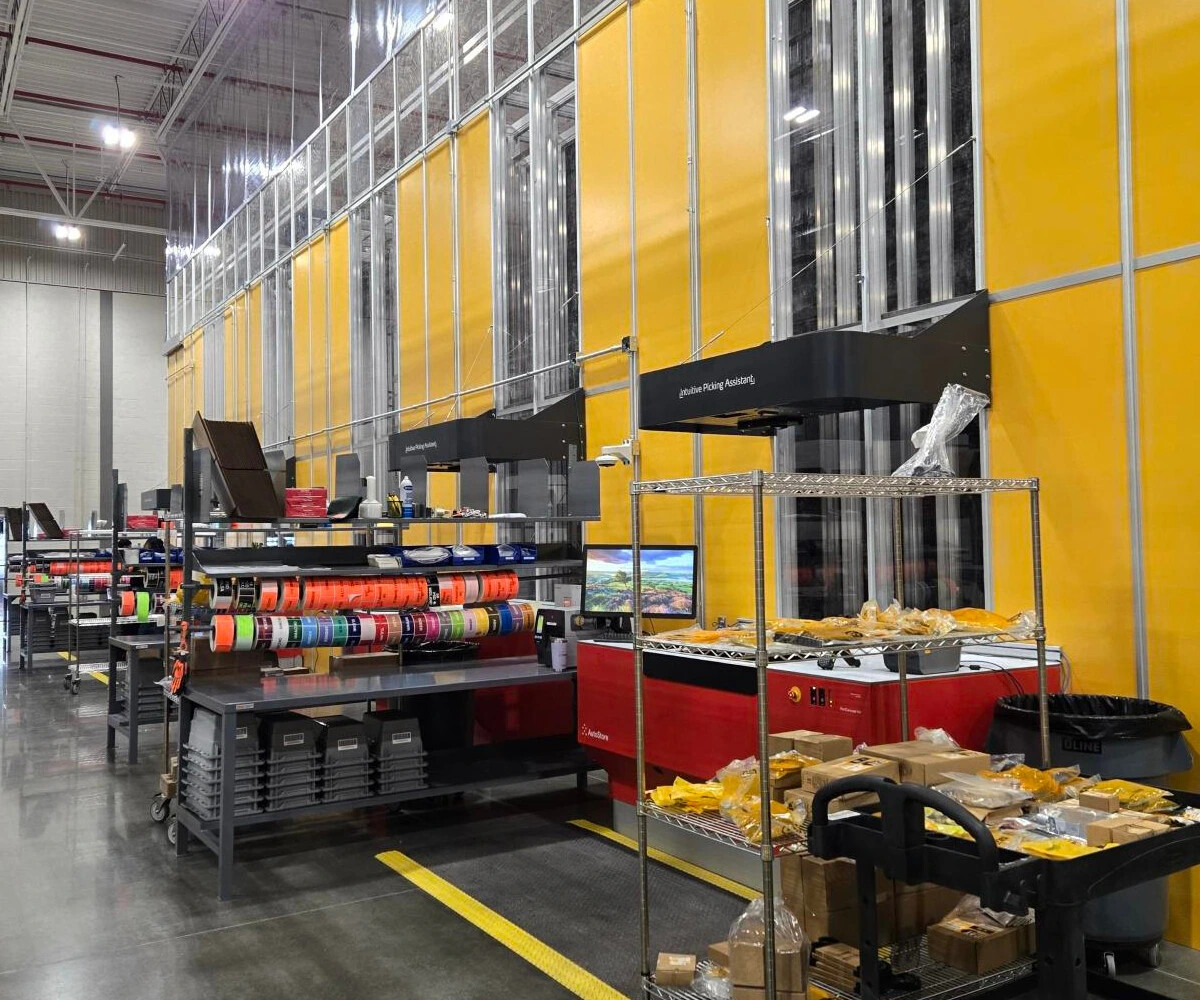
Warren CAT offers the cleanest public example. At its 50,000-square-foot Midland, Texas parts facility, Kardex connected AutoStore to the dealer’s existing FDC WMS through its FulfillX orchestration software. Kardex says the operation has roughly 25,000 bins and 16 robots, handles about 300 order lines an hour and achieves more than three times the storage density of traditional shelving. Urgent service orders can be prioritized without throwing the rest of the queue into confusion.
What changes a cautious dealer’s mind is not automation theater. It is continuity. FulfillX sits between the WMS and the robots; completed tasks and inventory changes flow back to the system employees already use. The integration framework can then be repeated at another store. The lesson is pleasantly unfashionable: preserve the business logic that works, automate the walking and searching that do not, and migrate site by site.
Tracking the awkward middle
K*Track takes over once “where is the part?” becomes the important question. It records inventory and non-inventory items, from customer orders to laptops, worn cores and machine attachments. Staff can search partial document numbers, capture signatures and photos, route deliveries to branches or jobsites, and send SMS or email when an order is ready, collected or delivered. Its mobile app can keep working through poor connectivity. The audit trail remembers whether each message succeeded.
The product’s name carries more weight than its star. K*Track honors Keith Rodricks, one of the original developers, who died unexpectedly before the application was completed. Enterprise product names are usually exercises in trademark availability. This one doubles as institutional memory.
At Carter Machinery, FDC describes K*Track working with a Meridian Smart Locker so customers can retrieve parts outside counter hours. WMSv2 guides picking and packing; an employee scans the order into a locker; K*Track sends credentials; the customer opens the compartment before dawn or after closing. For a technician driving toward a disabled machine at 4 a.m., “customer experience” is not a survey score. It is a door that opens.
Inventory planning gets an AI connector
ICS attacks the problem earlier, before the wrong inventory reaches the shelf. Its modules cover allied-stock replenishment, excess stock, planned orders, forecasting and budgets, known future events, Caterpillar PIC programs and analytics. The design turns analysis into a daily list: buy this item, transfer that one, return the surplus, investigate the supplier miss. It accounts for lead time, seasonality and known events such as rebuilds or promotions rather than treating last year’s sales as prophecy.
ICS 5.0 adds a Model Context Protocol connector for enterprise AI tools, a connector for business-intelligence platforms and a library of pre-built AI insights. FDC says customers can audit earlier recommendations and permit automated action inside defined risk limits. The sensible word there is “defined.” An inventory agent is useful only when a dealer can control what it may order, move or flag.
The commercial packaging is equally pragmatic. ICS is sold as a monthly subscription that includes hardware, software, upgrades and support, avoiding one large capital payment. Exact dollar prices are negotiated rather than posted. Before a full commitment, FDC offers a Strategic Alignment & Validation Study that runs 24 months of the dealer’s sales history, open purchase orders and stock levels through the system. The study produces a baseline and targets; if the buyer continues, the entire study fee is credited toward implementation. It is a demo with consequences.
Software plus the humans after go-live
FDC is not a pure self-serve SaaS company, and pretending otherwise would miss the work. It sells subscriptions and products alongside implementation, custom development, interfaces, data conversion, consulting, remote managed services and support. Lightedge hosts WMSv2, K*Track and ICS, supplying hybrid infrastructure, monitoring, backup and disaster-recovery capabilities. FDC also has an alliance with VitalEdge as an endorsed implementation and support partner for the e-Emphasys dealer ERP, while integrations extend to Kardex automation, Meridian lockers and Texada ServiceLink.
Named customer rollouts include Warren CAT, Hawthorne Cat, Fabick Cat, Blanchard Machinery, IMCA, Carter Machinery and Wheeler Machinery. The users are not just IT departments. Parts managers, inventory analysts, warehouse operators, counter staff, service teams, drivers and customers all touch different edges of the system. That is why support becomes part of the product. One anonymous general parts manager on FDC’s site puts it simply: “The people at FDC Solutions have always felt like an extension of our team.”
What another vertical software company can copy
- Start with the costly exception, not the broad category. “Phantom inventory” is a sharper product brief than “supply-chain transformation.”
- Modernize around trusted systems before demanding replacement. A browser layer or reliable interface can create value sooner than a grand rewrite.
- Use the buyer’s real data before the contract. A paid, creditable validation study makes risk reduction part of the sales process.
- Let partnerships cover the physical and infrastructure layers. FDC does not need to manufacture robots or operate data centers to make both useful.
The boundary is part of the moat
This approach has conditions. A company outside equipment dealerships, without DBS or DBSi history, may get more leverage from a broad WMS or ERP ecosystem. A warehouse with poor master data, undefined processes or no appetite for implementation will not be rescued by a specialized interface. High-density automation makes sense where SKU volume, throughput, labor pressure and space constraints justify it; it is an expensive answer to an imaginary bottleneck in a small, slow storeroom.
FDC’s advantage also depends on continuing to translate old expertise into new systems. The company is now bridging IBM-era dealer infrastructure, browser software, hybrid cloud, AutoStore and agentic AI. Legacy knowledge becomes a moat only if it shortens the path forward. Otherwise it becomes a museum.
So far, the company’s best evidence is operational: more than 80 dealer relationships, 105 WMSv2 stores and a growing list of public go-lives. FDC did not make the heavy-equipment parts business simple. It made the complexity legible enough to act on. That is a quieter claim, and a more useful one.