The spare part had four names. In one ship store it was ABC. In another it was 123. Elsewhere, 456 and 789. According to a HAL case study, a drilling contractor’s suppliers had assigned different numbers to the same physical item. A manager looking for a replacement could see separate inventory records without seeing the stock those records represented. The part was there. The information needed some assembly.
- HAL’s C2C software follows individual materials across suppliers, warehouses and job sites.
- Its specialty is preserving detail through packing, repacking and handoffs.
- The useful lesson: agree on an item’s identity before optimizing its journey.
C2C linked the aliases to a single part record, giving rig managers a combined view across ship stores and on-rig inventories. This is a modest-sounding fix with an interesting implication. Sometimes a supply-chain problem begins with vocabulary. Move the goods faster and the naming problem travels faster, too.
A career spent thinking about the handoff
HAL’s founder, Ernest Allen “Al” Parkin, came to commercial software after 25 years in the US Navy. He had been a pilot, systems integrator and senior logistics systems architect. In 1992, he founded HAL, Inc. to apply that experience to private-sector materials management.
The product’s name spells out its ambition: conception to consumption. A material starts as a requirement, becomes a purchase-order item, passes through suppliers and logistics operators, and eventually reaches the people who will use it. Each organization has a perfectly reasonable view of its own work. Keeping those views connected is the difficult bit.

The box is only the beginning
HAL occupies a particular corner of enterprise software: materials management for project logistics. Its customers include third-party logistics providers, export packers, energy businesses and capital-construction teams. Their concern extends beyond whether a shipment reached a destination. They need to know which ordered pieces arrived, what condition they are in, and what can happen next.
C2C tracks purchase-order lines and sub-lines, supports eight levels of packing and over-packing, and handles receiving, consolidation and release workflows across facilities. A box can change its companions without erasing the records of its contents. That detail matters when one shipment is divided or several are packed together.
The system runs as hosted software on AWS. C2C Mobile brings barcode scanning, RFID and GPS-enhanced locating to Android devices; inspection records can carry photographs and signatures. HAL also configures workflows and connects existing business systems. The commercial proposition combines software access with the work of making the customer’s operation fit together.
Three cities, then the field
An exploration-company case makes the integration problem concrete. Materials passed through facilities in Calgary, Houston and Singapore before reaching drilling sites and remote, unmanned laydown yards. Procurement ran through SAP. Engineering requirements, orders and physical receipts needed to remain connected over that distance.
HAL describes connecting C2C to SAP so purchase orders, goods receipts and goods issues stayed synchronized. The same system covered materials in transit and on site. The point of the integration was practical: someone managing a remote yard should be able to work from a record that still agrees with the procurement system.
That helps explain C2C’s market position. SAP and CargoWise appear among its integrations. Buyers can evaluate C2C as a specialized materials layer alongside existing systems. They can also compare dedicated project-logistics products such as Emerger. The useful comparison is which awkward handoffs each product can actually handle.
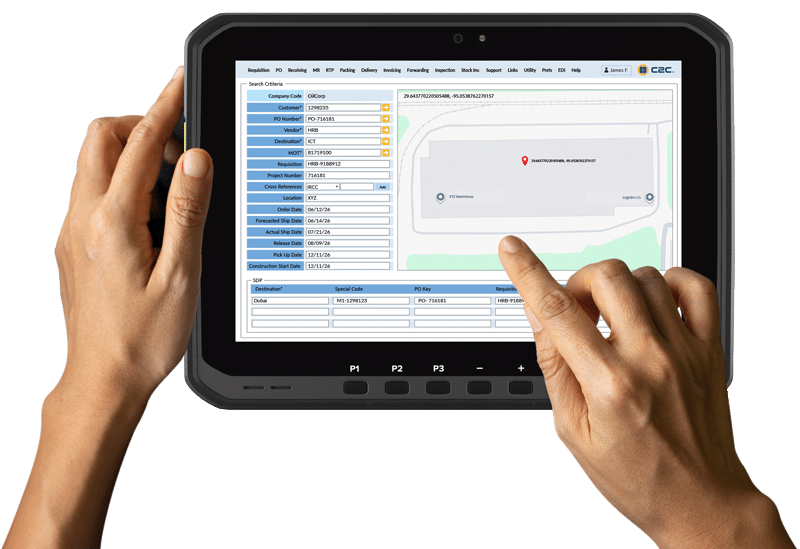
Transaction Packing offers a useful view from the customer side. The Houston export packer describes C2C Online as a way for customers to track purchase-order items, inventory and proof of delivery without installing the earlier tracking software. Its account includes receiving, picking, packing and shipment verification. Visibility becomes something the packer can offer the customer throughout the work.
Even the paperwork had a bottleneck
HAL faced its own version of operational friction. A historical Windward customer study describes trouble with C2C’s reporting component, JReport. Licensing was costly, document layouts needed repeated adjustments, and correcting one report required deploying a whole report catalog. Customers also bore document costs tied to page counts.
HAL evaluated alternatives and chose Windward’s AutoTag and reporting engine. Templates could be edited in Microsoft Office, and individual reports could be deployed separately. The change addressed both the price of the component and the recurring labor of correcting its output. Windward reports that reduced fees reached HAL’s customers.
“Reporting is a small part of what we offer as a whole, but it’s a very important part.”Chuck Hanebuth, identified as HAL’s CEO in the historical Windward case study
For another software company, the copyable move is specific: measure what a small correction forces everyone to do. A feature that works can still be expensive to maintain.
Count what changes, not just what moves
HAL’s Venezuela capital-project case describes putting C2C over an existing 3PL system. The reported starting problem included delays and pilferage or loss reaching 20% of managed material. HAL says that figure fell below 1%, with the project completed on schedule. Those are results from one company-published case, rather than a forecast for the next customer.
Pilferage and loss of managed material
Another collaboration, with FIATECH, ThomasNet and New Way Valve, addressed counterfeit material. C2C Mobile supported verification at receipt, with scanning, photographs and supplier information. Here the record concerns authenticity as well as location: an item’s arrival does not automatically make it acceptable for installation.
The practical prerequisite follows from these examples. People must identify material consistently, record movements and resolve exceptions. Software cannot cross-reference an alias nobody supplies or document an inspection nobody performs. A buyer with simple stock and few handoffs should weigh whether this depth earns its operating effort.
Start a demonstration with the troublesome part. Give it four names. Pack it inside another box. Split the delivery. Ask who can release it and who can see what remains. HAL’s business becomes easier to understand when the ordinary object gets complicated.
Follow the material
HAL website ↗ · Explore C2C ↗ · News & case studies ↗
LinkedIn ↗ · Twitter / X ↗ · Facebook ↗ · Request a demonstration ↗