A warehouse is a building full of verbs. Receive. Count. Move. Chill. Break down. Repack. Label. Pick. Stage. Load. Ship. Each verb takes time, people and equipment. Each can also carry a price. The difficulty is making sure the invoice remembers everything the warehouse did.
This is the practical country Kim Gregory Emond has occupied for more than 25 years. Royal 4 Systems describes him as a 3PL logistics specialist experienced in solving problems across warehousing, shipping and billing. His current title is Chief Marketing Officer, but his public biography begins with the work itself. That ordering feels revealing. In enterprise software, a title says where someone sits. A vocabulary says what they understand.
Emond's vocabulary is specific. Third-party logistics, or 3PL, is the business of handling someone else's goods. That apparently simple arrangement multiplies the rules. A single building may hold inventory for many clients. One needs cold storage. Another pays by pallet. A third wants products relabeled or assembled into kits. Each client has its own contract, cadence and definition of a billable service. The stock can stand side by side. The records cannot.
The expensive distance between done and billed
In 2022, Royal 4 put Emond forward as the specialist for a live webinar with a confrontational premise: how much money are 3PL companies losing with an off-the-shelf billing engine? The company framed the problem with a striking estimate - as many as 65 percent of 3PL businesses losing an average of $10,000 a month in revenue. The figure was promotional, not a disclosed independent study. The operational question beneath it was concrete: how can a provider capture all the value-added services it performs?
Consider what “value-added” means on an actual floor. A carton arrives and must be opened. Items are inspected, sorted and repackaged. Labels change. A rush order needs special handling. Frozen goods spend time in a blast room. Someone performs a cycle count for a particular customer. None of these jobs is as visually final as a truck leaving the dock, yet each consumes resources. If the work is recorded merely as movement, the business memory is incomplete. It needs an owner, a task, a unit, a price and a moment in time.
That paradox gives Emond's subject its bite. A missed shipment announces itself. A missed charge may hide inside a good day. The customer received the service. The warehouse remained busy. Staff solved the immediate problem. Only later does the financial record fail to reflect the operational one. Success on the floor can disguise leakage in the ledger.
An operator's eye in a marketer's office
There is a useful tension in Emond's dual identity. Marketing likes a clean sentence. Warehouses resist clean sentences. They contain exceptions, awkward corners, partial pallets, unusual units of measure and customers who have negotiated special handling. The executive explaining the software has to simplify the argument without simplifying away the buyer's reality.
Emond's public material does this by starting with consequence. The webinar did not lead with a database architecture or an inventory of features. It began with money possibly left uncollected. From there, the technology could be understood as a chain of evidence: warehouse activity feeds a management system; the system applies customer-specific rules; those rules produce an invoice that can defend itself.
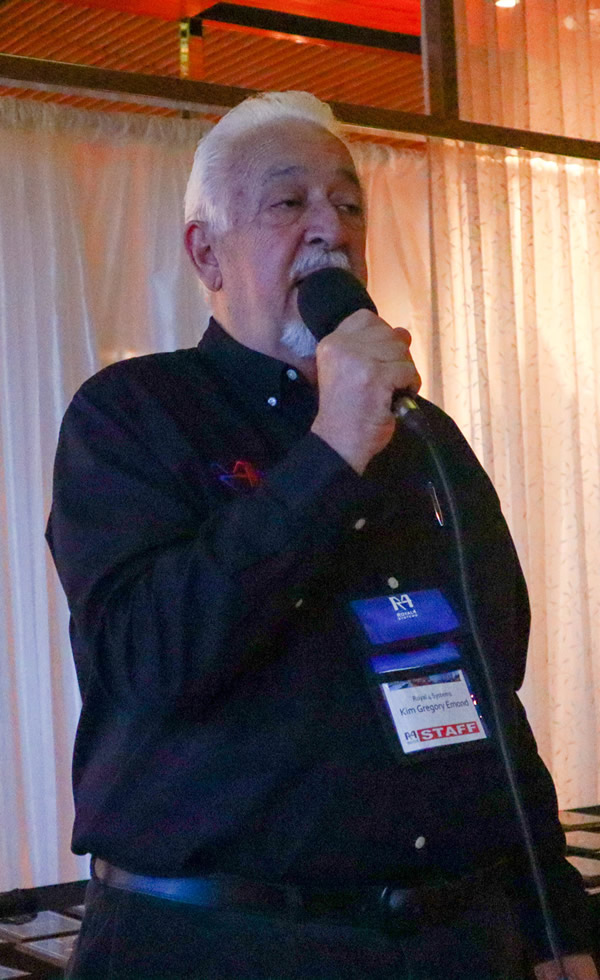
The photograph suits the assignment: Emond at a microphone, staff badge visible, mid-explanation. Royal 4 presented the billing session as a live conversation, including questions with an expert. This is appropriate for 3PL work, where the difficult cases tend to arrive as sentences beginning, “What happens when…” What happens when inventory belongs to several owners? When storage charges change after a grace period? When a task is priced by weight for one client and by unit for another?
Good enterprise software is partly a catalogue of such questions, answered in advance through configuration. Royal 4's WISE materials describe billing by task, volume, labor, unit of measure and schedule. The same physical action can have different commercial meanings depending on the customer agreement. For Emond, explaining that flexibility means joining the floor's messy facts to the buyer's financial concern.
Rules before features
The billing calendar alone can become a small world of exceptions. One customer may be invoiced daily, another monthly, another on an anniversary date. Storage might include a grace period, begin on receipt or recur by the space reserved rather than the space actually used. Repacking can be priced by the units produced, the labor consumed or a negotiated flat rate. The system has to know the rule before it can recognize the charge.
This helps explain why Emond's experience matters in a marketing role. A list of software features is easy to assemble and hard to remember. An operator's rule is different. It begins with a client, an agreement and a real event. Once described plainly, it lets a prospective buyer test the product against the oddities of their own building. Can it distinguish stock owners? Can it attach a special service to the correct contract? Can it bill on the customer's actual schedule?
Those questions move the discussion away from technology as spectacle. The software becomes infrastructure for keeping promises on both sides. The provider promises to handle each client's inventory according to its rules. The client promises to pay according to its agreement. The record between them needs enough detail to keep both promises intelligible.
In 3PL, customization is not a decorative option. It is the shape of the business. Every additional customer introduces a fresh set of conditions without creating a fresh warehouse. The art lies in sharing space, labor and systems while keeping ownership, instructions and charges unmistakably separate. Emond's three-part field - warehousing, shipping and billing - is really the study of how those conditions survive from one end of the operation to the other.
The discipline of remembering
Royal 4 has spent four decades developing supply-chain software, and its WISE system is built around rules: location rules, picking rules, shipment procedures, packaging techniques and customer billing arrangements. Emond's own 25-plus years therefore sit inside a longer institutional project. The company builds the mechanisms; his specialty is communicating why they matter to people whose day is measured in dock doors, orders and exceptions.
A 3PL provider occupies an unusual position of trust. It holds goods it does not own and performs work on behalf of companies whose customers may never know the provider's name. Accuracy is therefore not a decorative virtue. Inventory must stay separated in data even if it shares a building. Instructions must survive shift changes. A customer should be able to connect the amount on an invoice to work that genuinely occurred.
This is where billing becomes more than an accounting epilogue. It is a compressed account of operations. A precise invoice says what the warehouse did, for whom, in what quantity and under which agreement. When the record is credible, the provider can charge without improvisation and the customer can audit without archaeology.
The detail can become almost comic. Royal 4 advertises granular invoicing down to five decimal places. Five decimals are not the stuff of stirring executive speeches. They are, however, exactly the sort of specificity that tells an operator the software has met a complicated contract before. Precision has its own rhetoric. Sometimes the persuasive flourish is simply another zero after the decimal point.
Emond's career offers a compact lesson in the marketing of technical systems. Start with the work. Respect the exception. Follow the consequence. A buyer does not need to be dazzled by every possible function. The buyer needs to recognize a costly Tuesday afternoon and see how the next one could be handled differently.
A quiet form of operational ambition
The aspiration visible in Emond's work is not a moonshot. It is a tighter correspondence between reality and record. Every receipt recognized. Every owner distinguished. Every unusual service captured. Every shipment connected to the activity that made it possible. The ambition is modest in language and considerable in practice: let less useful work vanish.
This matters because logistics is full of handoffs. Goods pass from maker to carrier, dock to rack, rack to picker, picker to packer, and warehouse to customer. Information makes the same trip in parallel. At each handoff, detail can be preserved or blurred. Software supplies the rails, but experienced operators know which details deserve a ticket.
Emond has spent more than a quarter-century around those details. His clearest public introduction is still the plain one Royal 4 chose: experience solving issues related to warehousing, shipping and billing. Three nouns, arranged in the order work travels. Goods enter a building, leave it, and become a commercial account of what happened in between.
In that middle space, the little verbs accumulate. Receive. Count. Move. Chill. Repack. Pick. Ship. The warehouse performs them quickly, often invisibly. Kim Emond's subject is ensuring the business does not forget.
Follow the work
Kim Emond's professional profile and the Royal 4 material behind his work in 3PL billing, warehouse management and supply-chain software.