A purchase order has the visual authority of a finished decision: neat rows, approved quantities, exact prices, promised dates. On a factory floor, it is closer to a weather forecast. SourceDay says 52 percent of PO lines will change. A supplier pushes a delivery by six days. A price rises. A quantity gets split. The buyer learns by email, the planner keeps reading the ERP, and two versions of reality quietly begin to diverge. By the time the discrepancy becomes obvious, somebody is paying for an expedite, holding too much inventory or explaining why production stopped.
SourceDay exists for this unlovely middle of the supply chain. Founded in Austin in 2013 by Tom Kieley and Clint McRee, the company sells cloud software to manufacturers and distributors that connects buyers, suppliers and enterprise resource planning systems. It does not replace the ERP. It catches what happens after the ERP sends an order into the world: acknowledgments, changed dates, new quantities, price proposals, shipping notices and all the small negotiations that determine whether a part actually arrives.
The order is not the work
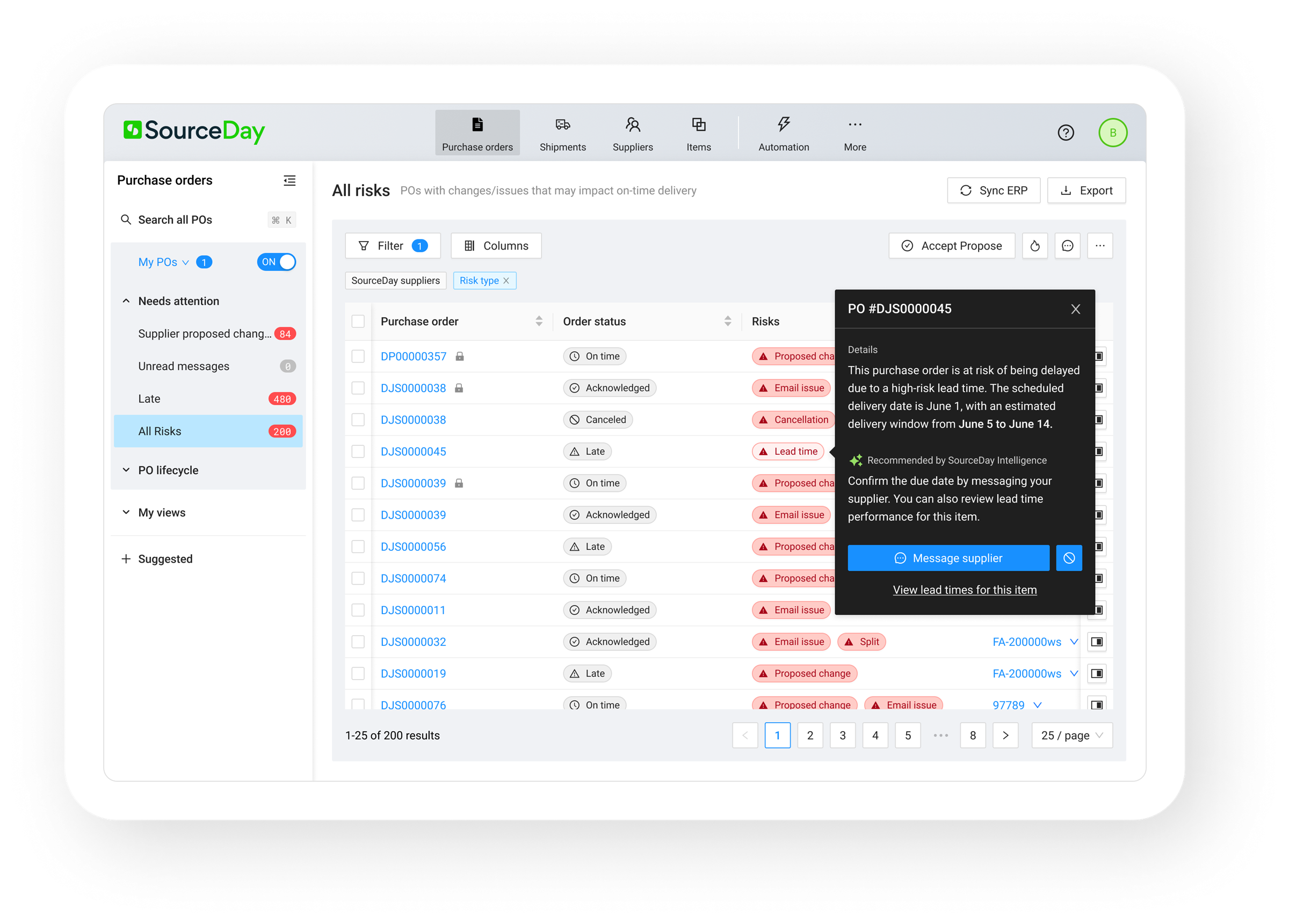
The product's basic loop is easy to understand. A PO flows from an ERP into SourceDay. The supplier can acknowledge it through the portal, interactive email, API or EDI. A proposed change becomes structured data rather than a sentence buried in an inbox. The buyer accepts, rejects or discusses it; approved changes flow back into the ERP. Dashboards surface late orders, missing acknowledgments and risky lead times. Scorecards turn the history into a view of supplier performance.
The controlled loop
That last step is the point. Plenty of tools can display a warning. SourceDay wants the operational record to remain usable by planning, finance and production. It highlights certified relationships with Epicor, Infor, NetSuite and Acumatica, systems common in the manufacturing and distribution businesses it serves. SourceDay is an official Epicor ISV, a certified Infor Solution Partner, an Acumatica Marketplace partner and has held Built for NetSuite certification since 2019. In 2023, NetSuite named it SDN Partner of the Year.
What failed first was the inbox
SourceDay's customer stories repeat the same opening scene with almost comic consistency: email, spreadsheets, phone calls, sometimes fax, and one exhausted person holding the plot together. CMD managed more than 5,000 purchase orders a year, often with 40 to 50 lines, across more than 400 suppliers. It had dedicated a full-time employee just to keep up with acknowledgments. DuraMark described its older workflow as a mix of Excel, Word, job jackets and tribal knowledge. Growth did not make those habits heroic. It made them dangerous.
At Sportsman Boats, pandemic demand turned the daily churn of pricing and lead times into a stress test. The revealing failure was literal: email trouble and domain blacklists interfered with supplier responses. Suppliers already active in SourceDay kept receiving updates and shipping parts. Sportsman reported 70 percent supplier adoption, 99 percent date accuracy, a 66 percent reduction in safety stock and no missing-parts downtime while the business grew 40 percent. Its conclusion was not that inventory had become unnecessary. It was that reliable commitments allowed a smaller buffer.
“When we see a PO come through SourceDay, we know we can trust that date.”Cole Wilson, systems manager at Sportsman Boats
Ag Leader supplies the cleanest before-and-after picture. It reported customer on-time delivery rising from 76 percent to 99 percent, while inventory fell 32 percent and every strategic supplier adopted the platform. Progress Rail said supplier communication that once consumed a day fell to 15 minutes or less. An SMC account representative estimated he saved an hour a day. Napoleon reported that SourceDay paid for itself in under three months and that incorrect invoices fell 90 percent per week after it added the accounts-payable product.
Ag Leader / customer on-time delivery
AI with a stop button
The company has spent its second act moving from collaboration toward controlled autonomy. SourceDay Intelligence, introduced in 2024, uses the company's PO-lifecycle dataset to detect lead-time, proposed-change, missing-acknowledgment and email risks. Newer agents analyze supplier, item and purchase-order behavior. The Decision Automation Engine goes further: customers set tolerances, and the software can execute a low-risk change while escalating the ambiguous ones.
That distinction matters. A price decrease may be safe to accept. A small move-out on a noncritical delivery may fit a buyer's policy. A larger increase or a delay on a line-stopping component should pause. In May 2026, SourceDay said its engine had evaluated 597,000 supplier-initiated changes across 120,000 supplier entities and $20 billion in annual direct spend. It executed 52,000 without manual intervention. Customers using the automation resolved changes about 30 hours faster and buyers managed 17 percent more spend without additional headcount, according to the company.
“Autonomous procurement only works when teams control exactly where AI acts and where it stops.”Mikey Wey, VP of product and design at SourceDay
This is also where SourceDay's decade of rather boring data becomes interesting. The business says its network processes 100 million PO changes a year. Historical supplier responses, item lead times, price movements and accepted resolutions create context a generic model does not have. The moat, if it holds, is not merely an algorithm. It is permissioned operating history combined with integrations that can turn a recommendation into a controlled update.
Built for direct materials, not every dollar
The procurement market is crowded. SAP Ariba, Coupa, Oracle, Ivalua, JAGGAER and GEP sell broad suites spanning sourcing, contracts, spend and payment. Native ERP workflows remain the default. Email and spreadsheets remain the stubborn free competitor. SourceDay's narrower claim is that direct materials require a purpose-built execution layer after the PO is placed. A missing office chair is annoying. A missing bearing can idle a line.
ERP holds the official order and feeds planning, finance and operations.
SourceDay captures supplier reality, manages exceptions and synchronizes accepted changes.
Source-to-pay platforms cover more categories but may be wider than a direct-material PO problem.
The business model follows enterprise SaaS convention: buyers request a demo and receive a custom quote; the company does not publish a price list. Suppliers participate free. That arrangement is strategically important because the paying customer's visibility is only as good as the supplier's willingness to answer. SourceDay markets interactive, no-login emails and supplier training alongside its software. This is one of those products where onboarding is not a service wrapped around the product. Adoption is part of the product.
Its partnership strategy reinforces the same focus. ERP certifications reduce integration anxiety and put SourceDay beside products customers already trust. A partnership with Medius connects current PO data to invoice automation, joining material flow with payment. The company reported a $5 billion quarterly direct-spend run rate entering 2026, more than 30 percent year-over-year growth in customers and new bookings during 2025, and a 436 percent increase in autonomous PO change processing in the second half of that year.
The playbook starts before the agent
There is a practical sequence here for operators, even if they never buy SourceDay. Start with open purchase orders, not an abstract transformation program. Count unacknowledged lines, stale dates, unresolved price changes and the hours buyers spend chasing them. Pick the suppliers and items that threaten production. Establish one visible record of every commitment. Make ownership explicit. Measure supplier response and on-time delivery against the same definitions. Only then automate the repeatable, low-consequence decisions.
What an operator can copy Monday morning
- Audit the open-order queue for supplier reality that never reached the ERP.
- Start with strategic suppliers and line-stopping parts, where clean data has an obvious owner.
- Offer more than one response path, including structured email for suppliers who resist another portal.
- Define tolerances for dates, quantities and prices before asking software to act.
- Prove reliability first; reduce inventory buffers only after commitments become trustworthy.
The conditions matter. A factory with few direct-material POs or stable local suppliers may not need another layer. A company seeking contracts, expense management and indirect purchasing in one suite may prefer a broader platform. Dirty item masters, unclear ERP ownership and unwilling suppliers will blunt any automation. And reducing safety stock before supplier commitments are current merely moves risk from the balance sheet to the production schedule.
SourceDay's own story carries a similar sequencing lesson. It launched direct-spend SaaS in 2015, raised $6.5 million in a 2018 Series A, $12.5 million in 2020 and $31.5 million in a 2022 Series C led by Norwest. Total reported funding is roughly $54.8 million. In late 2024, Michael Miller moved from chief operating officer to chief executive, while co-founder Kieley shifted to the board. The product's vocabulary changed from collaboration to intelligence to autonomous procurement, but the original problem stayed put: what the supplier can deliver and what the ERP believes should not be different facts.
That is SourceDay's useful restraint. It does not promise a world without changing orders. Manufacturing would laugh at the suggestion. It proposes a world in which the change is seen, judged and recorded soon enough to remain a decision instead of becoming a surprise.
Keep digging
Explore the company, the product and the operating evidence behind the numbers.