The magnet worked. That was the trouble. At Light & Motion, where Arena co-founder Eric Larkin once worked, an underwater video housing used magnets to operate switches through its enclosure. Replacing a roughly dollar-a-piece magnet with one costing less than a quarter looked sensible. Functional tests passed. Then salt water corroded the replacements, causing failures in the field. The company switched back and later redesigned the switches with a seal.
A parts substitution had become a product problem. The saving was visible; the consequence required a different question. Arena by PTC sells software for the places where those questions ought to meet: engineering, manufacturing, purchasing, quality, and the suppliers who turn a design into something real.
- The job: keep product parts, revisions, approvals, and quality records together.
- The audience: manufacturers with complex products and distributed teams or suppliers.
- The commercial deal: annual SaaS agreements, priced to the organization.
- The useful lesson: a shared record needs a sensible review process to earn its keep.
The parts list becomes a meeting place
A bill of materials, or BOM, is the organized list of parts and assemblies needed to make a product. It sounds like clerical furniture. In practice, it is where a surprising number of decisions collide. Engineering chooses a component. Purchasing finds a source. Manufacturing needs an approved revision. Quality needs to know what changed and why.
Arena’s product lifecycle management software, PLM, puts those relationships into a shared cloud record. Teams manage items, assemblies, documents, requirements, and change histories; suppliers receive controlled access. A change can move through a review workflow instead of living in a succession of attachments. Mechanical, electrical, and software information can be considered together, rather than traded like diplomatic correspondence.
The company began in 2000 as Bom.com, founded by Michael Topolovac and Eric Larkin. By 2003, the name had become too narrow. Its offering already encompassed collaboration, cost analysis, supply chain management, and change workflows. Topolovac told EE Times, “We really outgrew what we were.” Arena was a name roomy enough to accommodate the business.
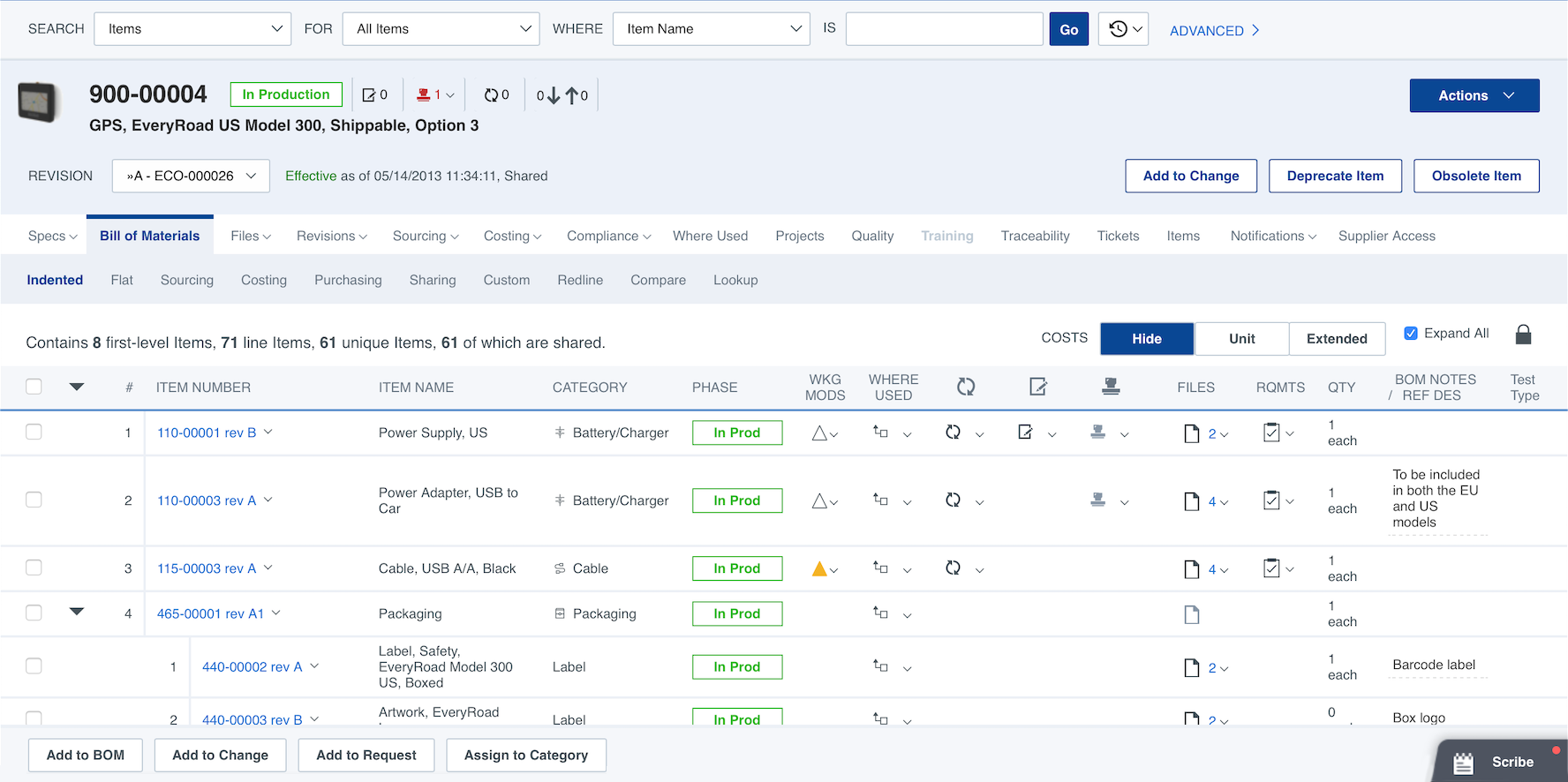
Two rev As walk into a factory
Nutanix’s Arena customer story contains a wonderfully uncomfortable detail: suppliers sometimes built the wrong version of a product even though its revision label looked right. Uncontrolled spreadsheets and emails had produced competing copies of the BOM. The label could no longer settle an argument about what to make.
The resulting rework meant more procurement, build, and test cycles. Nutanix wanted reliable BOMs, cost visibility, supplier collaboration, and an interface to its NetSuite ERP system. Arena supplied a controlled environment in which affected stakeholders reviewed the same information. Suppliers accessed the same BOM and revision.
Reported change in engineering change order approval time after adopting Arena.
A customer-specific result, reported in Arena’s case study.The story also reports no wrong BOM builds after implementation and an almost 50% shorter concept-to-cash cycle for the second-generation product. Those are results from one customer’s account, rather than a forecast for the next buyer. The transferable idea is narrower and sturdier: give reviewers and builders the same controlled information before work starts.
The missing room between design and production
AMP, the recycling robotics company, had another version of the problem. It used SOLIDWORKS for design and NetSuite for enterprise resource planning, but needed a bridge between them. Access to product information and authority to review changes were concentrated among particular engineers. Buyers, suppliers, and other participants needed a view of the work.
AMP worked with a consultant to select PLM software and integrated Arena with both existing systems. Released design information became available for review and sign-off in Arena. Approved part numbers, definitions, and descriptions then moved into ERP. Scott Krueger, AMP’s PDM specialist, put the starting position bluntly: “We didn’t have processes behind any of the things that we were doing.”
This gives Arena a precise place in the software stack. CAD creates designs; ERP helps execute the business of production. PLM controls the product information and decisions that travel between them. Buying the middle system can be useful when the handoff itself has become a source of mistakes.
Quality gets an address
Arena’s second principal offering is its quality management system, QMS. The distinctive choice is to connect quality records to the product design and BOM. Corrective and preventive actions, design history, training records, and controlled documents can sit in context with the thing being manufactured.
Consider an audit question about a changed component. A document repository may contain the relevant procedure; a connected product record helps establish which design, revision, and quality activity it concerns. Arena supports that traceability. A manufacturer still needs its own sound procedures and evidence. Software cannot confer regulatory approval by tidying a folder.
Medical-device companies are a clear audience, alongside electronics, robotics, industrial products, and aerospace and defense. Arena reports more than 1,500 customer companies worldwide. Its published stories include Accuryn Medical, Markforged, Echodyne, and Digi International, illustrating the range of physical products behind the software.
Buyers have alternatives: Siemens and Dassault Systèmes in PLM, Propel in product collaboration, and MasterControl, Greenlight Guru, or Qualio in quality management. Arena’s pitch is particularly legible for organizations wanting cloud delivery, supplier participation, and product-linked quality. Compare the actual workflow and integration requirements; a vendor’s category label is a poor substitute for a trial with your own data.
What the subscription buys
The commercial model is enterprise SaaS. Arena’s pricing page describes annual agreements and quotes based on team size, roles, compliance requirements, and supply chain complexity. It offers a 10-day trial. Plans bundle different capabilities, and some additions cost extra. The sensible purchasing exercise includes licenses, implementation, integrations, migration, and internal time spent establishing the process.
Cloud delivery shifts platform maintenance to the vendor. The buyer’s remaining work is substantial but different: decide who owns records, which suppliers see which information, and what constitutes an approved change. A badly governed parts list can travel to the cloud with all its bad habits intact.
A parts list becomes useful when it can answer a disagreement.THE EDITOR’S TAKE
PTC bought Arena in January 2021 for approximately $715 million, net of acquired cash according to its filings. The strategic logic was public: combine Arena with Onshape to offer SaaS CAD and PLM. In September 2022, PTC launched their native connection, enabling product information to pass between the two cloud systems. That pairing links design work more directly to the record used downstream.
The product record learns new tricks
Arena’s newer capabilities extend the same premise. Supply Chain Intelligence puts electronic component sourcing, lifecycle, and compliance information beside the BOM. Teams can monitor risky items and receive notifications as conditions change. This moves the availability question closer to the engineering decision, where an alternative may still be relatively easy to choose.
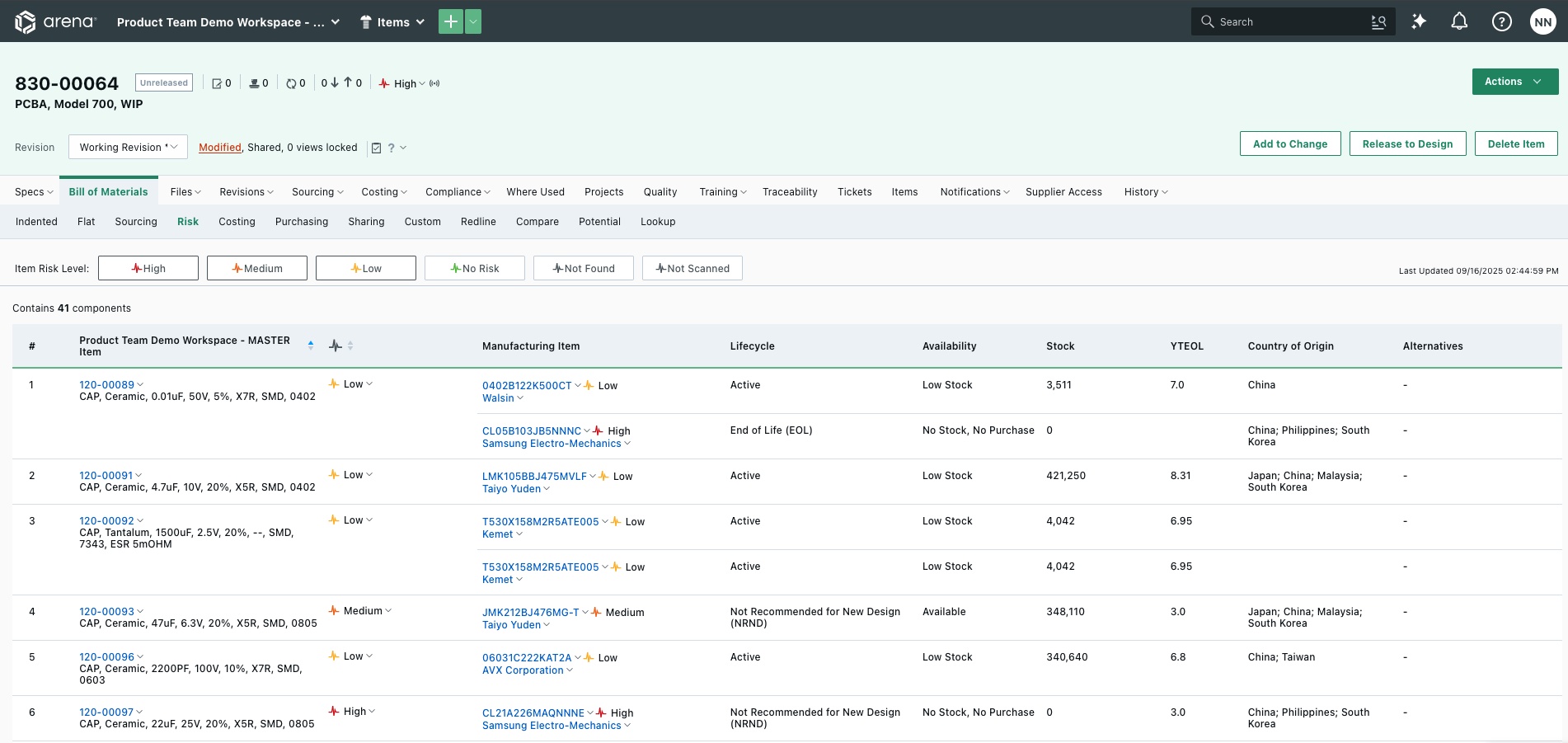
The December 2025 AI Engine release introduced document summarization and file comparison powered by Amazon Bedrock. These are practical jobs in a business full of specifications and revisions. Arena’s AI policy, updated in August 2026, says assistants and actions suggest or summarize without changing records or triggering workflows. Features that send customer data to language models are disabled by default and controlled by workspace administrators. Users must review the output.
In August 2026, Arena Connect added a visual workflow builder, more than 200 pre-built connectors, and templates for applications including Jira, Microsoft Teams, and Slack. The release also added AI change summaries and automated BOM compliance capabilities. Integration is the recurring theme: reduce the effort required to carry approved information across the other tools a manufacturer already uses.
Copy the discipline before the dashboard
For a prospective buyer, a useful demonstration begins with an ordinary change: replace a component, attach the evidence, route the decision, show the supplier what is approved, and follow the data into ERP. Then ask someone who was absent from the meeting to explain what happened. If the record cannot tell the story, a polished dashboard has earned very little.
The review burden should fit the consequence. A small, colocated team iterating a low-volume prototype has different needs from a dispersed organization releasing a regulated product into volume production. More formal approval can protect the latter and obstruct the former. Configure with that distinction in mind, and test the supplier permissions and integrations that your work actually requires.
Arena makes sense where product complexity and organizational distance have made memory unreliable. Its proposition becomes less compelling when a team has few parts, simple handoffs, and little need for formal traceability. The useful question is whether the cost of keeping everyone aligned has become greater than the cost of a shared system. The cheaper magnet is a reminder to count both sides.
See the work for yourself
Arena website · Plans and trial · Company news · Arena blog