A custom industrial door is a terrible thing to quote with a spreadsheet. Change the width and the panels change. Pick another motor and the electrical specification moves. Add a window, a wind rating, a color, a dealer discount, freight, and a drawing. Somewhere between “Can I get a price?” and the factory floor, a salesperson can promise a machine that engineering cannot build.
Revalize lives in that uncomfortable gap. The Jacksonville software company sells tools that draw products, control product data, test designs, guide configurations, calculate prices, generate proposals, and hand orders to production systems. Its portfolio covers the industrial alphabet soup - CAD, PDM, PLM, CPQ - plus catalogs, visualization, hospital equipment planning, lighting calculations, and fluid-system simulation.
The company itself is younger than a five-year maintenance contract. TA Associates and software operators at ST6 formed Revalize in June 2021 by combining AutoQuotes, Configure One, Engineered Software, FPX, and Lighting Analysts. It began with more than 8,000 customers. By November, after another acquisition burst and a minority investment from Hg, 13 businesses sat under the umbrella and the transaction valued Revalize at $1.8 billion. Today it presents 19 brands and says it serves more than 16,000 customers.
A roll-up with steel-toed boots
This was not a founder spotting an empty market and writing version one in a garage. It was a private-equity thesis with a product catalog attached: buy proven, sector-specific software; preserve the knowledge hiding inside each product; then connect enough of it to become the manufacturing customer’s route from idea to cash.
That distinction explains Revalize’s odd charm. Its brands solve jobs generic business software tends to flatten. PIPE-FLO models a fluid system before anyone builds the physical pipes. AutoQuotes keeps a foodservice catalog of more than a million products. Attainia helps hospitals plan and budget capital equipment. MicroD lets a furniture shopper drape another fabric across a sofa. TENADO makes CAD for metalworkers, fire-protection planners, woodworkers, and traffic designers. PRO.FILE governs engineering documents, versions, bills of material, and changes.
At the commercial end sits Configure One Cloud. A manufacturer encodes what can be built, which options conflict, how components affect price, and what belongs in the bill of materials. Salespeople, dealers, or customers answer guided questions. The system produces a valid configuration, a visual, a price, a proposal, and eventually an order. Integrations carry customer, item, price, and order data between Revalize and systems such as Salesforce, NetSuite, Microsoft Dynamics, SAP, JD Edwards, IFS, HubSpot, and Acumatica.

“They were able to take our quoting process from days down to minutes, putting out an accurate quote.”Donna T. · Komar Industries
What actually changed
The cleanest proof comes from customers who had a measurable before. Haas Door sells garage-door systems through 270 dealers. Its old process could take days or weeks, including as long as two weeks to get drawings to a customer. A Revalize case study says Configure One Cloud reduced that quotation process to minutes. Komar Industries, which makes industrial waste and recycling equipment, reports the same days-to-minutes shift.
PRO.FILE customers describe a different bottleneck: product truth scattered across CAD, ERP, shared drives, and people’s heads. Argo Hytos says it cut maintenance time for part-master data and bills of material by 40 to 50 percent. One published customer account says an earlier Siemens Teamcenter implementation was stopped after a year and “a high investment”; after restarting with PRO.FILE, the company was productive at three sites within four months. The lesson is not that one famous system always beats another. Scope, fit, and the implementation team can beat a longer feature list.
Revalize has eaten its own product-data cooking, too. AutoQuotes worked with Sitation and Akeneo to replace manual product creation and bulk updates with a product information system. Sitation reports that the project lowered per-product creation cost by 71 percent and increased completed-product volume by 55 percent. It won a 2022 Akeneo customer-experience award. The interesting detail is the timing: the implementation ran while the client was being folded into Revalize and its content department was being retrained and restructured. Organizational mess did not disappear; the workflow became less dependent on it.
What does it cost?
The honest buyer’s budget
Revalize does not publish a standard price for its core enterprise products. Sales are quote-based. A public 2025 Revalize University schedule did list a Configure One migration-training subscription at $1,200 per year and a private four-hour virtual class at $900 for up to four people.
The license is only one line item. Buyers should price product-rule modeling, data cleanup, ERP and CRM connections, drawings or visualization, user training, support, change management, and the employee who will own the rules after launch.
That last cost is the one glossy demos hide. CPQ is not a mind reader. Someone must teach it which gearbox fits which frame, when a discount needs approval, and how a valid configuration becomes a manufacturable bill of materials. PLM cannot create a culture of version control by itself. A digital twin is only as useful as the model and operating data beneath it.
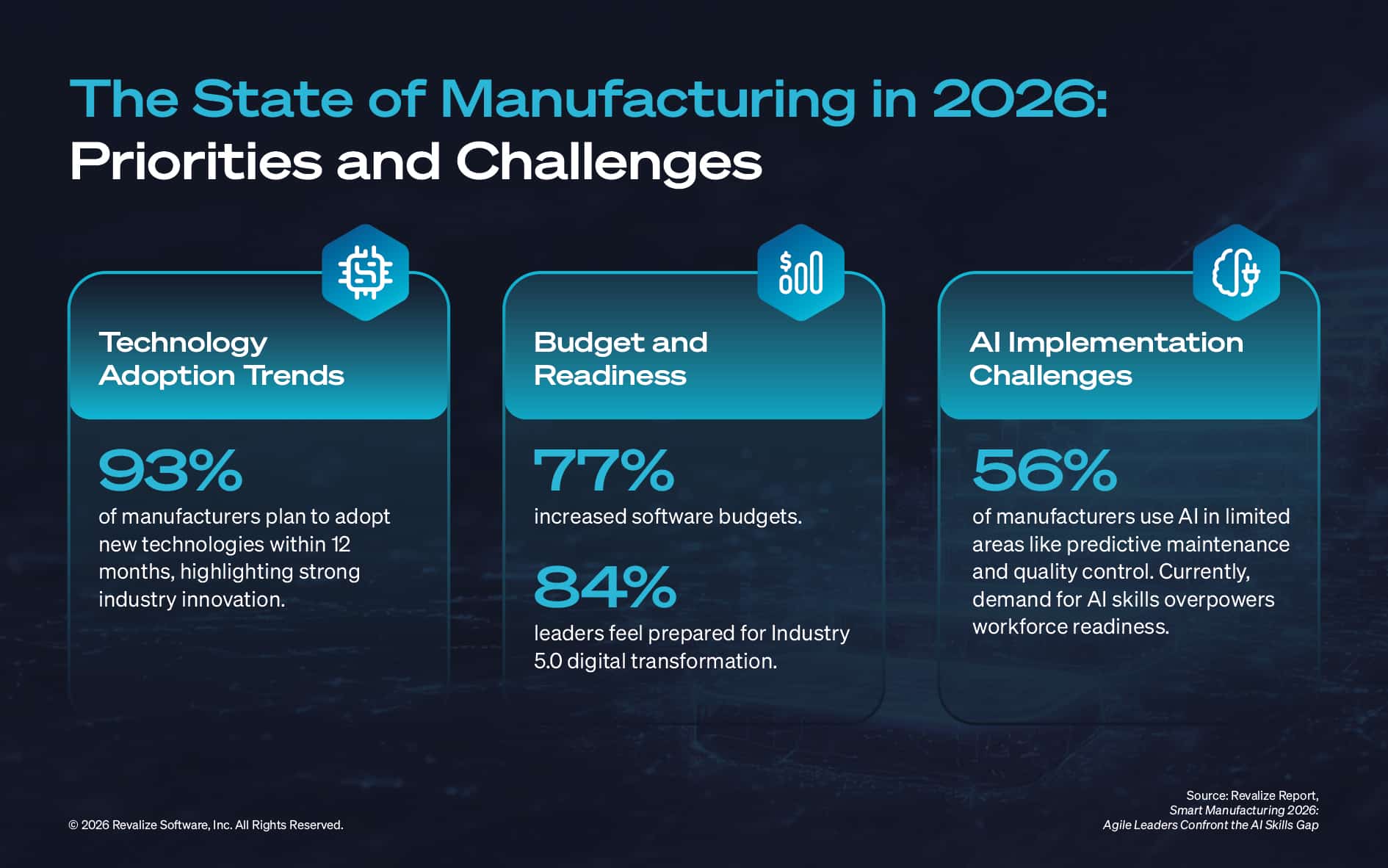
Revalize’s own 2026 survey supplies an accidental warning label. Among 500 manufacturing software decision-makers in the United States and the German-speaking DACH region, 77 percent said software budgets had increased and 93 percent planned to use new technology. Yet only 10 percent said AI was fully integrated across operations. Money and appetite were abundant. Integration and skills were not.
The moat and the seams
Against broad software companies, Revalize’s advantage is specificity. Salesforce, Conga, Oracle, SAP, and Epicor compete in CPQ. Siemens, PTC, Dassault Systèmes, and Autodesk compete across product data and lifecycle management. CAD and simulation have their own crowded fields. Revalize’s answer is not one universal application. It is a shelf of tools that already speaks pump, restaurant kitchen, hospital, door, sofa, or metal fabrication.
That is also the risk. A portfolio is not automatically a platform. Products acquired from different companies can carry different interfaces, databases, deployment histories, and support habits. Revalize’s Integration Hub, cloud migrations, common partner program, and cross-sell strategy are attempts to bridge those seams. The company’s 2026 partner program gives resellers and implementation specialists tiered enablement, marketing support, and access across CAD, PLM, and CPQ. Partners can widen distribution; they can also absorb the local implementation work a centralized vendor cannot.
The company has continued shipping at the product level. In 2026, PRO.FILE added structured engineering-change management and prepared its architecture for more web access and automation. TENADO METAL 3D expanded into the Benelux and U.S. markets. These are not dramatic attempts to melt 19 names into one. They are evidence of the more practical strategy: improve each specialist product while making the handoffs less painful.
What to steal - and when to walk away
The copyable idea is not “buy 19 companies.” It is to find an expensive relay race. Map where information changes hands, where the same data is typed twice, where an expert checks every order, and where a mistake reaches production. Start with the nastiest handoff. Encode the rules. Measure quote time, error rate, engineering touches, and rework before and after. Keep the domain people close; their knowledge is the product.
Good conditions
- Products have many valid and invalid combinations.
- Engineering repeatedly checks sales work.
- Product data needs versions, approvals, or compliance.
- Dealers and distributors need governed self-service.
Bad conditions
- The catalog is small, fixed, and easy to price.
- No one owns product rules or data quality.
- The company cannot fund integration and training.
- Teams want software to settle unresolved process disputes.
Under the wrong conditions, Revalize can be a very capable answer to a question a company does not have. A simple merchant with fixed SKUs may be better served by ecommerce and ERP. A manufacturer unwilling to standardize its rules will simply automate arguments. A buyer demanding one perfectly uniform interface across every function should inspect the specific Revalize product, not purchase the umbrella story.
But in a factory where every quote is a small engineering project, the pitch lands. Revalize is selling the removal of suspense. The salesperson should know that the promised product can be built. Engineering should know which version was sold. Production should receive the right parts. Finance should recognize the right price. That sounds mundane, right up until a six-figure machine arrives with the wrong motor.