The engineer has fixed the problem. The van has left. The customer can get back to work. Somewhere in the office, however, the job is still unfinished: the information needed to send an invoice has not arrived. For a service business, a missing worksheet can keep a perfectly good day’s work sitting outside the billing queue.
Praxedo UK operates in that unglamorous, consequential space. Its software joins the office schedule to the technician’s phone, then carries the completed work report back into the business. Scheduling gets much of the attention in field service management. The return journey of the information may be just as valuable.
Consider Henry Schein France, the dental-equipment supplier. In a customer account published by Praxedo, it reports reducing invoicing time from five weeks to 24 hours, helped by electronic service reports sent after jobs. That is a customer’s reported experience, rather than a promise for every deployment. Still, it makes the commercial point unusually clear: fixing equipment and documenting the fix belong in the same process.
Reported invoicing time before and after Praxedo. This measures issuing invoices, not when customers pay.
The diary was the first thing to disappoint
At London security installer Premier Security, the earlier system was essentially a static diary. Engineers used paper job sheets; the office lacked a live picture of their progress. Business manager Jerri Shorter wanted job information delivered directly to their phones and a simpler way to assign work.
“The problem is, I can’t charge for the installations if the paperwork hasn’t come back!”
Jerri Shorter · Business Manager, Premier Security
The company’s account describes seven field technicians. Praxedo brought configurable job forms, photographs of completed work and records the office could retrieve. Shorter also praised the help during implementation. The attraction was practical: fewer calls to locate engineers, less chasing for information, and a usable record of what happened at the customer’s premises.
There is a useful distinction here between an appointment and a job. A diary can say where somebody ought to be. A service record must also explain what they found, what they changed and what should happen next. Praxedo’s proposition depends on carrying that extra detail without making the technician’s day an exercise in typing.
A dispatch desk that travels in a pocket
The product has three audiences. Dispatchers use a web application to create and allocate work. Technicians use a mobile app for their schedules, instructions, job histories and reports. Customers can receive progress messages and, through portal options, check work orders or arrange appointments.
Offline operation matters because the workplace is wherever the equipment happens to be. The mobile app supports work without reception and synchronisation when connectivity returns. A buyer should distinguish that from continuously live tracking: information recorded offline must reconnect before the office can receive it.
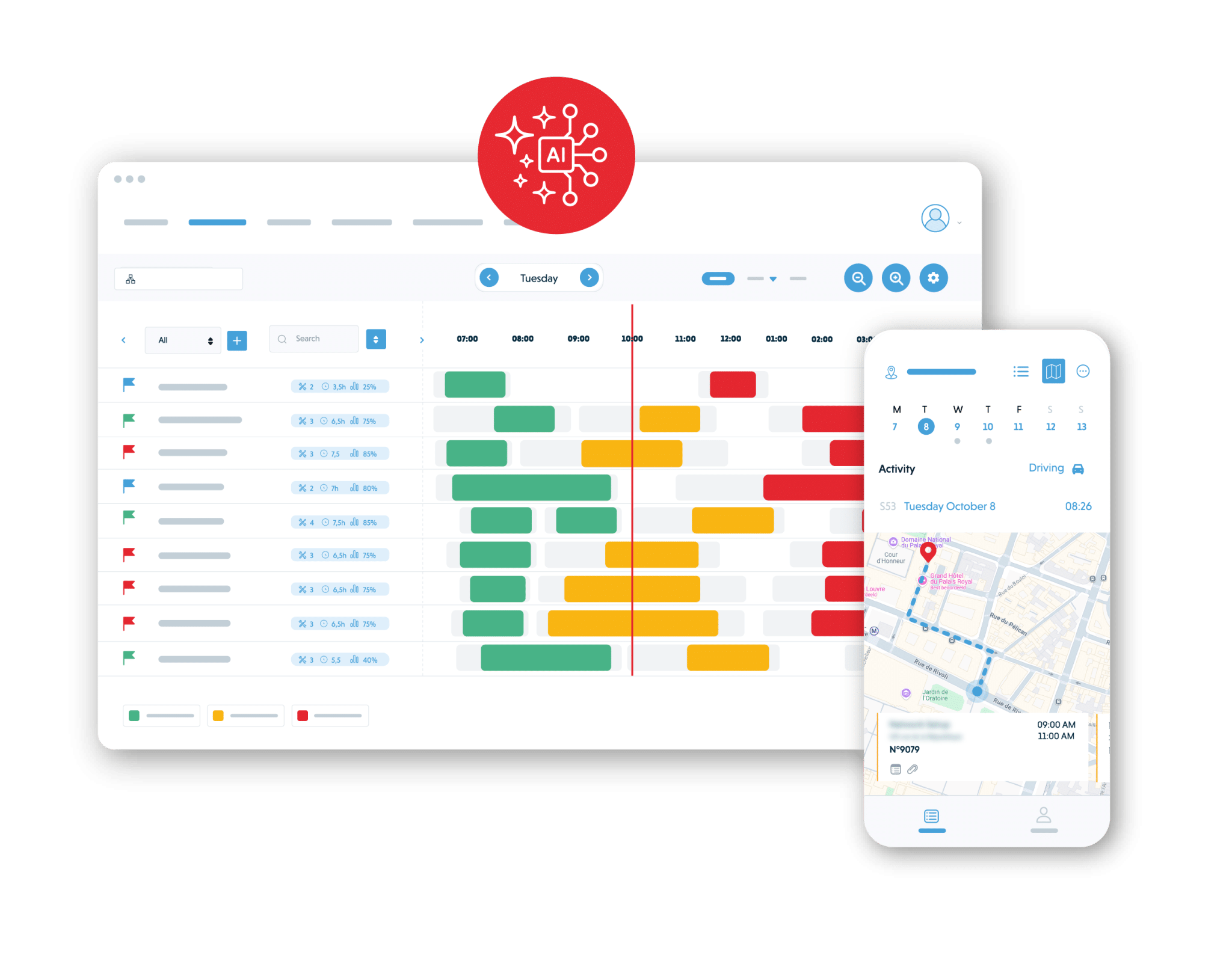
SmartScheduler adds automated route planning around operational constraints. The company describes AI-assisted matching that considers skills, travel time and customer availability, alongside drag-and-drop scheduling and status monitoring. The point is to help a dispatcher handle the combinations that become difficult to juggle mentally as the job list grows.
The sensible test is an untidy day. Insert an urgent call, a delayed repair and a customer who is available for only a short window. See what the scheduler proposes and what the human planner can change. A convincing demonstration should resemble the work people actually do, including the inconvenient parts.
Twenty reports were nineteen too many
Bargreen Ellingson supplies a more revealing example than a tidy product tour. Its chemical division services dish and laundry machines, often several assets at one location. The previous platform could produce more than 20 separate reports from one visit. Business analyst Kiely Joyce joined technicians in the field, hard hat included, and saw the cumbersome process for herself.
A request for proposals followed. With Praxedo, the team could put multiple machines into one Route Service Order for a visit. Joyce describes paperwork taking five to ten minutes, compared with as much as 30 previously. These are her estimates. The important design decision is concrete: organise the report around the visit that customers and technicians recognise.
That lesson travels beyond this product. Before writing software requirements, follow somebody through the work. Count the screens, the repeated entries and the reports a customer receives. A system can be digital and still create unnecessary administration. The purchasing question is whether it represents the business correctly, down to something as basic as what counts as one job.
- 01 / PLANMatch the work to a qualified technician.
- 02 / DOCarry instructions and capture the result.
- 03 / RETURNSend the completed report to the office.
- 04 / PROCESSUse the evidence in the business system.
An editorial map of the workflow, not a measured performance comparison.
£35 is a starting price, not a project budget
Praxedo sells subscriptions. Its published UK tiers are Basic at £35, Advanced at £59, Optimised at £89 and Automated at £129 per user per month, with a minimum of five users. Large enterprises can request a customised plan. On simple seat arithmetic, the Basic minimum is £175 monthly; ten Advanced users would be £590 monthly.
Published UK price per user/month, checked 7 September 2026. Five-user minimum. Illustrative subscription arithmetic excludes separately quoted items.
Customer and appointment portals, video assistance and connectors have their own commercial arrangements. Buyers therefore need a quote for the configuration they intend to use. The subscription calculation alone does not establish the total cost of getting a team operational.
Implementation involves decisions as well as training. Somebody must choose the forms, define completion, decide which information is compulsory and agree where records go next. Praxedo describes a dedicated onboarding specialist, requirements analysis, configuration assistance and introductory training, followed by local support. That is relevant expertise for a company moving working habits, not merely installing an app.
A useful pilot would measure report completion time, office corrections and the interval before a job becomes ready to bill. Keep the starting measurements. Without them, a new interface can feel faster while the same bottleneck survives in a different department.
Keep the accounts system. Connect the field.
Praxedo’s integration approach is central to its market position. It offers connectors for Microsoft Dynamics 365 Business Central and Salesforce, plus APIs for other connections. Its documentation describes exchanging customer, equipment and technician data, creating work orders from business systems and returning service reports and post-job information.
That gives buyers a specialist field-service application alongside an existing business system. It also gives them integration work to examine. A completed report should arrive where the next person needs it, with identifiers and fields that make sense. Test that path during evaluation, rather than assuming an available connector settles every workflow question.
Salesforce Field Service is one alternative, with its own offline mobile application and configurable workflows. An offline app alone therefore does not establish Praxedo’s difference. The more useful comparison is how well each product handles the buyer’s job structure, scheduling constraints, existing systems and support needs.
Praxedo’s commercial activity reinforces that positioning. Its November 2025 Directions EMEA announcement focused on Business Central integrators and resellers. Its September 2025 Connected Britain announcement addressed telecom operators and subcontractors coordinating field deployment. These are two routes into the same problem: work has to move reliably between organisations, systems and technicians.
A French business with a UK front door
Praxedo dates its founding to 2005, with Jean de Broissia and Pierre Lavigne as co-founders. The UK legal entity, PRAXEDO LTD, was incorporated in December 2020. Its registered office is in London; the group’s headquarters are in Paris. Keeping those dates separate prevents a regional company profile from quietly rewriting the group’s history.
The founders self-financed the business before bringing in MBO+ as a minority investor in March 2022. Their stated reasons were to strengthen the organisation and accelerate international development. In April 2023, Praxedo acquired video-assistance specialist ViiBE. Remote diagnosis extends the proposition upstream: before allocating a journey, help establish what the problem is and whether a visit is necessary.

The group reports more than 1,500 customer companies, 65,000 daily users and 150,000 jobs a day. Those are worldwide figures. Its public culture statements stress relationships and adaptability; a more tangible expression is the foundation the founders established in 2022, initially endowed with €400,000 over four years to support inclusion and access to employment.
Software cannot decide whether a business has defined its work sensibly. A five-user minimum also makes this a different proposition for a lone operator, while a company already satisfied with its service module needs a reason to add another system. Praxedo’s strongest case starts where the customer accounts do: find the handoff that is costing time, test it with real jobs, and make the information arrive when the work is done.