At Eastern Lift Truck, the troublesome part of a repair could arrive after the technician had finished. Managers lacked visibility into work in progress. Paperwork travelled between the field and the office. Billing accumulated toward the end of the month. The machine could be ready for its next shift while the business was still assembling the story of the last one.
This is the territory ServiceMax occupies: the distance between doing useful work and making that work legible. A repair has a physical life, involving tools, parts, and a person who knows what to do. It also has a commercial life, involving warranties, promised response times, and someone who must decide what belongs on the bill. Losing the connection between them is expensive.
- The job: organize field service around the equipment being maintained, including its history and coverage.
- The buyers: manufacturers, equipment operators, dealers, and service providers with complicated installed machinery.
- The proposition: give technicians and office teams the same usable account of the job, from dispatch through completion.
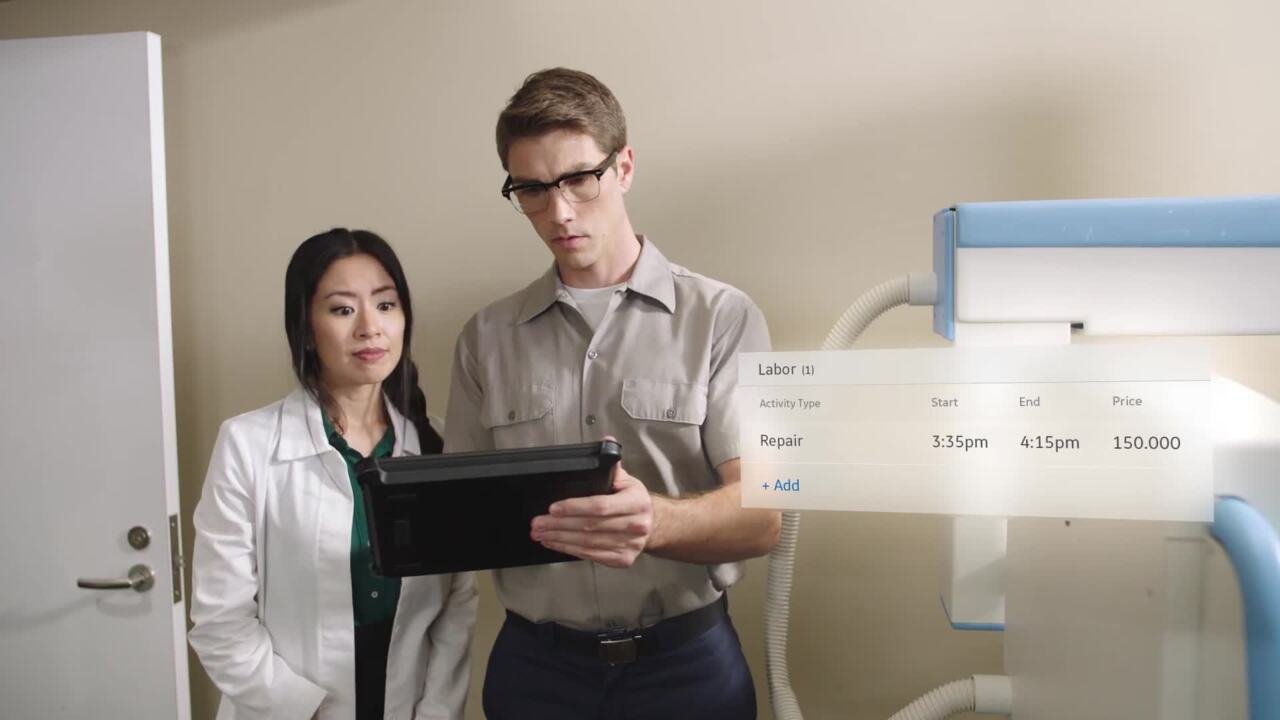
Eastern Lift adopted ServiceMax Core and Service Board. Its published customer story reports two hours less paperwork per technician per week, better visibility, and faster invoicing. Those are customer-reported outcomes, rather than a promise for every installation. But they identify a wonderfully unfashionable software opportunity: help the office stop asking what happened.
A serial number deserves a biography
Most businesses have a record of the customer. ServiceMax asks them to keep a sufficiently detailed record of the machine, too. The same model of equipment can have different components, repair histories, warranties, and obligations. A customer name alone does not tell the technician which part fits or tell the service manager whether the visit is covered.
ServiceMax Core brings together work orders, installed equipment, parts, and contract administration. Dispatchers use Service Board to match jobs with resources. The organizing idea is asset-centric field service: the individual piece of equipment remains visible as technicians, parts, and work orders come and go.
The company serves equipment-heavy businesses in manufacturing, medical devices, energy, utilities, and related markets. PTC describes its sweet spot as organizations with 50 or more technicians and complex equipment and contracts. That is a useful indication of fit, not a minimum admission requirement. A business with straightforward appointments should weigh how much of this machinery it actually needs.
An editorial map of the workflow. The quiet work happens between the boxes.
The tablet has to survive the basement
A field service application has an awkward test to pass. It must be useful precisely where a desk-bound application would be least comfortable: beside the equipment, with intermittent connectivity and a customer waiting.
ServiceMax Go provides technicians with work and equipment information, supports offline data capture, and synchronizes records. Its document tools support service reports and customer signatures. DataGuide supplies forms and checklists. Zinc adds communication with colleagues and experts. These are practical responses to work that does not politely pause when the signal disappears.
Schneider Electric gives the offline requirement a larger stage. Its ServiceMax customer story describes a multinational operation trying to reconcile local autonomy with a consistent customer experience. The company reports eliminating 70% of paper-based processes and increasing its first-time fix rate by three points. Offline access and support across Windows, Android, and iOS mattered to that deployment. Standardization had to travel with the technician.
The money is hiding in the service record
MilliporeSigma had disconnected databases across service and commercial teams. Pulling together information could take a month. With a unified field service system, its teams could monitor performance in real time. The interesting result was commercial: its case study reports contract attachment moving from 10% to as high as 40% after the first year, alongside a 94% renewal rate.
Bars compare the reported rates. They describe one customer’s experience.
A service visit is also an opportunity to understand what a customer owns and what support it needs. If the record is scattered, that opportunity is easy to miss. Asset 360, built natively on Salesforce Field Service, adds equipment visibility, maintenance planning, service contracts, and entitlement capabilities. Its contract tools can represent negotiated pricing and coverage against specific assets and services.
Westmor, which makes and services petroleum and liquid-handling equipment, illustrates a related benefit. Its case study reports a 20% increase in technician utilization. It also describes tracking warranty terms even for products Westmor did not install, helping avoid charging customers for covered work. Better commercial control sometimes means knowing when to leave a charge off the invoice.
Three routes into a complicated market
ServiceMax’s main offerings are Core, Asset 360 for Salesforce, and FieldFX. Core supplies the field service platform; Asset 360 extends Salesforce Field Service with asset-focused capabilities. FieldFX addresses energy-sector field operations, where contracts, equipment, jobs, and field tickets can be particularly involved.
FieldFX came with LiquidFrameworks, acquired in November 2021 for $148 million on a cash-free, debt-free basis, subject to adjustments. ServiceMax financed the purchase with cash and borrowings, including a new $100 million term loan. This was a purchase of sector expertise as well as software: energy service businesses have specific ticketing and field-execution requirements.
The business model is enterprise subscription software, accompanied by implementation and support. A historical financial disclosure shows $28.7 million in subscription revenue within $33.2 million total revenue for the quarter ending October 2021. That is evidence of the model, not a current annual revenue figure. Buyers should budget for configuration, integrations, training, and ongoing administration as well as licenses.
Alternatives include Salesforce Field Service, Microsoft Dynamics 365 Field Service, ServiceNow Field Service Management, and IFS. The comparison is unusually tangled because Salesforce is also ServiceMax’s platform partner. Asset 360 explicitly works with Salesforce Field Service. The buying question is which system best represents the equipment and contractual complexity already present in the operation.
$1.46 billion for the life after the factory
Co-founders Athani Krishna and Hari Subramanian built the business that became ServiceMax, founded in 2007. An investor account describes early backer Matt Holleran recruiting Dave Yarnold as CEO and helping sharpen the strategy. It is a reminder that a company devoted to service technicians still needs its own supporting cast.
GE Digital announced a $915 million acquisition in November 2016; GE’s annual reporting records completion in January 2017. Silver Lake agreed to buy a majority stake in December 2018, with GE retaining 10%. In 2020, ServiceMax announced $80 million in growth funding led by Salesforce Ventures and Silver Lake.
Then came a detour. A proposed combination with Pathfinder would have taken ServiceMax public. On December 6, 2021, the companies mutually terminated the agreement, citing unfavorable market conditions. Neither owed the other a termination fee. The public-market route had failed to close; the release does not establish that customers had rejected the product.
GE deal announced2018
Silver Lake agreement2021
Listing plan cancelled2023
PTC deal completed
PTC completed its purchase in January 2023, following an agreement valued at approximately $1.46 billion. The rationale fits the product: PTC’s engineering systems describe what was designed and built, while ServiceMax records what happens to individual machines in use. Repair history can become useful information for the next design. A product’s departure from the factory becomes the beginning of another record.
The retiring technician leaves a harder problem
In February 2025, PTC released ServiceMax AI, a generative assistant that uses documented equipment and service history. It can search manuals and troubleshooting material, answer questions about a job, and help with documentation and scheduling tasks. The significance lies in the records it can consult, rather than the novelty of a chat window.
In a launch essay, ServiceMax general manager Joseph June described retiring technicians and knowledge transfer as an impetus. Manuals and conventional knowledge systems were falling short. The team explored large language models, then ran a customer beta program. That account supplies a specific explanation for the change in approach: hard-won field knowledge was difficult to put within reach of the next technician.
“Our goal was to create an experience that feels like you’re working alongside another human technician, dispatcher, or operator.”
Joseph June, ServiceMax general manager, February 2025
The June 2026 Core 30.0 release adds task dependencies, timing offsets, localized work instructions, and clearer entitlement details. The wider 26R2 release emphasizes AI controls, scheduling adjustments, and configuration-aware parts decisions. The direction is revealing: a useful suggestion must fit the actual job, the actual part, and the actual promise to the customer.
Start with the handoff everyone distrusts
The transferable lesson is modest enough to use tomorrow. Pick a recurring service handoff: dispatch to technician, technician to billing, or repair to engineering. Establish what information is missing, who owns it, and how often the gap causes repeat work. Measure that before choosing a platform.
A deployment will struggle if equipment records are inaccurate, coverage rules are unresolved, or technicians cannot capture useful information without wrestling with the application. These are operational judgments, not published failure rates. Offline tools address connectivity; they cannot settle an argument about which contract applies. AI can retrieve recorded knowledge; it cannot retrieve a repair that nobody documented.
ServiceMax’s claim on this market is its attention to the long, commercially complicated life of equipment. The repair matters. So does the part that was fitted, the promise that was made, and the bill that follows. There is rather a lot of business hiding behind a machine that appears to be working.