The company that decided the most boring data on earth - the spec - deserved a system of its own.
A brand manager opens version 14 of a spreadsheet. A supplier in another time zone is working from version 11. The label says 12 grams; the line is running 14. By the time anyone notices, a few hundred thousand units of something are already on a truck. This is not a disaster. It is Tuesday.
Multiply that small friction across every formula, every box, every pallet, every ingredient a large company touches - and you get the quiet tax that supply chains have paid for decades. Nobody owned the spec. Everybody assumed someone else did.
Specright's whole pitch is that this is fixable, and that the fix is unglamorous: put the specification - the exact recipe of a product and its packaging - into one place, version it, link it, and let humans and AI read from the same page.
They call that data the DNA of products. It is a good metaphor and an honest one. A package, like an organism, is the sum of thousands of tiny decisions written down somewhere. Specright's bet was that "somewhere" should be a platform, not a folder named Final_FINAL_v3.
“Specright is the first cloud-based, patented platform for Specification Data Management.”- The category it did not so much enter as invent
Matthew Wright spent more than 25 years inside packaging - International Paper, Temple-Inland, and a manufacturer he co-founded. He did not arrive at software through a hackathon. He arrived through two and a half decades of watching the same data get re-keyed, lost, and argued over.
In 2014 he started Specright on a contrarian hunch: that specification data was its own category, distinct from ERP, distinct from PLM, distinct from the spreadsheet graveyard. Most people thought it was a feature. Wright thought it was a company.
He turned out to be persuasive. Wright also wrote a book - The Evolution of Products and Packaging - that landed on Amazon's Hot New Release list, which is a respectable outcome for a subject most people would not bring to a dinner party.
In April 2025 he handed the CEO title to Mike Boese - a software operator out of Oracle, SAP, PeopleSoft, and Hearsay - and moved to Executive Chairman, where he still runs industry councils and university relationships. The founder stayed close to the thing he built.
25+ years in packaging before founding Specright in 2014. Coined the Specification Data Management category and authored a book on product and packaging evolution.
Appointed CEO in April 2025. Veteran of Oracle, SAP, PeopleSoft, Taleo, and Hearsay. Mandate: infuse AI into every part of the platform.
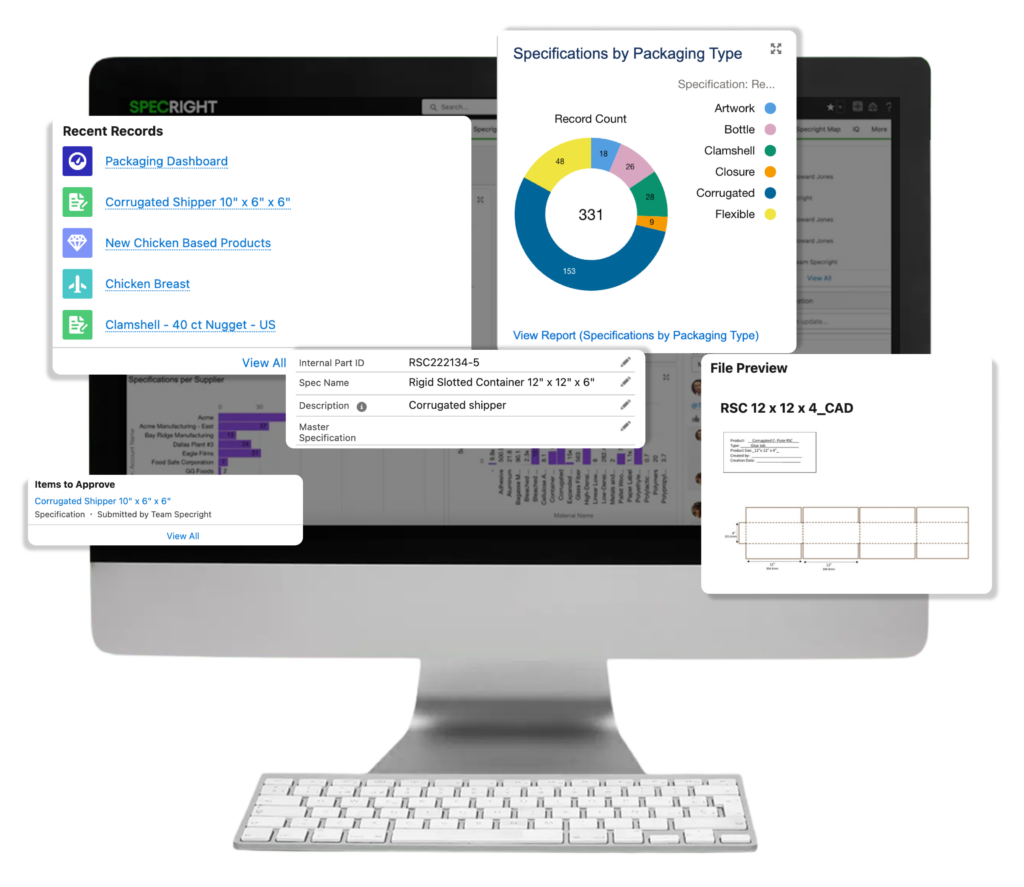
The patented, cloud-based system of record for products, packaging, formulas, ingredients, and bills of materials - all in a single source of truth.
Create, compare, and version specs with full change management and audit history. Everyone reads the same page, and the page remembers who changed what.
Shared workflows so brands and suppliers handle specs, approvals, and changes together in real time - instead of over a chain of attachments.
AI-assisted formula creation reported to run up to 10x faster and cut bench time roughly 60%, plus specification-first PLM for food & beverage.
Backed by Sageview Capital, VMG Catalyst, Pritzker Group Venture Capital, Okapi Venture Capital, Fika Ventures, and Mucker Capital.
Mike Boese named CEO; Matthew Wright transitions to Executive Chairman to keep leading councils and university relations.
Named to Gartner's Cool Vendors in AI and Data Tools for Packaging, recognized for completeness of vision and ability to execute.
New AI and specification-first PLM capabilities for food & beverage, including AI Formulation that compresses bench time.
Announced international growth, expanded leadership, and broader AI-driven capabilities across the product.
For most prospects, the real competitor isn't another vendor. It's a spreadsheet, an email thread, and a shared drive.- The case Specright makes against the status quo
The founder spent 25+ years in packaging before deciding the messiest data on earth deserved its own software category.
Specright's first partner wasn't a tech giant - it was a university: Cal Poly's packaging program.
Wright's book, The Evolution of Products and Packaging, hit Amazon's Hot New Release list.
The company frames product data as "DNA" - every package and formula has a genetic record worth keeping.
New CEO Mike Boese previously led Hearsay and held roles at Oracle, SAP, PeopleSoft, and Taleo.
Same brand manager. Same supplier. Same time zones apart.
But now there is no version 14, because there is no version 11 either. There is one spec, and both of them are looking at it. The label says 12 grams, the line is set to 12, and if someone changes it, the system writes down who, when, and why.
That's the whole trick - unremarkable until you realize how much of the world runs on the gap Specright closed. A package, like an organism, is the sum of thousands of small decisions written down somewhere. Specright just made "somewhere" a place you can actually find.