Arrow Labs and the Software That Finally Reaches the Field
The back office went digital decades ago. The people fixing towers, patrolling ports and repairing pipelines were still carrying clipboards. A Dubai company built MIMS to close that gap - and got Tim Draper to bet on it.
Walk past a construction site, a telecom exchange or a container terminal and you will see two economies running side by side. In one, everything is a dashboard. In the other, a technician holds a clipboard, a two-way radio and a paper form that will get typed into a computer hours later, if at all. Rami Darwish spent two decades in that second economy - securing cities and critical infrastructure - before he decided to build a company for the people inside it. That company is Arrow Labs, and its product is called MIMS.
The premise is almost stubbornly simple. Roughly 80% of the world's workforce - close to 2 billion people - does not sit at a desk. They drive routes, inspect assets, respond to incidents and keep physical things running. For years, enterprise software mostly skipped them. Arrow Labs decided that was the opportunity, not an accident.
That line is worth pausing on, because it is a positioning choice as much as a slogan. Most operations software sells automation as a way to need fewer people. Darwish sells it the other way around: give field workers the same real-time information the office already has, and they become more valuable, not more replaceable. It is a small rhetorical move with a large go-to-market consequence - the buyer and the user stop being adversaries.
01 / THE PRODUCTWhat MIMS actually is
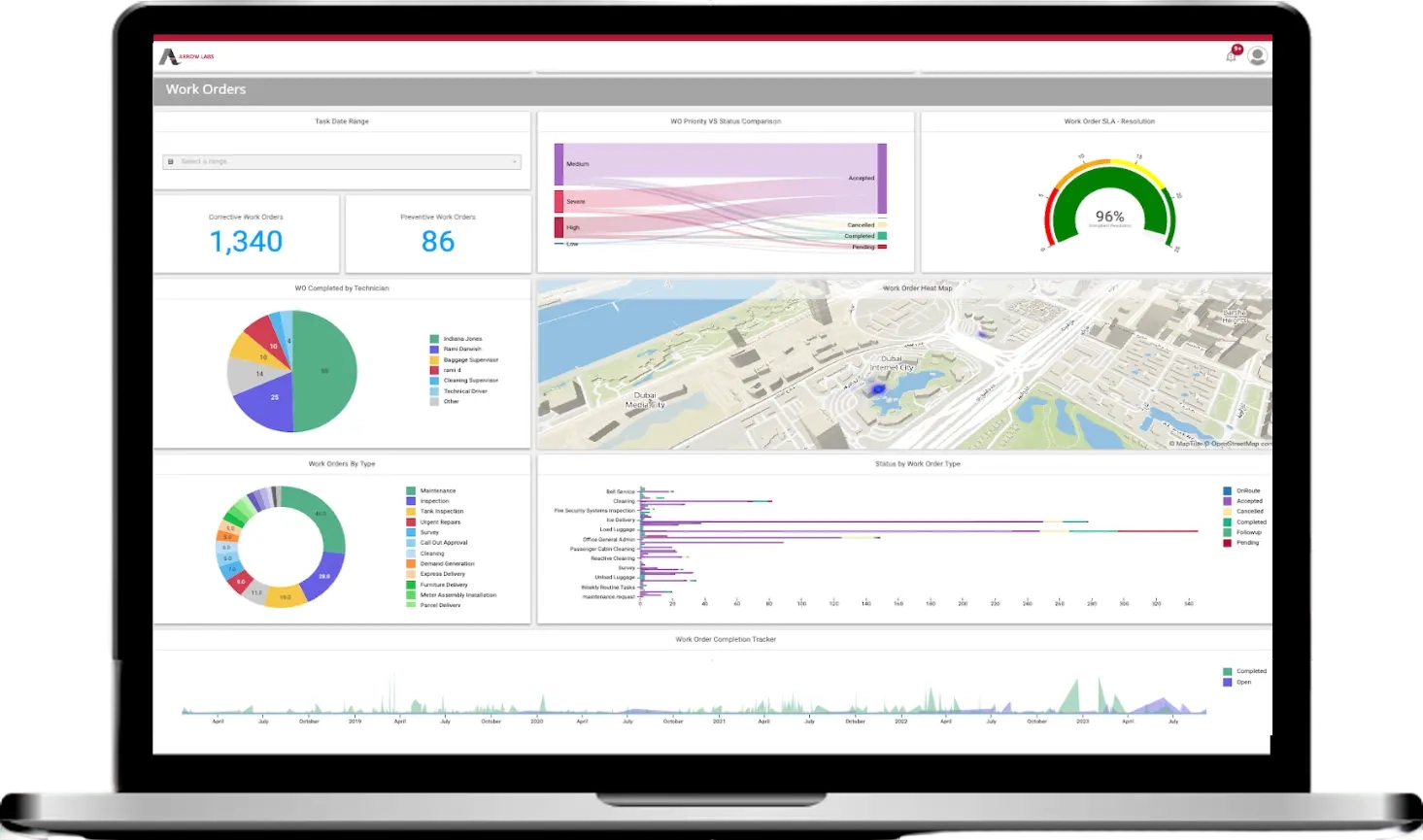
MIMS is an enterprise operations platform. Strip away the category jargon and it does one job: it takes the messy coordination of a distributed field workforce - who goes where, with what, by when, and did it meet the agreement - and puts it on a single system. Workers reach it through a mobile app, a web console, wearable smartwatches and IoT buttons wired to physical assets. The company describes it, plainly, as an "operational co-pilot that turns chaos into clockwork."
The wearable is the detail that tends to stick with people. A field worker on a ladder or in a hazmat suit does not want to fish out a phone. So in 2019 Arrow Labs shipped a MIMS smartwatch that pushes the next task to the wrist. It is a modest piece of hardware with an outsized message: this company actually thinks about what the last 50 feet of an operation feel like.
02 / THE MARKETOne platform, seven industries
Most young software companies are told to pick a vertical and own it. Arrow Labs went the other way, because the pain it targets is horizontal: coordinating people and assets in the field looks structurally similar whether you are running a telecom network, an oil field, a logistics fleet or a security operation. MIMS has been deployed across telecom, oil and gas, utilities, logistics, maintenance, aviation, maritime and safety and security - including a telecom operator serving more than a million homes.
Named customers hint at the range: retailer Hyperpanda, industrial gas company Linde, London property-maintenance firm Essential Repairs, connectivity provider B-Net, and Expo City Dubai. During the COVID-19 lockdowns, Essential Repairs kept its property maintenance running remotely on the platform - the kind of quiet stress test that tells you whether software is actually load-bearing.
Where MIMS shows up
03 / THE MONEYWhy Tim Draper wrote the check
In July 2021, Arrow Labs raised a $5 million Series A led by Draper Associates, with Global Ventures and B&Y Ventures joining. Draper's portfolio reads like an internet history syllabus - Baidu, Hotmail, Skype, Tesla, Twitter - and this was among his earliest bets in the Middle East and North Africa. For a Dubai-founded company selling into unglamorous field operations, a name-brand Valley investor validating the thesis mattered as much as the capital.
The business model is straightforward enterprise SaaS: MIMS is licensed as a subscription, priced by users, modules and deployment size, sold to organizations with large distributed workforces. Third-party trackers put recent annual revenue around $1.8 million on a team of roughly 16 to 18 people - a deliberately lean shape for software running mission-critical work.
04 / THE PATHFrom Dubai outward
Arrow Labs did not follow the usual script of raising in a startup capital and then finding customers. It built where the field problems were, then let the product travel. Below, the short version of how it got here.
05 / THE DIFFERENCEHow it stands apart
Field service software is not an empty field - ServiceMax, Salesforce Field Service, IFS, ServiceTitan and connected-worker tools like Beekeeper all live nearby. Arrow Labs' distinction is less about any single feature and more about where it plants its flag: at the intersection of workforce, assets, incidents and SLAs, reaching workers through mobile, wearables and IoT at once, and built for mission-critical, distributed environments rather than tidy service calls. Add the "saves jobs" framing, and you get a product that operations leaders and frontline crews can both say yes to.
It also earned a bit of home-field recognition: the UAE named Arrow Labs to its Future 100 list, a government program spotlighting companies it considers shapers of the country's economy. For a firm whose product is mostly invisible - it runs in the background of other people's operations - the acknowledgment is a rare moment in the daylight.