The most expensive part of a field-service job can be the blank space around it. A dispatcher has the address. An engineer has the diagnosis. A van tracker knows the journey. The customer has approved extra work in a phone call, and accounts is waiting for a signed sheet that may be folded inside a glovebox. Everybody knows a piece; nobody owns the complete sentence. BigChange made a business from adding the punctuation.
Founded in Leeds in 2013 by Martin Port, BigChange sells cloud software for companies whose work happens somewhere else: at a boiler, drain, security gate, hired digger, roadside asset or chilly car park awaiting grit. Its platform links customer records, quotes, schedules, routes, mobile job cards, photographs, signatures, vehicle data, reports and invoices. The office can dispatch a job; the engineer can update it from a phone or tablet; the customer can receive an ETA and proof of service; the finance team can bill from the same trail.
That description sounds obvious now because a decade of software has trained us to expect connected systems. In the trades, it is still an argument against paper, private text messages, memory and software bought department by department. BigChange’s distinctive move was not inventing every component. It was treating the field-service day as one object.
The second-time founder who charged too little
Port arrived with unusually relevant scar tissue. He had founded vehicle-tracking company Masternaut and sold it before imagining a wider system. Telematics could say where a vehicle was, but location alone could not say why it was there, what the engineer found or whether the work was ready to invoice. His new proposition would join tracking with scheduling, CRM and mobile work.
The first thing to fail was not the technology but the price. Port told Deloitte that BigChange struggled for traction because it had set subscriptions too low and “undervalued our service.” The company moved the monthly charge from £40 to £60. Customers stayed. By 2017, BigChange reported 600 customers and 15,000 users; Deloitte placed it 25th in the UK Technology Fast 50 after four-year growth of 1,095%.
“We set our prices too low at the beginning, and undervalued our service.”Martin Port, on BigChange’s early mistake
The useful lesson is not “raise your price.” It is to locate the expensive consequence. BigChange was not selling a nicer diary. It was selling fewer wasted journeys, less transcription, better evidence and a shorter wait for cash. Once the unit of value became the whole job rather than the software seat, the economics looked different.
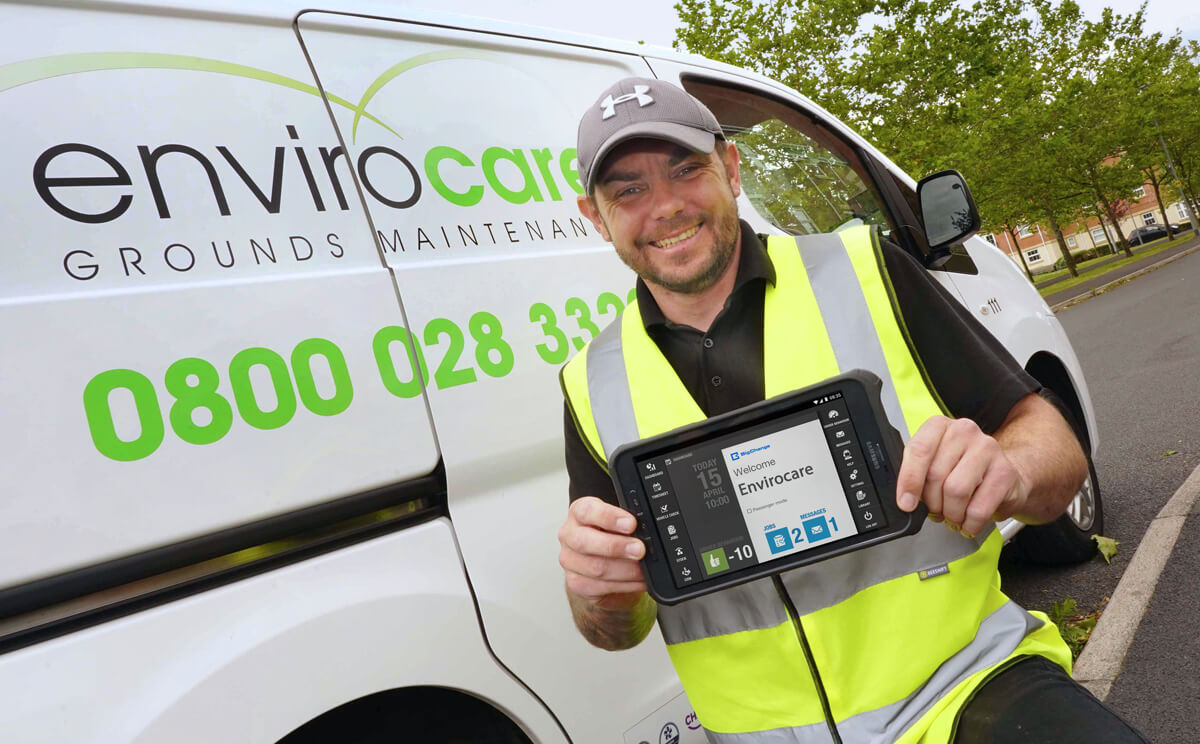
Customers buy fewer loose ends
BigChange’s customer list crosses facilities management, plumbing and HVAC, drainage, waste, electrical contracting, industrial doors, equipment hire, grounds maintenance, fire and security, utilities and transport. The common feature is not the trade. It is coordination: recurring contracts, moving people, moving vehicles, site rules, safety records and a bill that depends on proof.
The public case studies are cheerfully unglamorous. Nixon Hire said JobWatch lifted mobile-workforce productivity by about 20%, increased on-time arrivals by more than 10% and first-attempt completions by more than 5%. HSS Groundcare reported engineer utilisation rising from roughly 50% to 90%, nearly doubling jobs per day. Kiwi Facilities Maintenance said it completed 20% more jobs each week. Saltworks connected Met Office forecasts to its gritting workflow and said the automation saved the equivalent of two administrative roles.
Customer-reported outcomes in BigChange case studies; they describe particular implementations, not a guaranteed result.
The pattern matters more than any percentage. Information captured once keeps moving. A photograph taken on site becomes proof for a customer and support for an invoice. A vehicle’s position informs the scheduler and the ETA message. A job history briefs the next engineer. BigChange’s web platform, mobile app and fleet layer form the core; customer portals, finance connections, reporting, hardware and data services widen the account.
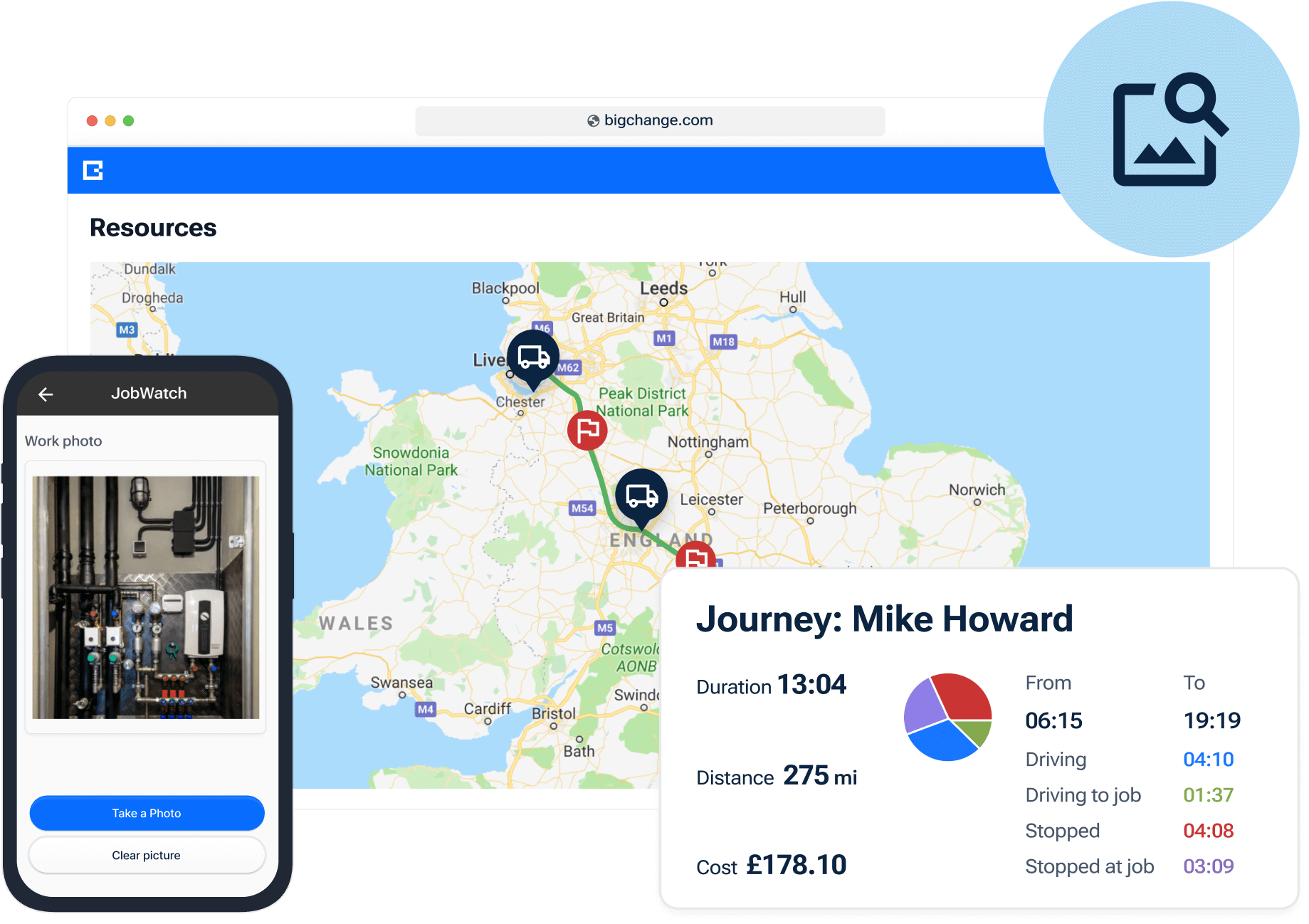
The all-in-one promise - and its price
BigChange competes with Salesforce Field Service, ServiceTitan, Commusoft, Totalmobile, Jobber, Microsoft Dynamics 365 Field Service and a long tail of simpler job-sheet apps. Its pitch is breadth with field-service specificity. Xero, Sage and QuickBooks connections move financial data; its API and data services connect other operational systems; customer-specific forms and workflows accommodate jobs that do not fit a generic template. The advertised 24/7 UK support is part of the product, not a footnote.
The model is recurring B2B software, generally priced per licence, with extras for tracking equipment, connected devices and additional services. BigChange now asks prospects to request pricing. Third-party listings in 2026 put vehicle tracking from £14.95 a month and job management around £79.95 per licence per month, with higher tiers above that. Those numbers are a useful signpost, not a quote.
That makes BigChange easier to justify when the workflow is genuinely complicated. A twelve-van maintenance company can spread the subscription across dispatch, compliance, fuel, customer service and billing. A sole trader who needs a calendar and three job-sheet fields may be paying for an aircraft cockpit to visit the next street. The platform also depends on disciplined setup: untidy customer records, vague job statuses and optional field completion produce connected untidiness.
The copyable part is sequencing
Map the full job before buying the tool. Identify every handoff, decide which evidence must be captured once, connect the financial system, then make the digital record easier to trust than the side-channel. HSS Groundcare said some engineers resisted JobWatch at first - and later refused jobs that were not in it. Adoption turned when the system became the dependable way to work.
Two deals, then an intelligence layer
In February 2021, Great Hill Partners invested £75 million in BigChange at a reported £100 million valuation. Port moved from chief executive to chairman, and the capital was intended to accelerate product development and international growth. The transaction also confirmed how far the company had travelled from its underpriced opening offer.
Great Hill Partners’ 2021 growth investment, at a reported BigChange valuation of £100 million.
Simpro Group acquired BigChange for an undisclosed sum in October 2024. The fit was plain: Simpro wanted greater depth in vehicle tracking, CRM, advanced scheduling and mobile-workforce management, while BigChange gained a home beside Simpro, AroFlo and ClockShark. K1 Investment Management backs the group. BigChange remains a customer-facing brand, now inside a larger field-service software portfolio.
Port starts BigChange around an all-in-one mobile-workforce idea.
Deloitte records 1,095% four-year growth and a Fast 50 place.
JobWatch receives a Queen’s Award for Enterprise: Innovation.
Great Hill invests £75 million; reported valuation reaches £100 million.
Simpro Group acquires BigChange.
Lightning adds AI agents to the accumulated operational record.
First connect the work. Then ask it questions
BigChange’s 2026 release, Lightning, places an AI layer over customer job data. The central assistant is called Cooper. JobReady prepares technicians with site history and likely requirements. JobScribe turns spoken descriptions into structured documentation. FieldReady creates training around a company’s procedures. JobBrief drafts customer-facing summaries. JustAsk is the natural-language doorway into reporting.
There is a sensible idea under the theatrical weather system of names: AI is more useful after the business has a reliable operational memory. A generic chatbot can write a pleasant paragraph. It cannot know that the previous visit found a failing pump, that the client requires a particular access form and that a compatible part is already assigned to a nearby van unless those facts have been captured and connected.
BigChange advertised Lightning at approximately £2,000 a year and positioned it as a way to supply operational capacity that smaller businesses cannot hire. Those productivity and margin claims deserve to be tested in live accounts. In August 2026, parent Simpro Group said the next shared phase, THUNDER, would be revealed in London on September 22. The language is new; the wager is the same one Port made in 2013. A field-service company performs better when the story of its work survives every handoff.
A platform for companies with somewhere to go
BigChange is best understood as an operating platform for the middle of the market: businesses large enough to feel the friction between sales, dispatch, field teams, fleet, compliance and accounts, but not necessarily large enough to build a custom system. Its approximately 250-person team, 24/7 support, implementation resources and trade-specific workflows are part of that positioning. So are its customer portals and multi-site records, which make the buyer’s buyer visible.
Its mission is stated as making customers successful; its broader purpose speaks of growth and sustainability in its community. The culture language has evolved since the acquisition, from five “Big on” values to group-wide ideas including accountability, teamwork and customer focus. The most revealing cultural habit may be the Product Portal launched in 2025, where customers can submit ideas and follow their progress. For software that asks people to replace familiar workarounds, visible listening is not decoration.
The result is a company with an unusually concrete theory of digital transformation. Do not begin with transformation. Begin with the missed ETA, the duplicated address, the photograph no one can find and the invoice waiting for a signature. Put them in order. Give everybody the same record. BigChange’s story is what happens when the humble job sheet is allowed to remember the entire day.