At 7:12 on a wet Monday morning, a tree-service office can already resemble air-traffic control. A homeowner has sent a photo of a cracked limb. An estimator is driving across town. One crew needs a chipper; another needs a gate code. Yesterday's job is finished but not invoiced. The owner wants to know which lead source is working, and everyone wants the answer before the next phone call.
ArboStar sells a single place to put that disorder. The Toronto software company has spent more than a decade building a business-management platform specifically for arborists and tree-care operators. It combines the familiar machinery of a CRM with estimating, scheduling, route planning, work orders, equipment records, employee management, accounting, payments and reporting. The product works in a browser and on mobile devices, including core field workflows designed for patchy connectivity.
The phrase “all in one” is abused in software. Here it describes a practical ambition: keep the job intact as it moves from an office conversation to a tree on a map, then to a crew's phone and, eventually, a paid invoice. A generic CRM can remember a homeowner. ArboStar can remember the seventh oak on that homeowner's property, the work quoted against it, the photographs a crew filed and what was done last spring.
One job, five handoffs
A database with bark on it
ArboStar's most revealing feature is not its dashboard. It is Tree Inventory. Each tree can exist as a permanent, mapped record connected to estimates, jobs, invoices and field reports. A crew can see which tree receives which service; completed work changes state on the map; the customer portal can show the same trees attached to a document. Before finishing a job, workers can be required to submit notes and photographs for every service.
That sounds fussy until next season, when an estimator needs to know what happened at the property. The record is no longer a blurry photo in somebody's text thread. It is an operating history. This is the central trick of strong vertical software: model the physical thing around which the industry already organizes itself. For a dental platform, it may be the tooth. For auto software, the vehicle. For ArboStar, it is the tree.
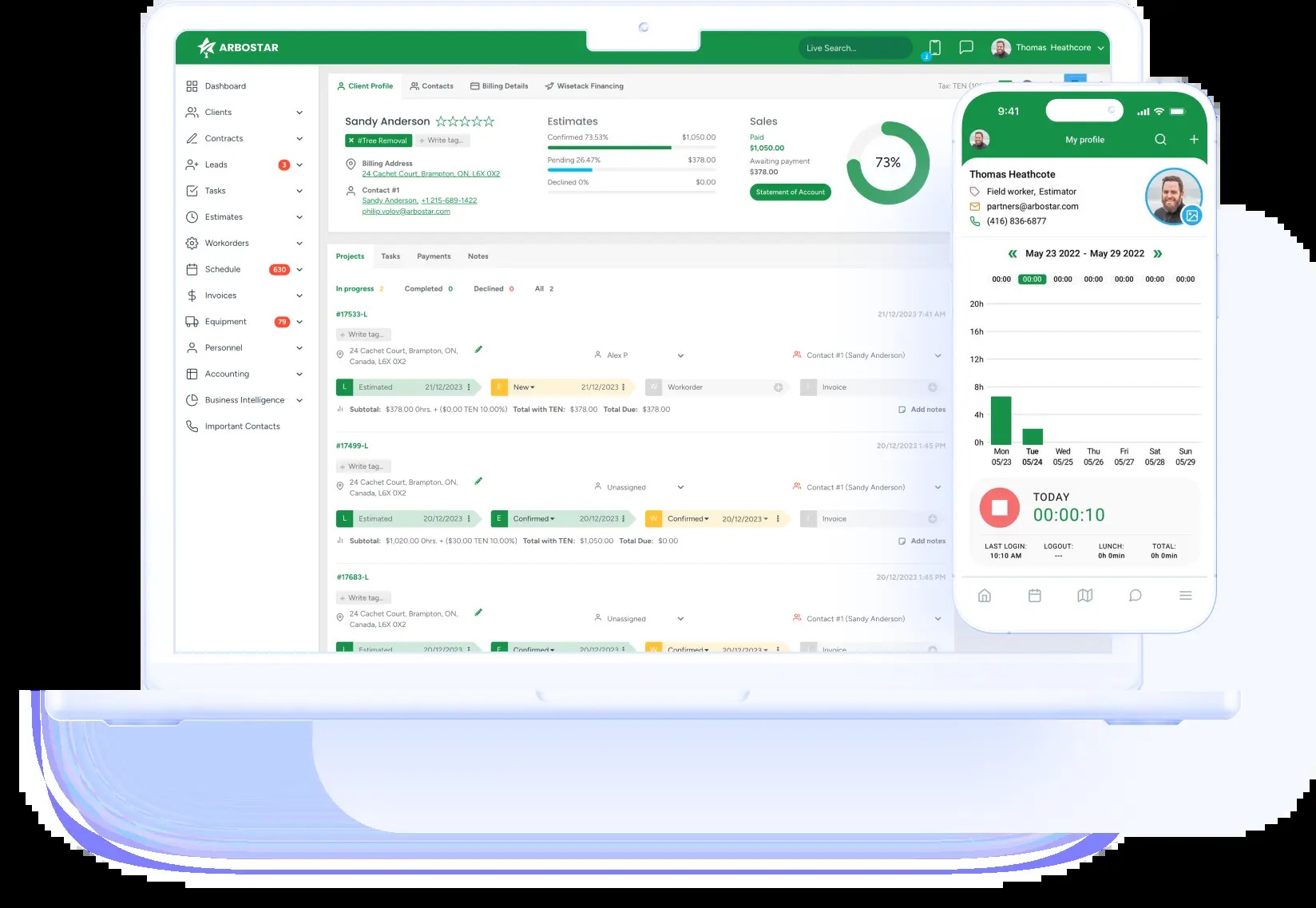
The product follows from that data model. An estimator can create and send a quote from a phone, use a calculator to price a service, attach voice notes or video and convert an accepted estimate into work. Schedulers can see crews and jobs on maps, optimize routes and guard against double-booking. Managers can track equipment, labor and marketing performance. Invoices can synchronize with QuickBooks, Xero, Sage or Fortnox, while Wisetack financing appears inside eligible U.S. customer estimates.
“In a single year I might engage with about 2,000 existing and prospective tree-care clients, and I want to make each of them feel important.”Shane L. · Customer review published by ArboStar
What failed first was the handoff
ArboStar does not publish a neat garage-origin myth, a founder's first invoice or the amount it cost to write version one. Its own history is more useful because it is less cinematic. The company says arborists built a wishlist after observing that available systems handled only slices of the business. Customers had to integrate products, move between interfaces and reconstruct the full picture from separate sources.
Public reviews show the failure sequence in the wild. One tree-company manager described moving from pen and paper to Google spreadsheets, then ArborGold, before growth exposed missing features. The company spent about a year watching field-management demos before switching. Other reviewers praise ArboStar's depth but admit that the number of functions takes time to absorb. That is the honest bargain: replace coordination debt with software that must itself be learned.
The cost is similarly contextual. ArboStar's official site now quotes plans around licenses and requirements, offers volume discounts and gives two months free for annual billing. G2 publicly lists a Basic starting point of US$200 for one user per month. Implementation and data migration matter as much as the sticker price because a tree company is not buying a blank login. It is rebuilding the way leads, services, crews and money move.
The vertical SaaS playbook to steal
ArboStar competes with tree-specific products including SingleOps, ArborNote and Arborgold; broad field-service systems such as Jobber, ServiceTitan and Aspire; and the stubbornly effective bundle of paper, spreadsheets, calendars and accounting software. Its distinction is breadth tied to a narrow market. Equipment is not generic inventory. Offline mode is not a convenience. Route planning is not just dots on a map. Each feature bends toward the conditions of tree work.
That specificity creates an accumulation effect. Once a company stores clients, trees, prices, service history, crew time, equipment, photos and invoices in one system, the next module has better context. Business intelligence can compare estimates with completed work. Marketing reports can connect lead sources to sold jobs. A service reminder can be based on what actually happened to a tree. The platform becomes more useful because the records touch.
Four things another founder can copy
- Choose an industry where handoffs are frequent and mistakes are expensive.
- Make the industry's physical object a first-class record, not a custom field.
- Win the field worker with offline access and fewer taps, then win the manager with connected reporting.
- Treat migration, configuration and training as product features. Switching is the sale.
The business model is conventional B2B SaaS: subscriptions sold monthly or annually, generally priced through sales by licenses, modules and requirements. The go-to-market is less conventional in its intimacy with the trade. ArboStar publishes safety and business education, attends arborist events, offers referral rewards and emphasizes support. Its stated values are innovation, customer-centricity and integrity; reviewers most often make the culture tangible by describing responsive support and feature requests that later appear in the product.
Now put an AI in the bucket truck
ArboStar's next act is RAI, a beta collection of assistants for reception, scheduling, estimates, marketing, safety, HR and equipment. The logic is stronger than stapling a chat window to a dashboard. A receptionist assistant can collect a caller's photos and details. A scheduler can weigh traffic, job duration and equipment. An estimator can draft a proposal from field images. An equipment assistant can flag a chipper nearing its maintenance threshold.
The company says actions can be permissioned to suggest, request approval or run automatically, with logs and rollback during beta. Those controls matter. A cheerful AI error in a poem is forgettable; an error involving a hazardous tree, a crew's certification or a five-figure estimate is operational. RAI will earn trust only when it improves the real record underneath, shows its work and knows when to wait for a human.
The moat is not “AI for arborists.” It is the connected history the AI can safely reason over.
When the pitch does not work
ArboStar is not the automatic answer for every person with a chainsaw and a truck. A solo operator with a small, stable book of work may reasonably prefer a cheap scheduler and accounting app. A landscaping company whose core operations are recurring mowing routes rather than tree assets may fit another platform better. A team unwilling to standardize services, clean its data or train field workers will simply pour old confusion into a newer database.
Good fit
Several crews, growing lead volume, expensive equipment, repeat properties and painful office-to-field handoffs.
Weak fit
Very simple jobs, little appetite for setup, no process owner or a business that needs only one narrow tool.
Nor does all-in-one eliminate tradeoffs. Feature breadth can produce screens that take time to learn. Customization can preserve bad processes as easily as good ones. Route optimization cannot rescue a day when a removal runs four hours long. Software can make the handoff visible; management still has to decide what happens next.
Yet ArboStar's market position makes sense because tree care contains so many costly seams. A missed lead wastes demand. A vague work order wastes crew time. A forgotten tool stops a job. An invoice created days later slows cash. The company has spent more than a decade turning those seams into adjacent modules. The result is not glamorous software. It is a control room for people whose actual office may be a cab, a driveway or forty feet above the ground.