There is a small logistical miracle behind every portable toilet that appears beside a construction site on Monday and disappears after the job. Somebody sold the rental, found an available unit, chose a driver, sequenced a route, recorded the service, sent an invoice and remembered to collect it. When that operation runs on paper, spreadsheets and phone calls, the miracle gets expensive. ServiceCore sells the alternative: one cloud system built around the peculiar rhythm of portable sanitation, septic pumping, grease hauling and roll-off dumpsters.
This is vertical software in its purest form. The Denver company does not pretend that a plumber, a waste hauler and a portable-restroom operator all have the same day. It models the awkward details: recurring 28-day billing, units that move between yards and job sites, drivers who need proof-of-service photos, and septic routes that depend on truck capacity and dump stops. That specificity is the product and the defense.
01 / The failure
The morning the invoice shrank
Elite Sanitation Services offers the cleanest explanation of what ServiceCore actually changes. Its old system failed first at the handoffs. Route sheets were printed. Dumpster and septic work lived on separate orders. A change during the day meant stopping a driver, making a call and manually figuring out where the new job belonged. Billing consumed at least one or two hours every day, and invoices did not always arrive. The company was chasing customers for money while still untangling the schedule.
ServiceCore pulled those steps into a single loop. Dispatchers changed a job on the computer; it appeared in the driver's app. The office optimized routes, batch-sent bills and put more customers on autopay. Melissa Pedro of Elite said the billing run fell to about five minutes each morning. Drivers returned earlier, the gas bill declined and collections became less awkward. Those are customer-reported results, not controlled experiments, but they show the buying logic with unusual clarity.
I do my billing in about five minutes in the morning.Melissa Pedro, Elite Sanitation Services
Price had been the objection. Pedro described ServiceCore as one of the more expensive options. What changed her mind was not a discount; it was the disappearance of collection work, plus savings in fuel and driver time. That is the company's most useful sales lesson: premium software earns its keep when the customer can point to a hated task that vanishes and cash that arrives sooner.

02 / The machine
A system of record for gross logistics
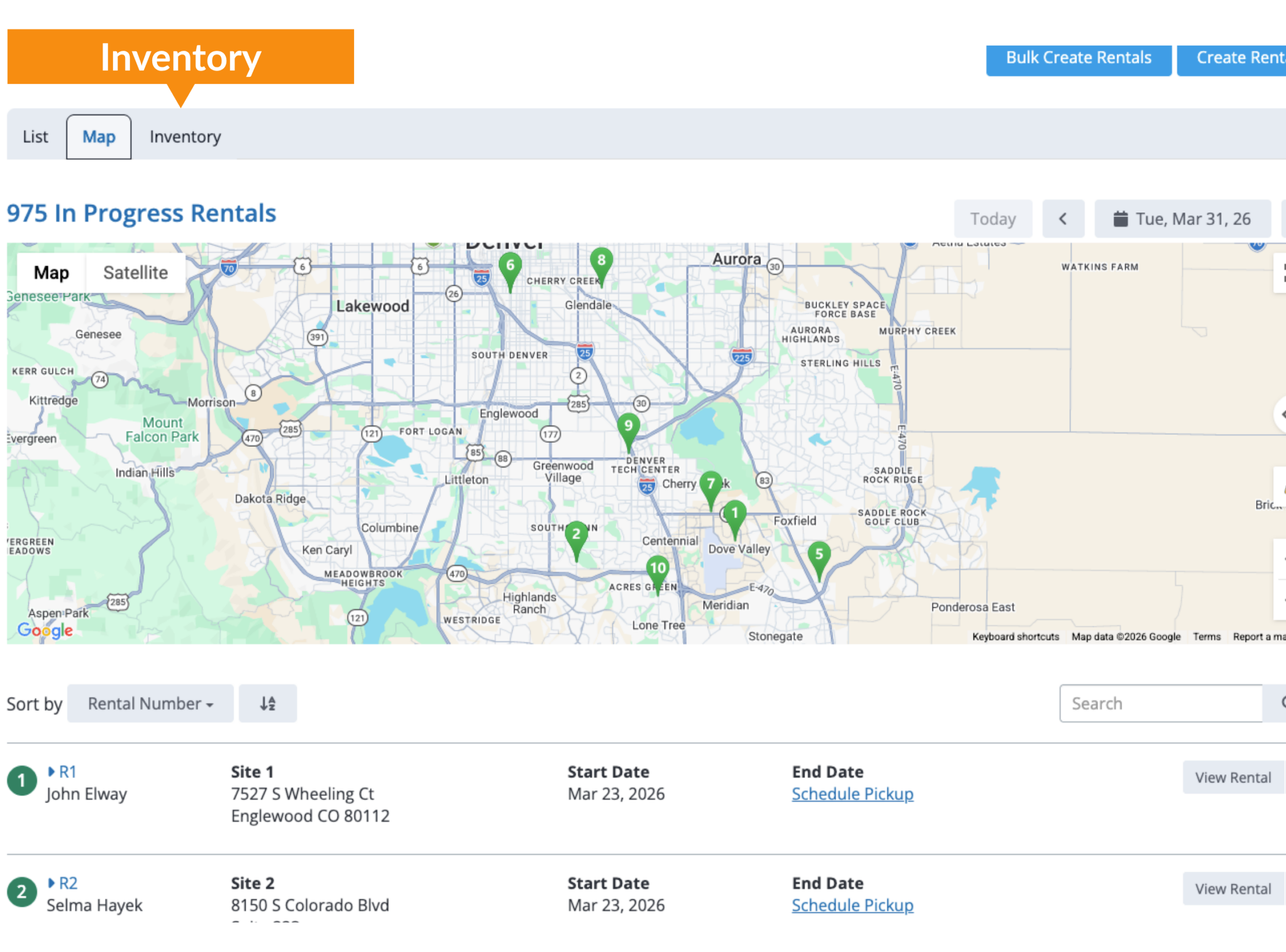
The product follows a job from the first customer call to the bank. Customer records hold sites, rates, taxes and service history. Dispatchers drag work onto a schedule, see it by day, week, list or map, then optimize for fastest time or shortest mileage. The mobile app gives drivers directions and job detail, while sending statuses, notes, signatures and photos back to the office. Inventory connects the physical unit to its yard, rental and future availability. Billing turns completed work into recurring invoices, card charges and accounting entries.
The route optimizer considers travel time, service duration, access windows, endpoints and typical traffic. The inventory model can be bulk, useful for a pile of interchangeable standard toilets, or serialized with a barcode or QR code for an exact dumpster or restroom trailer. Pro Reports then asks sharper management questions: Which routes are profitable per mile? Which customers are underpriced? Is equipment sitting idle? Which driver finishes the work?
03 / The wedge
Generic field service misses the toilet
A general field-service tool can schedule a technician and issue an invoice. It does not naturally understand portable inventory, a 28-day rental cycle, gallons pumped, manifests, disposal runs or the difference between delivering and servicing the same unit. Legacy sanitation systems understand more of the vocabulary but can separate routing from billing or carry desktop-era friction. ServiceCore's bet is that operators will pay for both vertical depth and a modern interface.
The competitive field now includes Summit, CRO, PumpDocket, Routeware, PJR and Basestation, with Jobber, Housecall Pro and ServiceTitan appearing when buyers start from generic software. ServiceCore's bundle is the argument: native driver app, live inventory map, recurring billing, customer portal, payments and QuickBooks sync. Docket, acquired in 2023, gives the company a more explicit product foothold in dumpster rental. A 2025 alliance with equipment maker Satellite Industries points in the other direction - toward sensors that could feed field-equipment data directly into the system.
04 / The economics
The truck is the subscription
ServiceCore prices primarily by truck and includes additional office seats. That choice reveals how the company sees its market: the revenue-producing route, not the desk worker, is the customer's economic unit. Contracts are annual, exact quotes require a demo, and implementation costs extra. Capterra listed a starting price of $200 per month in August 2026, but an operator's real bill depends on fleet and setup. Digital marketing packages add another service line. ServiceCorePAY adds payments economics while promising rates below what some customers pay elsewhere.
The model attracted growth capital. Full In Partners invested in 2019. In February 2022, Mainsail Partners put $54 million into a recapitalization that bought out Full In and added money to the balance sheet for product development and customer success. ServiceCore has since appeared on the Inc. 5000 four years running; the 2026 listing reported 472 percent three-year growth. Its LinkedIn footprint shows roughly 160 employees, and the company moved into a 14,794-square-foot Denver headquarters planned around hybrid work.
The origin is less tidy than the usual garage myth. Clear Computing had served septic operators since 1989. In 2017, waste-software company 1bg acquired it and formed ServiceCore, then set about moving customers to a new SaaS platform. John Gadeken and Ori Staub are identified as co-founders; Jonah Chilton, who joined after moving to Denver in 2019, now leads the company as CEO. In other words, ServiceCore did not discover a nonexistent market. It modernized one with 27 years of proof.
05 / The human layer
The operators teaching the software
ServiceCore's most defensible feature may sit outside the codebase. The company hires former operators for implementation and support. They know what it means to drive a truck when somebody calls out, to beg a yard manager for an available unit, or to postpone billing because the route sheet is not reconciled. For a customer migrating years of records while the trucks keep rolling, that fluency lowers the emotional cost of switching.
Elite's Pedro said that speaking the same language moved her onboarding anxiety from a 10 to a two. Jons To Go compared the training to family walking through each step. That matters because the product only works when the business changes its habits: records must be migrated, routes configured, drivers trained, cards collected and work completed in the app. Software cannot centralize a process its users continue to run on paper.
If I can get people home to their families a few hours earlier while adding more dollars to the bottom line, I'm a happy camper.Jonah Chilton, CEO
The same operator-first posture shapes a culture that is unusually blunt for B2B software. Its published values include “Love Our Customers,” “Be Real,” “Deliver Results,” “Keep It Fun” and, yes, “Give A Shit.” Every employee participates in an equity appreciation program, according to the company. A 2024 office announcement put its employee Net Promoter Score above 70. The language is playful; the underlying point is serious. Niche customers can tell instantly when the software company has never seen the job.
06 / The copyable bit
Start with the hated hour
The transferable lesson is not “build software for toilets.” It is to map the complete handoff that makes a niche business leak time or money, then choose a result the customer can measure before lunch. ServiceCore's most credible proof is five-minute billing, fewer missed services and drivers home earlier. Founders hunting for a vertical can copy the method; operators evaluating the product can use the same sequence.
- Name the first failure. Is it missed service, route planning, lost inventory, late invoices or collections? Pick one baseline and time it.
- Clean the operating data. Customer sites need valid coordinates, jobs need durations, inventory needs owners and recurring work needs consistent rules.
- Move the full handoff. Booking without driver adoption, or routing without billing, preserves the swivel-chair work the platform is meant to remove.
- Make autopay and proof routine. Cards on file improve collections; notes, photos and signatures reduce disputes and office calls.
- Review the economics after 30 days. Track billing minutes, fuel, overtime, missed stops, days to payment and revenue per route against the old baseline.
It will not pencil out everywhere. A one-truck operator with simple, low-volume work may get enough from a cheaper scheduler and QuickBooks. A company unwilling to standardize job data will feed the optimizer bad inputs. Fleets that require commercial-vehicle restriction routing need another safety layer. Buyers should also price the annual commitment, implementation and payment terms against measurable savings. The honest comparison is not feature count. It is the cost of the current mess versus the cost of changing it.
For the right operator, ServiceCore becomes the quiet system behind a very visible object. The toilet arrives. The driver knows where to go. The office knows what happened. The customer gets the bill. That sounds ordinary, which is the point: good vertical software turns the small daily miracle back into a routine.
Explore the company