The pool technician is already late. There are twelve backyards left, one filter making a noise it did not make last week, and a homeowner who would like photographic proof that someone actually came. On paper, this is a cleaning route. In practice, it is a moving chain of chemistry, logistics, customer service and accounts receivable. Lose one reading or forget one invoice and a tidy blue rectangle becomes a messy little business problem.
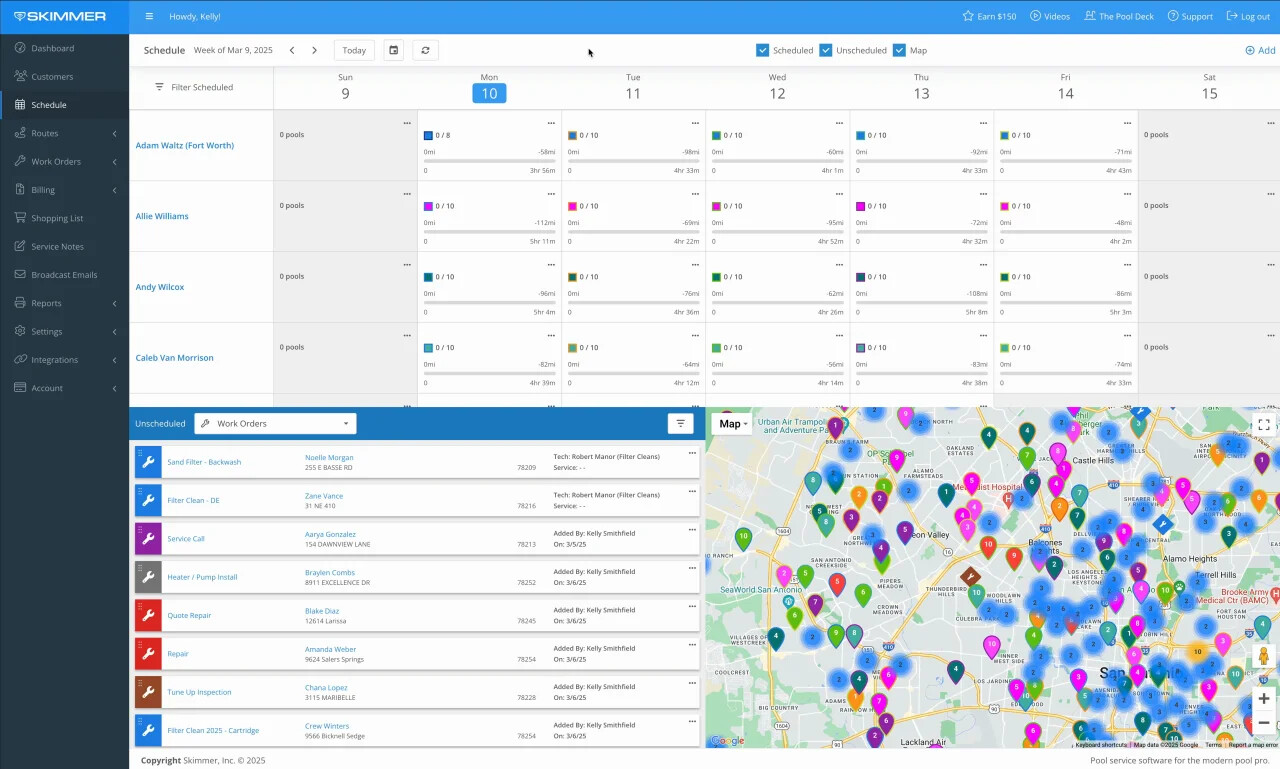
Skimmer was built for that mess. Its web and mobile software organizes customers, routes, technicians and work orders; records water readings, chemical doses and photos; sends service reports; turns completed work into invoices; and collects card or bank payments. The company says more than 35,000 pool professionals now use it to service over one million pools in North America. This is unshowy infrastructure for an industry that spends its day in the sun.
The first thing to fail was the clipboard
The origin is almost suspiciously on-theme. In Phoenix, software engineer Ronny Hash teamed up with a pool professional buried in paperwork. Hash did ride-alongs. He watched the stops happen. The first Skimmer version launched in 2017 with feedback from the people who would tap it beside a pump, not from executives imagining field work in an air-conditioned conference room.
That observation supplied the product’s useful vocabulary. Generic field-service software knows jobs, customers and calendars. Skimmer knows bodies of water, saturation index, readings and dosages. It knows that one address may contain a pool, spa and fountain. It knows that a technician needs to work offline, that chemicals may be included in a monthly rate or itemized, and that the homeowner wants an email before wet footprints have dried.
- Route sends the technician
- Readings and doses get logged
- Photos prove the visit
- Report reaches the customer
- Work becomes an invoice
A service report that behaves like a receipt
Skimmer’s sharpest feature is not flashy. It is the completed service report. A technician records what the water looked like, what was added and what needs attention. The customer receives a branded account of the visit. The office gets a timestamped history. A complaint that once began with “Were you even here?” now meets a photo and a chemical log.
This is where operations and reputation meet. The same stop can update inventory needs, flag an issue, trigger a recurring work order and flow into billing. Skimmer says its customers can save more than 20 hours a month and drive roughly 200 fewer miles using optimization tools. Those are company claims, not universal outcomes, but the mechanism is plain: denser routes and less re-entry mean fewer paid minutes disappear between pools.
“Our purpose at Skimmer has always been to help our customers build great businesses.”Jack Nelson · Chief executive
The first outside inflection came from another delightfully mundane encounter. In 2020, investor Pete Freeland discovered Skimmer through his own pool professional. He and Jack Nelson joined forces around the business, and Unbundled Capital backed its expansion. A $5 million follow-on arrived in early 2022. By October 2024, Mainsail Partners put in $74 million of growth capital, joining Freeland and Shane Skiffington on the board.
What changed minds was not a theory about “digitizing the trades.” It was evidence that a specific professional already trusted the product with the day. In April 2021, Skimmer reported 2,100 pool-service businesses and said that count had roughly doubled in twelve months. By 2024 it cited 30,000 users. In 2026, it reached No. 615 on the Inc. 5000 after reporting 561 percent revenue growth over three years, its fourth straight appearance on the list.
The $49 question
Skimmer does not charge by employee. It charges by serviced location, while technicians and administrators are unlimited. The Getting Started tier begins at $49 a month for up to 49 serviced locations, then costs $1 for each additional location worked that month. Scaling Up starts at $98 for the same initial 49, then charges $2 per additional serviced location. Enterprise pricing is negotiated.
Monthly minimum · 49 serviced locations included · $1 for each additional location
Monthly minimum · 49 included · $2 each after that · route optimization included
The model follows customer activity, which is elegant for a seasonal business. Visiting the same pool ten times does not multiply the fee. A dormant customer does not count. But the arithmetic changes with scale. A 500-pool company on Scaling Up lands near $1,000 a month before add-ons, and route optimization, recurring work orders, quotes and required checklists sit above the entry plan. A solo operator who needs only a calendar may find a flat-priced competitor or even a careful spreadsheet cheaper.
Payments add a second engine. Skimmer Billing creates invoices from service, repairs, parts and dosages, supports AutoPay and synchronizes with QuickBooks Online. Published processing rates are 2.9 percent plus 25 cents for cards, with another 0.5 percent for keyed or recurring charges, and 1 percent plus 25 cents for ACH, capped at $10. Skimmer says its platform processes more than $500 million in annual payments. Once money travels through the same system as work, the route app becomes financial infrastructure.
From the deep end to the whole backyard
The $74 million has widened the product map. In February 2026, a Heritage Pool Supply integration began syncing frequently purchased products and costs. By July, pool professionals could move from an approved quote to a direct Heritage order without leaving Skimmer, with live pricing and order status tied to the job. That matters because a wrong pump price is not a software annoyance. It is a margin leak attached to a truck roll.
In August, Skimmer and Stripe added working capital for eligible U.S. payment customers. Offers depend partly on payment volume and history; approved funds may arrive in one or two business days, then repayment tracks daily sales. This is useful when the constraint is a truck, inventory or another technician. It is less useful for a business unwilling to process substantial volume through Skimmer, because eligibility and repayment live inside that payments relationship.
Then came the bigger strategic turn. On August 24, Skimmer acquired Pool Builder Geek and Poologics. The former brings AI-centered visualization and construction project tools; the latter brings an established system for CRM, estimates, projects and job costing. Pool Builder Geek founder Tommy Reynolds joined to lead construction strategy. Terms were not disclosed.
“Pool builders do not need generic contracting software with a pool label added to it.”Tommy Reynolds · Pool Builder Geek founder
The line doubles as Skimmer’s competitive thesis. Pool Brain, Paythepoolman, Pool Office Manager, POOL360 PoolService and Pool Service Software fight for the same specialists. Jobber and ServiceTitan offer broader field-service machinery. Skimmer’s defense is depth: chemical math, proof-of-service, live support and now a connected path from quote to distributor. Its ambition is to follow a pool from backyard visualization and permitting to every filter clean that follows.

The market is growing up in wet shoes
Skimmer has also made itself an industry observer. Its 2026 State of Pool Service report combined responses from more than 1,600 professionals with activity from its own user base. The picture was optimistic but practical: 84 percent expected revenue growth, 61 percent planned to find internal efficiencies, and 62 percent called qualified-technician hiring their top challenge. Meanwhile, 63 percent expected homeowners to demand digital communication and photo or video reports.
That is fertile ground for Skimmer, with conditions. The model works best when routes repeat, field records matter, owners want professional customer communication, and billing volume justifies a unified system. It is weaker when a business spans many unrelated trades, needs unusual enterprise customization, operates on razor-thin per-location margins or refuses to put payments and customer history inside one vendor. Software can compress a good process. It cannot repair chaotic pricing or make scarce technicians appear.
What another vertical-software founder can copy
- Ride with the worker until the industry’s odd nouns become product fields.
- Choose a unit of pricing that customers already count. For Skimmer, it is the serviced location.
- Turn proof-of-work into the bridge between operations, customer trust and billing.
- Add financial products only after the core workflow generates reliable transaction data.
- Expand along the customer’s job, not a fashionable feature list: service, repair, parts, financing, then construction.
There is a neat symmetry to Skimmer’s story. It began by removing paper from a truck. Now it wants to connect the person who designs the pool, the distributor who supplies the equipment, the technician who balances the water and the homeowner who pays the bill. That is a large wager on a narrow industry, which is precisely the point. The best vertical software does not make the work look less peculiar. It notices every peculiar detail and gives it somewhere useful to go.