The quickest route into Matt Aiello’s professional world runs through a portable toilet. This is less a joke than a useful correction. The object that a passerby ignores is, for an operator, a moving unit of inventory. It must be delivered, serviced, photographed, collected and billed. Somebody has to know where it is. Somebody else has to fit it into a driver’s day. A locked gate or an absent employee can rearrange the entire board before breakfast.
Aiello is the chief marketing officer of ServiceCore, the software company that tries to make that board manageable. Its customers work in portable sanitation, septic service, grease collection and roll-off dumpsters. These are trades with physical assets, recurring routes and very little patience for airy language. Aiello’s task is to explain software to people whose judgment is formed in yards, trucks, job sites and billing offices. The vocabulary is wonderfully concrete: dump points, disposal fees, service photos, cards on file, units per driver.
On LinkedIn, he compresses his specialty into a clean sentence: “I build marketing functions inside PE-backed software companies.” The line is accurate, but it hides the texture. Building the function means learning what happens when the day goes sideways, finding the numbers that help an owner compare notes, and giving customers enough room to describe the work in their own language.
A career that kept moving closer to the job
Aiello’s résumé begins in 2001 with a marketing role at Active Communications - AT&T, followed by digital marketing at Linda Costa Communications Group. He then spent more than five years directing marketing communications for Marini SkinSolutions and moved to Sciton, a maker of laser and light systems, as global director of marketing communications and events.
The next turn was toward advocacy and policy. From 2013 to 2017, he held a senior marketing role at the organization now known as Advanced Energy United. Then came Customer Lobby and EverCommerce, where local service businesses became the subject. At EverCommerce, he led marketing across a portfolio of software companies serving blue-collar trades. By the time he joined ServiceCore in 2022, the pattern was visible: his work had migrated from communicating around products to understanding the operations around them.
The timing mattered. ServiceCore had announced a $54 million investment intended to accelerate its product roadmap, expand its team and support a growing customer base. The company then acquired Docket, extending its reach in roll-off dumpster software. Aiello celebrated the combination publicly, pointing to a shared offering across portable sanitation, septic and grease, and roll-off businesses. The corporate phrase for this is an expanded addressable market. The human version is harder: more kinds of operators with more kinds of days to understand.
“We hire good folks from the industry that have walked in PRO’s shoes.”Matt Aiello on ServiceCore’s industry focus
The dignity of the operational detail
Vertical software earns its adjective by refusing to be universal. ServiceCore is not trying to solve every office’s problems. It is built around the peculiar choreography of jobs, routes, payments and inventory in waste and sanitation. Aiello has described the product in the same sequence an operator might experience it: cut wasted time, manage jobs, optimize routes, track inventory, automate billing.
He also knows that the value of a feature is usually hiding in an inconvenience. Route optimization sounds clinical until fuel rises and overtime follows. Inventory tracking sounds administrative until a company overbooks its units. Automated billing sounds modest until staff spend hours producing invoices by hand. Real-time driver visibility matters when a site contact wants an answer now. The software story becomes credible only when each noun has a bad afternoon attached to it.
One working day, four places for friction
That attention also explains a line Aiello uses when discussing ease of use. ServiceCore can concentrate on the workflows of portable sanitation because it does not attempt to become a one-size-fits-most system. It is a competitive argument, certainly. It is also a philosophy of observation. Specific customers produce specific software, and specific software gives a marketer something sturdier than slogans.
ToiletTalk, with the emphasis on talk
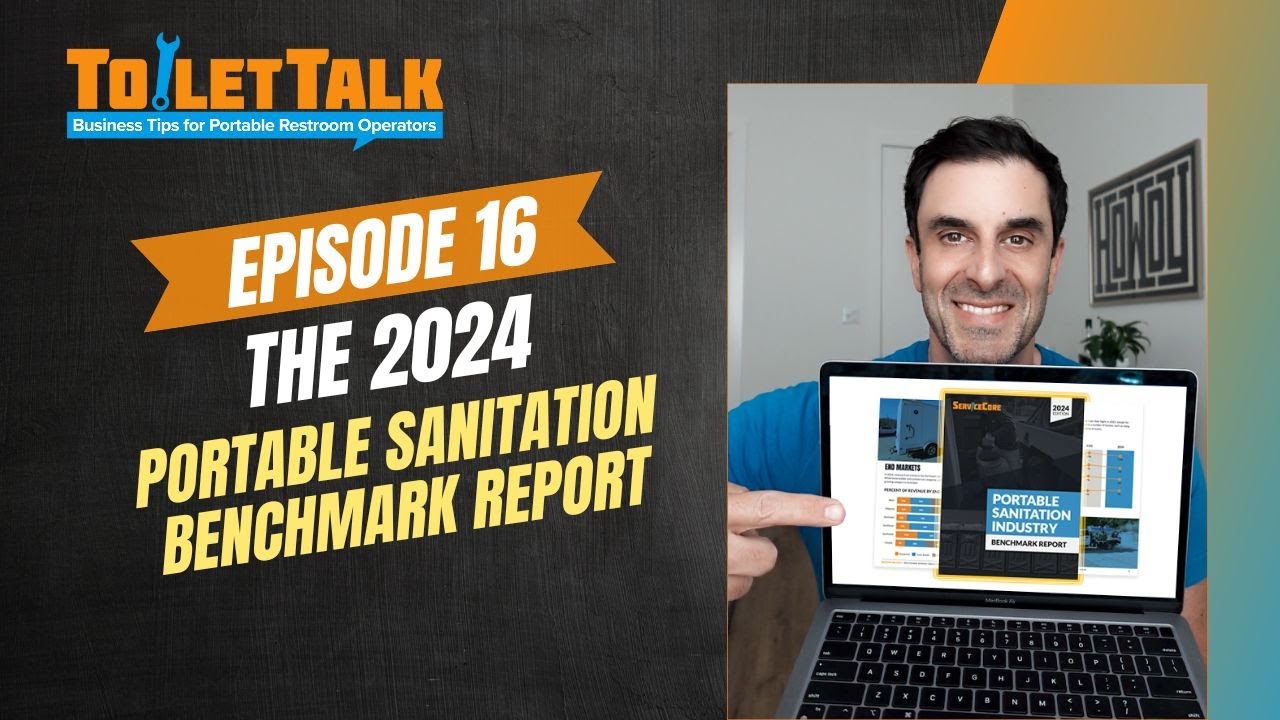
ServiceCore’s interview series is called ToiletTalk. The name does useful work before anyone speaks. It is memorable, unembarrassed and specific to the audience. It also gives Aiello room to play the host rather than the lecturer. In one episode, he opens with a breezy “What’s up, guys!” and then sits down with an operator to discuss margins, fleet maintenance, construction demand, fuel cards and receivables.
The comedy remains in the title. The conversation itself is grounded. Aiello asks how benchmark numbers meet the experience of running a company. A guest explains why branded trucks, search-friendly websites and a weekly construction-site ritual called “Donut Day” can bring in business. They discuss why photographs at drop-off and pickup may settle disputes. They move from a chart about costs to the practical question of where a route should unload.
This is a revealing posture for a marketer. The company may own the survey, the studio and the software, but the operator owns the meaning. Aiello’s role is to keep the numbers moving toward a decision someone can make. “This is your chance to see how your business stacks up,” he tells the audience. It is an invitation, not a victory lap.
The software company supplies the spreadsheet. The operator explains what the numbers feel like on Wednesday morning.
The benchmark project has grown with repetition. The first report drew more than 300 submissions from around the country. A later edition surveyed more than 500 operators across the United States and Canada. It now offers an annual view into costs, staffing, billing, service practices and profit. In a fragmented industry, the simple act of letting operators compare themselves with a wider field has value.
There is a publishing engine tucked inside that process. A survey produces a report. The report produces questions. The questions produce an operator conversation, and the conversation returns the chart to the conditions that made it. In the 2024 discussion, a finding about service photographs opens into a story about documenting drop-offs, pickups and blocked access. A finding about billing opens into the appeal of charging a card on file rather than chasing payment. The content keeps moving from aggregate to particular.
Aiello does not need to pretend that every answer belongs to him. His most productive moments as a host arrive in the follow-up: What has worked? What changed? Do you agree? A benchmark can tell an owner that high-margin operators tend to use software. An experienced guest can explain the judgment required to assign the right number of units to a fast driver or a more meticulous one. The chart identifies a relationship. Conversation gives it edges, exceptions and a human pace.
Marketing as a form of noticing
Aiello’s public work is not a life story told through sweeping personal revelations. It is a working philosophy revealed by repetition. Ask the operator. Name the friction. Measure the trade-off. Return next year with a better sample. The personality on display is plainspoken and lightly amused, but never embarrassed by the category. Portable toilets may attract an easy laugh. The businesses servicing them still have payroll, capital equipment, customers and routes to finish before dark.
This makes his current niche a good test of whether marketing is capable of respect. Respect is not solemnity. ToiletTalk proves that. It is the discipline of treating another person’s small operational concern as worthy of close attention. A driver’s route can be a strategic subject. A 28-day billing cycle can alter cash flow. A photograph can protect a company from a claim. Software becomes less abstract as the marketer becomes more curious.
There is also a useful tension in Aiello’s role. He builds within private-equity-backed companies, where scale is an explicit expectation. Yet the way to scale in a narrow market is to sound less generic, not more. The acquisition of Docket widened ServiceCore’s territory, but each additional trade still brings its own equipment, language and habits. Growth asks for a bigger system. Credibility asks that the system remember the locked gate.
Aiello’s career suggests that the two demands can meet. He has moved through enough industries to know the machinery of marketing, then settled into work where machinery is sometimes literal. The compelling part is not that a marketer learned to talk about toilets and dumpsters. It is that he learned these businesses become interesting at precisely the moment one stops treating them as a punch line.
Today Aiello works from Georgetown, Texas, for a Colorado-based company serving operators across North America. The distance suits the subject. ServiceCore’s customers are distributed, mobile and rarely sitting in the same kind of office. The common ground is the day’s work, translated carefully enough that a dispatcher, driver, owner and software team can recognize the same problem.
Keep exploring