In Jefferson Parish, Louisiana, a meal-delivery programme had a problem that looked like a shortage of capacity. It was also a problem of coordination. Jefferson Council on Aging said its old routing software made adding deliveries and changing routes tedious. Demand had grown during the pandemic. The daily plan was becoming an obstacle to the daily purpose.
- The work: software for pest control, lawn care, cleaning, security and delivery businesses.
- The wager: industry-specific rules make software more useful than a generic calendar.
- The test: fewer wasted handoffs, more completed jobs and a shorter path to payment.
Four hundred meals, hiding in the route
The organisation began its WorkWave contract in May 2021. In a customer case study published by WorkWave, it reported moving from approximately 1,100 meals a day to 1,500 with help from RouteManager. That is about 36.4% more deliveries. The figures describe one customer’s experience; they are not a forecast for every fleet.
Jeanne Tripoli, its care management and nutrition director, pointed to control over the routing process and an affordable price. There was another practical attraction: drivers could benefit without being required to use the mobile app. For a programme with older drivers and employees, that flexibility mattered. A software purchase became easier when it respected how people already worked.
WorkWave operates in precisely this space: the interval between having work to do and getting it done. Driving, reshuffling appointments, reconciling time sheets and chasing invoices all consume capacity. A full diary can conceal a surprisingly empty bank account.
A surfboard was a better clue than the old name
For decades, the business was called Marathon Data Systems. It traced its beginnings to 1984. By 2015, however, the name had become an awkward introduction. Then-CEO Chris Sullens told NJ Tech Weekly that some customers heard “Data Systems” and assumed they were dealing with a data company.
A branding agency interviewed customers, employees and prospects. What connected them was movement: technicians visiting properties, drivers making deliveries, revenue earned away from a desk. The name WorkWave followed. The change was announced in June 2015, alongside the acquisition of GPS-tracking company Foxtrax.
The seaside metaphor had local credentials. Sullens said the conference rooms already carried the names of nearby beaches; the Marathon sign was painted on a surfboard. Corporate identity occasionally requires an expensive revelation of something sitting in plain sight.
The useful discovery was more specific than a name. WorkWave’s customers needed the office and the road to agree about the same day. The office had the customer record. The worker had the evidence of what actually happened. Connecting those views became the organising idea.
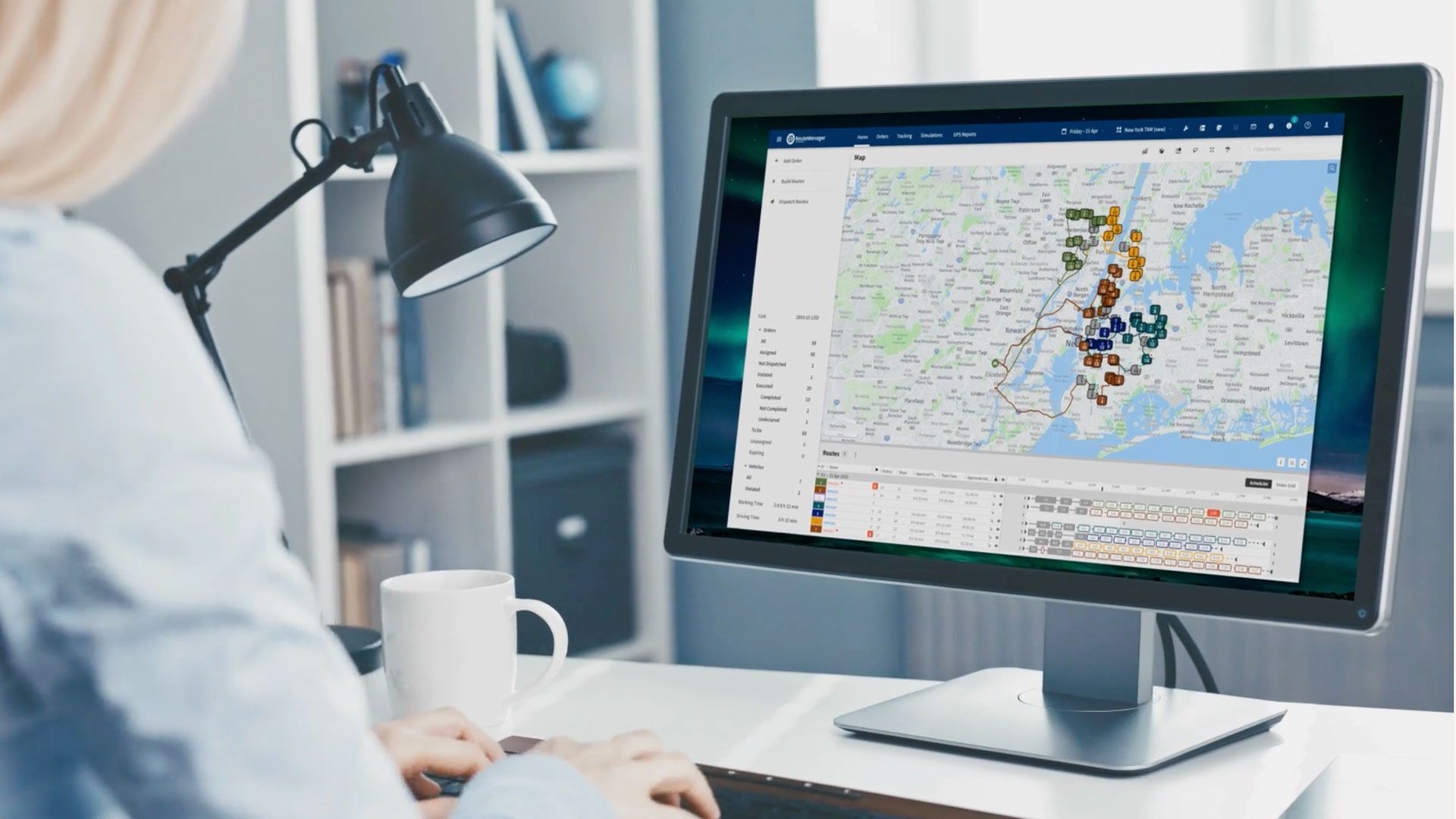
Same map. Different rulebook.
A pest-control technician and a security guard both travel to a customer’s premises. Their employers still need rather different software. PestPac handles the customer history, scheduling, routing, mobile work and billing of a pest-control business. RealGreen addresses lawn care and landscaping, with customer management, marketing, routing and field tools. TEAM Software serves cleaning and security companies, where labour scheduling, payroll, contract economics and job costing loom large.
WinTeam, TEAM’s industry-specific ERP, connects operations with financial management. RouteManager serves a different buying decision: planning and dispatching routes, tracking progress and recording completion. Its Routing Engine API lets an existing platform use route optimisation without replacing the whole system.
- 01Win the customer
- 02Schedule & dispatch
- 03Complete & record
- 04Bill & collect
A schematic of the workflow WorkWave’s portfolio addresses. Product features and integrations vary.
Much of that breadth came through acquisition. IFS bought WorkWave in 2017. In 2021, WorkWave became a standalone company backed by EQT and TA Associates, adding RealGreen and Slingshot; TEAM Software followed that September. The separation reflected increasingly different customer groups, according to EQT. The enterprise-software parent and the service-business specialist needed their own focus.
By March 2022, EQT reported that WorkWave had more than tripled revenue since the separation, through both organic growth and acquisitions. That distinction matters. Buying businesses expands revenue and expertise; it does not, by itself, prove that an existing customer has become more productive.
The bill is part of the job
WorkWave sells business software and related services, with integrated payments and financial offerings beside them. The model follows the customer beyond dispatch. A technician finishing a visit creates information that can become an invoice, a payment request, a renewal or a marketing opportunity. Each extra system between those steps creates another place for the task to wait.
The fintech portfolio includes payment processing, business funding through YouLend and customer financing through Wisetack. The latter can help an operator offer instalments on a larger job. Eligibility and terms still belong in the purchasing decision; financing is a financial product, not merely another button on a work order.
There is one refreshingly concrete public price. RouteManager advertises pricing as low as $54 per vehicle per month, with a four-vehicle minimum. Multiplication gives a starting calculation of $216 a month. It is an advertised floor for that product, not the price of the whole WorkWave portfolio.
4 vehicles × $54. Compare the quote with time saved, travel reduced and extra work completed. Check the configuration and contract before treating this as your bill.
The comparison should be practical. A service owner wants to know whether dispatch takes less time, whether fewer visits get missed and whether completed work gets billed promptly. Software earns its place through those measures. The elegance of the sales demonstration is a separate matter.
A dashboard that knows what a callback means
WorkWave’s company page reports more than 8,000 customer companies and 375,000 users worldwide. Its experience spans recurring service businesses whose needs repeat, but whose economics differ. A cleaning contract’s labour budget and a pest-control route’s callbacks deserve their own vocabulary.
Janitronics Facility Services offers a useful example. CFO Scott Somma was considering major analytics investments, including Power BI and Tableau, before joining Wavelytics’ early-adopter programme in 2025. The company already used WinTeam. WorkWave’s account of his decision says labour represented 80% of Janitronics’ costs.
“My concern as I looked at other platforms, though, is that they don’t know your business.”
Scott Somma · CFO, Janitronics Facility Services
The attraction was industry understanding and a chance to influence development alongside peers. That is a credible source of differentiation: software shaped by the operating questions customers ask. It also explains why WorkWave can keep specialist product names inside a larger company. A pest-control operator is buying familiarity with pest control, not a lesson in corporate structure.
It has competition. FieldRoutes, part of ServiceTitan, addresses pest control; Aspire serves landscaping and cleaning within the same group. Jobber covers home and commercial service workflows. WorkWave’s breadth is a reason to investigate it, rather than evidence that every competing product is unsuitable.
The AI still needs somewhere to live
Wavelytics was announced in February 2025 as a suite of data and analytics offerings. Its foundation is a curated warehouse that cleans and organises operational information. WorkWave then announced WAIve in January 2026, describing predictive intelligence, specialised agents and a natural-language interface.
February’s Decision Intelligence announcement added role-specific dashboards, scorecards and alerts. The intended shift is from inspecting yesterday’s figures to deciding what needs attention: an ageing lead, an employee’s performance or a change in customer retention. The announcements set release schedules, including Q2 2026 targets. A buyer should check the capabilities available inside the product they actually use.
In September 2026, WorkWave announced an AWS initiative to modernise its cloud architecture, using Amazon EKS and Bedrock AgentCore. It projected infrastructure-cost reductions of up to 50% and RealGreen performance improvements of up to threefold. Those are forward-looking targets. They describe the scale of the infrastructure ambition, not savings already delivered to a customer’s account.
The sequence is revealing. Industry software gathers the records. Analytics makes them easier to interpret. AI proposes or automates an action. Each step depends on the previous one being trustworthy. An automated answer produced from inconsistent records merely arrives at the wrong destination faster.
Borrow the method before buying the software
A reader can copy the underlying discipline immediately. Follow one job from enquiry to collected payment. Count the times somebody retypes information, phones for an update, changes a route or postpones an invoice. Pick the delay that costs the most, then test a change on a representative route or branch.
Measure dispatch time, completed visits, travel, callbacks and collection speed before expanding. Include the people who will use the system. Jefferson Council on Aging’s experience suggests that adoption improves when technology accommodates workers rather than demanding that every worker change at once.

A small operator with a simple schedule may find a lighter tool sufficient. RouteManager’s published vehicle minimum also sets a clear boundary. A business with incomplete addresses, uneven timekeeping or inconsistent job records should repair those inputs before expecting analytics to settle its arguments. These are implementation judgments, not a claim that one vendor wins every case.
The meal-delivery example makes the principle tangible. An easier route can create room for another visit. A cleaner handoff can turn finished work into collected money. WorkWave’s proposition lives in those ordinary intervals. They are where a service business discovers whether being busy is paying off.
Visit WorkWave, explore PestPac, RealGreen, WinTeam or RouteManager, and browse the newsroom and company blog.
Watch the 2026 Kevin Kemmerer video interview or explore videos on WorkWave’s YouTube channel. Follow LinkedIn, X, Facebook and Instagram.