A tree-care business is a choreography of people who rarely occupy the same room. A call lands at the office. An estimator drives to a property. A crew needs the right truck, tools and instructions. Someone photographs the site. Someone else turns the completed work into an invoice. The customer sees one company. Behind that view is a chain of handoffs, each capable of losing a detail.
Christina Flores works at the point where that complicated chain has to become a simple sentence. She is publicly listed as chief marketing officer of ArboStar, the Toronto software company built around the operating life of tree-care and landscaping firms. ArboStar's platform covers customer records, estimates, scheduling, work orders, employee management, equipment, mapping, invoicing and business intelligence. Flores's title puts her in charge of making that breadth understandable to a buyer who may be answering calls between site visits.
It is a distinctive marketing assignment. The customer does not want software for its own sake. The customer wants the information from Monday's estimate to reach Wednesday's crew and Friday's invoice without being retyped, forgotten or trapped in somebody's phone. Every module matters, but no buyer wakes up longing for modules. The story has to begin with the work.
“From the first estimate to the final invoice, from the office to the field.”ArboStar's expression of the customer journey
A niche with a very wide day
Vertical SaaS is often described as a narrow business. The phrase is misleading. The market may be specialized, but a working day inside it is broad. A tree-service owner can be a salesperson before breakfast, a dispatcher at nine, an equipment manager at noon and a collections department at four. The climber and the bookkeeper are part of the same job, even when their screens and vocabulary look nothing alike.
That breadth explains ArboStar's long feature menu. Its map can show leads, jobs, crews, vehicles and equipment. Its CRM carries prospects toward appointments and estimates. Its operational tools turn approved work into schedules and work orders. Financial tools pick up the sequence afterward. Seen separately, these are software categories. Seen together, they are one service moving through time.
For a marketer, the trap is obvious: describe everything and communicate nothing. A page full of capabilities can prove that the product is substantial while leaving the reader unsure where to enter. ArboStar's useful organizing idea is movement. First estimate to final invoice. Office to field. Lead to job. That movement turns a list into a route.
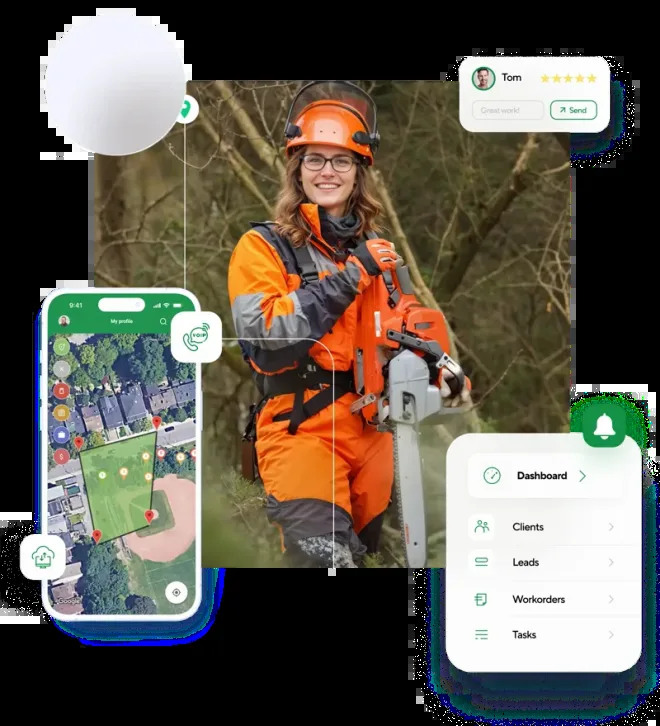
The message is a handoff too
Flores's public profile is closely bound to ArboStar. Her LinkedIn presence identifies the company and Toronto, while business databases list her CMO role. One small piece of visible activity is telling: she engaged with an International Society of Arboriculture post about why customers hire an arborist. It is not a grand declaration. It is a window into a fundamental category question, where professional expertise has to be explained to a homeowner.
That same explanatory gap exists one level up. ArboStar must explain to a tree-care operator why a connected system is more useful than the familiar mix of spreadsheets, calendars, accounting software, text threads and memory. The pitch is not merely consolidation. It is continuity. A detail entered once can remain attached to the customer, property, tree, crew and transaction as the work changes hands.
One record, five moments
Marketing itself works through similar handoffs. An industry partnership introduces the name. Search captures a practical question. A product page turns the question into a workflow. A demonstration has to preserve the promise while adding detail. Sales then carries that context into a conversation. If the message changes at every stage, the buyer does extra interpretive work. If it holds, complexity begins to feel organized.
Specificity is the advantage
ArboStar does not have to persuade the world that customer relationships matter. It has to show a particular owner how a lead becomes a site visit, how a site visit becomes a priced scope, and how that scope reaches a crew with the right equipment. The details are not clutter when they mirror the customer's day. They are evidence that the product understands it.
This is the durable advantage of vertical software marketing. Generic platforms can speak about productivity, efficiency and growth. A specialist can speak about GPS-tagged tree photos, man-hour rates, crew schedules, tree inventories and chipper maintenance. The words are smaller, but the recognition is stronger. A buyer can tell when a company knows which details become expensive when missed.
Write the customer's nouns in the order their work happens. That sequence is often a clearer homepage than the product's internal feature hierarchy.
The product's customer reviews reinforce the point. One user praises access to client records during live conversations. Another values having GPS-tagged pictures waiting on site. Another says the platform automates estimation and invoicing. These are not abstract endorsements of digital transformation. They are reports from moments when information arrived where it was needed.
“Everything is divided into modules, and each module is a gem in its own right.”Fred M., in a customer review featured by ArboStar
Marketing to the whole business
A platform this wide also has multiple audiences inside one customer. Owners care about margin and visibility. Office managers care about schedules and follow-ups. Estimators care about speed and accuracy. Crews care about usable instructions in the field. Finance cares about records that reconcile. Marketing cannot flatten those people into a single persona, but it can give them a shared object: the job moving cleanly from one stage to the next.
ArboStar's current materials show the company extending that object. Its RAI suite describes AI assistants for estimating, equipment, finance, marketing, crews, guidance and safety. The naming is playful, but the underlying strategy is practical. Put assistance inside the steps where the user already works. For Flores, that expands the narrative challenge again. The company is no longer only connecting records. It is proposing that software can act on them.
Here too, category knowledge matters. An AI estimator for a tree-care company cannot be marketed as a generic writing tool. It has to help assemble proposals from actual site information. An equipment assistant has to notice maintenance and usage. A crew tool has to respect routes, forms, alerts and field conditions. The more ambitious the technology becomes, the more concrete the explanation must be.
This is where a CMO's role becomes editorial. There will always be another capability, channel or claim competing for the top of the page. The job is to decide what the reader needs first, what can wait, and which proof earns the next minute of attention. Good compression does not make a complex product smaller. It gives the reader a way through.
The office and the field
Flores works from Toronto, a city associated with software companies rather than saw crews. ArboStar's market lives elsewhere too: in yards full of trucks, at kitchen tables where owners finish estimates at night, and on properties where reception can be unreliable. That distance makes listening a business requirement. The language of the product has to survive outside the product team.
ArboStar's careers page gives a public view of how seriously it treats that work. Its marketing leadership brief spans paid acquisition, public relations, partnerships, analytics, lead quality and the conversion from marketing-qualified to sales-qualified demand. It calls for close work with sales and product. In other words, marketing is not presented as decoration around the software. It is part of the operating loop.
The range of channels mirrors the range of users. Search advertising can meet an owner actively replacing a system. An industry partnership can create familiarity before that search begins. Educational articles can answer questions about pricing, local visibility or operations without forcing an immediate product decision. Webinars and demonstrations can then make the workflow visible. Each format does a different job, but all of them have to preserve the same category fluency. A campaign about lead conversion cannot forget the crew that eventually fulfills the promise. A campaign about field efficiency cannot ignore the customer waiting for an update. In a connected platform, a narrow message still has consequences elsewhere.
That loop offers a useful way to understand Christina Flores's professional story. The available facts place her at one company, in one city, with one executive title. The larger scale is inside the brief. She is attached to a product that must speak across the office and the field, across customer service and finance, across a first call and a finished job. Her work is to make those handoffs feel like one coherent business.
The tree-care industry provides a useful image for the task. A tree looks singular from the street. Underground, the system branches. So does a software platform. The marketer's craft is not to hide the branches. It is to show how they belong to the same living thing.