In 2008, a subscription to Praxedo cost €59 a month per equipped PDA, before volume discounts. It was a modest price attached to an ambitious proposition: a small maintenance company should be able to coordinate people on the road without buying the sort of computer system that required a large company’s budget. The device in the technician’s hand was becoming a door into the office. Jean de Broissia wanted to keep that door open.
He and his co-founder, Pierre Lavigne, had worked on mobile systems for large businesses. Again and again, the expensive installations seemed to share a common backbone. Why rebuild the plumbing for every customer? Put it on a shared internet platform, let customers configure their own reporting forms, and charge for use. There is a pleasing economy to the idea. Even software can suffer from unnecessary journeys.
For de Broissia, that observation became a career. Praxedo, launched in 2005, would remain focused on the people whose working day takes place somewhere other than a desk. The setting has changed from PDAs to smartphones and from manually arranged schedules to AI. His subject has remained recognisably the same: how to get a person, a job and the information needed to do it into the same place.
A business-school graduate looks beyond the desk
De Broissia graduated from EDHEC in 1997 and began his career at Alcatel India Limited. Subsequent work in telecommunications brought him towards mobile computing. By 2000, he was convinced that internet access on handheld devices would create useful new possibilities. That date matters. He was considering work on a mobile internet several years before today’s smartphone habits had become ordinary.
His meeting with Lavigne gave that interest a business partner and a focus on professional uses. Their eventual company was built for technicians, delivery staff and other people working in the field. This was a market with unromantic requirements: receive instructions, record what happened, send the report back. A missed connection between those steps can consume an afternoon. A successful one is unlikely to receive applause.
The founders were also watching early cloud companies, including Salesforce. They chose to distribute software as a service from the beginning. For a customer, that meant access by subscription. For the founders, it meant building a business whose relationship with a customer would continue well beyond the initial installation.
The customer who brought other customers
One early route to adoption ran through France Télécom. It recommended Praxedo to subcontractors so that intervention reports could reach it promptly and in a standard format. De Broissia credited the resulting subscriptions, and France Télécom’s active assistance, with helping the company break through. A large organisation’s need for orderly information had created an opening among smaller businesses doing the work.
That is an unusually concrete origin for a software sales strategy. The person buying a subscription and the organisation benefiting from its reports did not have to be the same. If a contractor could meet a major customer’s reporting requirements more easily, the software had a reason to exist before anyone delivered a presentation about digital transformation.
Praxedo’s later description of itself still emphasises configuration and simplicity of deployment. The early insight was portable: different trades could use a common platform while keeping forms and processes that reflected their actual jobs. The challenge was to make common software useful without pretending every working day was identical.
A conceptual view of the workflow, from dispatch to reporting.
Nineteen people, four countries
In April 2013, EDHEC announced that de Broissia would represent France at the G20 Young Entrepreneur Summit in Moscow that June. His account of Praxedo at the time was compact: nineteen employees, 150 customers, activity in France, Germany, Belgium and Luxembourg. The numbers describe a company already crossing borders while still small enough for nineteen people to carry it.
The economics helped explain the ambition. With servers in France, he said, expanding abroad did not require recreating the entire technical infrastructure. A sales presence could open another market. The cloud was as much a distribution decision as a technical one. Germany had already been an early destination, with a subsidiary announced in 2010.
He also explained how they had paid for the journey: monthly subscriptions from equipped users financed investment. Self-financing was a working arrangement with consequences. Expansion had to coexist with the income customers were already providing. It gave the business a pace and a source of discipline that would remain part of its story for years.
The paperwork has to go somewhere
By late 2013, de Broissia was discussing connections between Praxedo and enterprise software from companies such as Sage and Microsoft. Sending a technician’s report back from the road solved only part of the problem. The information also needed to enter the systems a business used to organise and account for its work. Otherwise, the digital report risked becoming paperwork with a brighter screen.
In 2016, his description of the product stressed intelligent scheduling, reports completed on phones or tablets, and tracking items consumed in the field. Praxedo was then serving more than 250 companies and looking towards North America through a Canadian subsidiary. These are details of implementation, but implementation is where his original idea either earns its subscription or loses it.
A 2018 video explanation made the two sides explicit: a mobile application for technicians and a web portal for those arranging and following their work. The office and the field needed a shared account of the day. Neither side could be treated as an afterthought.
A shorter route, a longer view
De Broissia’s writing shows him working through the wider consequences of that arrangement. In a 2018 column, he explored how connected equipment and machine learning could support predictive maintenance. His interest was in timing: use evidence from a machine to trigger attention when needed, rather than relying only on a calendar or waiting for a failure.
In March 2019, he took up another argument: the environmental effects of digital technology should include the physical activity it can avoid. Shared infrastructure, electronic documents and better routing all featured in his reasoning. He recalled the older routine of technicians collecting paper instructions at headquarters before setting out. Another drive back for missing information or a part could undo the day’s careful plan.
The appeal of his argument is its scale. A route can look like a small thing on a screen, yet it becomes kilometres when someone drives it. His writing asks readers to follow software beyond the device and into the movements it changes. He makes the case through work that already exists, with vehicles already on the road.
Customers in the room; research on the payroll
On 6 June 2019, Praxedo held its first Praxedo Day at the Maison de l’Amérique Latine in Paris. Around 170 customers attended. De Broissia and Lavigne opened the day together, looking back over fourteen years and ahead to product development and expansion in the UK and North America. The company’s international plans had an audience of people already depending on the product.
By 2020, Praxedo had ninety employees, with roughly forty devoted to research. De Broissia described reinvesting a substantial share of profits in development. He also spoke of strengthening existing markets before adding more, with the UK an immediate focus. The pattern was consistent: grow the footprint, while continuing to improve the machinery underneath it.
His advice about entrepreneurship combined persistence with attention to what the market was saying. Conviction needed lucidity. Read alongside the research headcount, that sounds less like an inspirational slogan than a recurring management problem: decide what to keep believing, what to change, and where the next month’s money should go.
Seventeen years before the minority partner
In March 2022, Praxedo brought in MBO+ as a minority investor. The company then supported more than 1,000 customers and had offices including Germany, Spain, the UK, the United States and Canada. For a business built through self-financing since its creation, the transaction marked a change in how the next stage would be supported.
The founders described a search for help structuring the organisation and accelerating international development. They had met several funds and considered different options before choosing MBO+. Their joint statement placed corporate culture alongside growth ambitions. After years of paying for expansion through subscriptions, they were selecting a partner to help manage a larger operation.
The founders chose a minority partner. That detail carries much of the story. Outside investment arrived after the business had established its model and international presence. De Broissia’s example gives aspiring founders something more useful than a rule about funding: a sequence of choices made at particular stages.
“We decided to look for a minority partner”
Jean de Broissia & Pierre Lavigne · March 2022
Making room for the next technician
The same year, de Broissia and Lavigne created the Praxedo Foundation, with an initial endowment of €400,000 over four years. Its stated areas include access to employment, equal opportunities, women in digital work and digital inclusion. The connection to the founders’ business is especially tangible in support for people entering technical occupations.
Praxedo’s partnership with Les Plombiers du Numérique involves employees training young learners to use its software during working time. Support for Sport dans la Ville includes activities connected with professional integration. These programmes put the company’s knowledge into other people’s hands. For someone seeking a first job, familiarity with the tools of an occupation can make that occupation less remote.
When Praxedo celebrated twenty years at its May 2025 customer event, de Broissia thanked the team and customers publicly. The anniversary supplied a round number. The training partnerships suggest another way to measure continuity: whether experience accumulated inside a company can become useful outside it.
Initial Praxedo Foundation endowment, over four years.
The day refuses to stay planned
By October 2026, de Broissia was describing a further shift in scheduling. Praxedo Automatic Smart Scheduler, he said, could manage technician schedules automatically and keep adjusting as the day changed. The company reported more than 1,500 customers across Europe and North America and more than 50,000 daily users in that interview.
He also described computer vision checking technicians’ photographs and giving feedback about completed work, alongside language-model uses such as translating reports and turning dictated accounts into forms. The examples return to familiar irritations: uncertainty, repeated entry, information stranded in the wrong format. AI reaches this story through the work already being done.
A schedule is a statement of intent; the afternoon is entitled to disagree. De Broissia has spent two decades building around that disagreement. From the €59 PDA subscription to software that replans a day, his career follows a stubbornly ordinary ambition: give the people doing the job a better chance of getting it done.
Further reading & watching
Explore de Broissia’s work, writing and interviews.
- Praxedo UK - company website
- Jean de Broissia on LinkedIn
- His business and technology columns
- Praxedo Foundation
- Meet Jean de Broissia - video interview
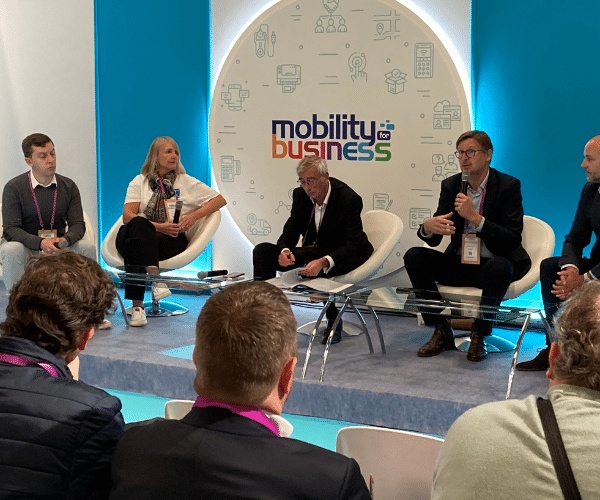
- Mobility for Business 2017 - video interview
- Automatic scheduling - October 2026 interview
- The 2022 minority investment
- Early days: Praxedo in 2008
- EDHEC and the 2013 G20 entrepreneur delegation
- International development in 2020
- Praxedo’s training partnerships