Golf had become a problem for Jim Higgins. An unusually agreeable problem, admittedly, and one that plenty of people would volunteer to investigate. He had been playing too much of it. What he missed, he explained when announcing his return to a chief executive’s job, was building businesses. A call from Charlesbank about Clerri arrived at the right time. The clubs had acquired competition.
There is something useful about this admission. A founder’s career is often narrated toward an exit, as if the whole purpose of creating a company were eventually to stop going there. Higgins offered a different ending. He wanted back into the work. In December 2025, Clerri appointed him CEO, opening another chapter after the company most closely associated with his name: Solutionreach.
To understand the appeal, it helps to follow the ordinary tasks that have occupied him. Selling a subscription. Answering a customer. Sending a reminder. Making sure a reply reaches the place where someone can act on it. These are modest verbs. They can keep a company busy for decades.
Before the reminder came the customer
Before founding his own business, Higgins worked at Ancestry.com, where he directed sales and service channels. The remit crossed online software, memberships, affiliate programs, call centers, advertising and trade shows. He was dealing with the untidy business of reaching people through several doors and making the service behind those doors cooperate.
A trade-show conversation and an online subscription may belong to different departments on an organization chart. To a customer, they belong to the same company. Higgins’s background put him close to that distinction. The sale had a beginning, but the customer relationship kept requiring attention afterward.
He graduated from Brigham Young University. His subsequent career makes particular sense when viewed through the sales-and-service work: the repeated interest in how people enter a relationship with a business, what makes the exchange convenient, and why they might stay. Software became a way to work on those questions at a larger scale.
A business that outgrew two names
In 2000, Higgins and a small team started Communitect. Its technology let banks send text messages to customers. The early proposition concerned a familiar commercial inconvenience: a business had something useful to tell somebody, and the telephone was not always the easiest way to do it.
Then came another use for the technology: appointment reminders. Empty spaces in dental-office calendars presented an administrative problem with a visible cost. Communitect connected with practice management systems and became Smile Reminder. The name was pleasantly literal. You could explain the product without requiring a second cup of coffee.
The business expanded beyond the original reminder. By 2005, its offering included email, recall messages and customizable newsletters. By 2011, the audience had broadened beyond dentistry, and the company took the name Solutionreach. A narrowly descriptive name had served its purpose. The customers had given the business more to do.
- 2000CommunitectBank text messages
- NEXTSmile ReminderAppointment reminders
- 2011SolutionreachA broader customer base
The interesting part happens after “yes”
A reminder looks wonderfully simple on a phone. Its usefulness depends on what happens after the recipient answers. In 2013, Smile Reminder announced a connection with Dentrix G5 that wrote appointment confirmations directly back into the practice management database. The reply could become a change in the working system.
That detail deserves a place in a founder story. Integration rarely gets the glamorous chapter. It involves other people’s software, established routines and information that must arrive in the right place. Yet the difference between a message and a completed task often lives there. Someone otherwise has to read the answer and enter it again.
Higgins’s product history gives that small handoff unusual prominence. Sending more messages is easy to describe. Making the incoming reply useful requires another layer of work. The customer buys the convenience at the front; the software company inherits the complications behind it. This is a reasonable division of labor, provided the software company does its share.
His practical advice on texting showed the same attention to the receiver’s experience. Keep the recognizable business number. Allow either side to begin a conversation. Show the sender’s name, preserve the history and let staff prioritize messages. Each detail answers a question that a feature list can easily skip: will the person using this know what to do next?
There is a particular discipline in that kind of product thinking. The person at the other end has a day already in progress. A message arrives inside it. If answering takes another phone call or another explanation, the promised convenience starts to look rather expensive. Higgins kept returning to the mechanics of making the exchange easier to finish.
Higgins once reached for an airplane to explain the bargain. As a passenger, he said in 2017, he wanted a decent experience and to arrive safely and on time. The machinery behind the journey could remain someone else’s specialty. His luggage, however, needed to emerge at the destination. Anyone who has watched an empty baggage carousel can appreciate the distinction.
The analogy brings his view of software down to a human scale. The customer has a result in mind. The company has a system to operate. Success means those two things meet without making the customer supervise every connection. It is an unromantic description of a product’s job, and a demanding one. The bag still has to arrive.
Growth needs people who do the plumbing
Summit Partners invested in Solutionreach in 2012. The financial terms were undisclosed. The work around the investment is more revealing than a hypothetical price tag: refining the sales infrastructure, enlarging the sales team, recruiting senior people and improving retention through predictive analytics.
In the investment period covered by Summit’s retrospective case study, revenue grew more than sixfold. The company added over 15,000 customers and reached more than 600 employees. Those figures belong to that historical period. Behind them was a collection of operating changes, each less photogenic than a founder shaking hands over a signed agreement.
Historical results during the investment period covered by the case study.
The business also received a Red Herring Top 100 North America award in 2016. Recognition provides a date for the scrapbook. Scaling a company requires a less ceremonial calendar: hiring, training, customer conversations, product decisions, then doing much of it again.
Higgins’s own account of preparing for 2019 emphasized investment in people, technology and customer success. He wrote about recruiting people who fit the company and giving them opportunities to grow. The ambition extended beyond acquiring customers. The organization had to develop enough capacity to keep serving them.
A place for the CEO at the whiteboard
As a business grows, its founder acquires responsibilities that can crowd out the work that first attracted him. Higgins addressed that problem directly in a 2018 essay about participating in product ideas. Legal matters, compliance and financial measures all needed attention. They could also absorb the entire job.
“running one on spreadsheets alone is a formula for failure”
Jim Higgins / on running a business, 2018
His proposed remedy was quite specific: join the product discussion early. Attend the larger planning sessions. Take part when a new product or substantial improvement is still being imagined. Let the team’s customer knowledge challenge the founder’s instincts, and give the team useful direction in return.
He described the enjoyment of those exchanges with the image of throwing spaghetti at a wall. The metaphor has the merit of allowing for a mess. An idea meeting earns its time by exposing possibilities before they become commitments. A CEO who arrives only when the roadmap is complete has missed much of the opportunity to shape it.
His earlier writing on customer loyalty gave the roadmap another job. Customers should help inform it. Designers should observe how people actually work. The company should explain how it intends to keep solving useful problems in the years ahead.
For subscription software, this is a practical concern. A customer can like today’s product and still consider leaving tomorrow. Higgins argued for showing a continuing relationship between the customer’s needs and the company’s plans. A subscription renews on a schedule. Confidence has to be maintained between those dates.
The second CEO’s desk
Solutionreach announced Ken Ernsting as CEO in August 2023 and said Higgins would continue on its board. The company he had founded would carry on with another executive leading it. Founding a business and running its next stage had become separate jobs.
Clerri’s December 2025 appointment brought Higgins into a different position: an experienced founder taking charge of an existing company. Clerri had emerged from the combination of Kleer and Membersy, which joined forces in 2024 and adopted the new brand in 2025. Higgins succeeded Dave Monahan, with Alan Press having served as interim CEO.
The product context had changed from reminders to membership management and recurring revenue. The operating questions remained recognizable: how to fit software into existing work, support the people using it and make the customer relationship last. His return put those questions back on his daily agenda.
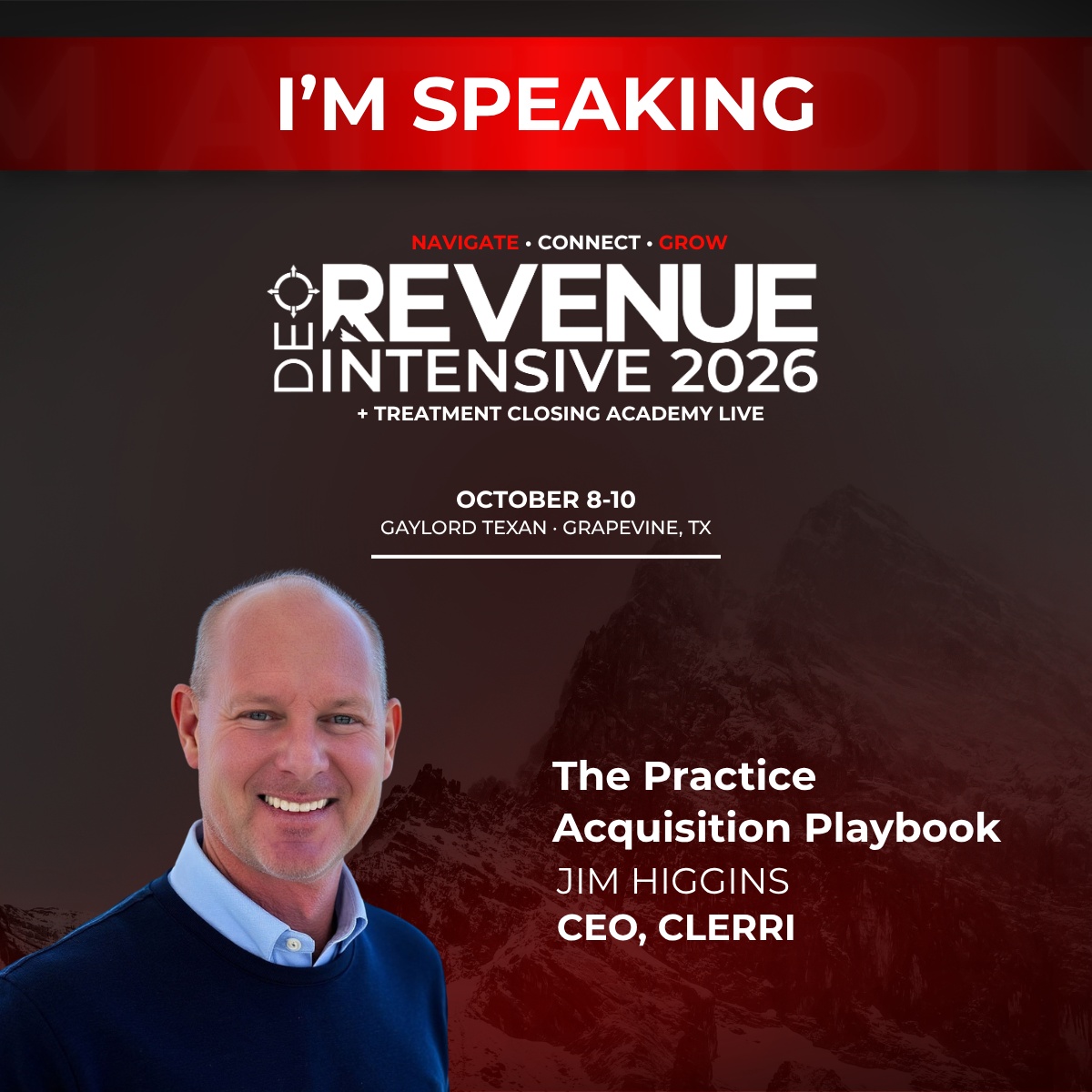
By October 2026, Clerri was promoting Higgins’s appearance at DEO Revenue Intensive in Grapevine, Texas, with a session called The Practice Acquisition Playbook. The announced topic placed him among business owners considering growth and the value of recurring revenue. It was another version of the customer-and-company questions he had spent years working through.
The appeal of his explanation for returning is its lack of ceremony. He missed building businesses. A long career had left him with an appetite for the activity itself: the unfinished product, the team to assemble, the customer whose problem needs a better answer. Golf could remain in the calendar. It would have to share.