A business owner has just enjoyed his best month. Weston Lunsford asks why. Silence. It is an awkward little exchange, the sort that can empty the fizz from a celebration. For an accountant, though, it is also an opening. A record month is pleasant. Knowing how it happened offers the possibility of having another one.
Lunsford built much of his working life around that distinction. He co-founded Dental Intelligence, the Utah software company that turned practice data into tools for running a business. Before the dashboards and outside investment, there were owners who could tell him what had happened to their money but struggled to explain what had caused it.
He had started a CPA practice in 2004 with Shaylen Peck. Looking back on those years, he described wanting to move beyond accounting that arrived after the action. A tax return is an excellent record of the past. It is less helpful when someone needs to decide what the team should do tomorrow morning.
By 2008, the differences among his dental clients had become hard to ignore. Practices with broadly similar patient numbers could produce sharply different earnings for their owners. Lunsford began examining the activities behind the totals. The question became more specific: which decisions, routines and conversations explained the distance between businesses that appeared so alike?
There is an appealing lack of glamour in this beginning. No theatrical revelation was required. The raw material was sitting in ordinary businesses, accumulating every day. Someone needed to care enough about the discrepancies to keep asking questions after the accounts had been prepared.
A whiteboard before a dashboard
One visit gave the inquiry a physical form. At a successful practice, Lunsford noticed a whiteboard in the breakroom covered with performance measures. The team used those numbers in its morning meeting. People participated, understood their responsibilities and discussed their work. The owner mostly listened, offering encouragement and praise.
That small scene matters to the company’s story. A whiteboard cannot make anyone act. Neither can a dashboard. What interested Lunsford was the connection between visible information and a team willing to use it. The meeting made the numbers part of the working day, rather than an exhibit produced for the owner’s inspection.
The software that followed had to address that same practical problem. Information scattered across systems needed to become something a busy person could understand and use. Lunsford’s early accounting work had put him close enough to the customer to see how much distance there could be between having records and having a useful explanation.
Dental Intelligence initially grew through analysts helping owners interpret their businesses. Eventually, some customers wanted the information without the consulting. They had learned enough to ask for direct access to the tools. For a service business, this is a slightly rude compliment: your teaching has worked so well that the pupil would like fewer lessons.
Lunsford followed that request toward software. The handoff is central to his career: expertise helped reveal a recurring problem, and customers helped identify the form its solution should take. The business could reach more people if its useful information no longer depended on an analyst being present for every explanation.
- ObserveFind the gap between similar businesses.
- ExplainHelp owners understand their data.
- EquipPut the tools in their hands.
The numbers acquire a company
Dental Intelligence launched its analytics product in 2015. Four years later, it announced a $34 million minority Series A investment from K1 Investment Management. At the time of that September 2019 announcement, the company reported more than 5,000 practices using its platform and a team of more than 150 people.
Part of the investment supported the acquisition of LocalMed, an online scheduling business. The move extended the company’s interest from understanding a schedule to helping fill it. Lunsford and LocalMed’s Keith English also appeared together in a 2019 conversation about real-time booking, discussing a convenience that customers already expected from other industries.
The distinction between a company’s age and a product’s age can disappear in a quick founder biography. Here, the 2015 launch offers a useful marker: years of working with clients had preceded the software’s arrival. The product represented accumulated observation, rather than the first appearance of the problem.
The 2019 funding also changed the scale of the assignment. A founder can personally explain an idea to a handful of colleagues. A growing organization needs ways for people who were absent at the beginning to understand why their work matters. Hiring creates a communication problem alongside the organizational chart.
Lunsford had to learn that lesson too. His account of leadership includes an admission that telling the founding story occasionally was insufficient. A new employee could join a company with a clear purpose and still miss the experiences that had made that purpose real to its founders.
Company figures at the September 2019 funding announcement.
A mission with receipts
His response was unusually concrete. At Dental Intelligence, statements about the company’s purpose had to be followed by a specific example of someone’s progress. Leaders brought those examples into onboarding, meetings and everyday conversations. The rule asked people to connect a large claim to an observable event.
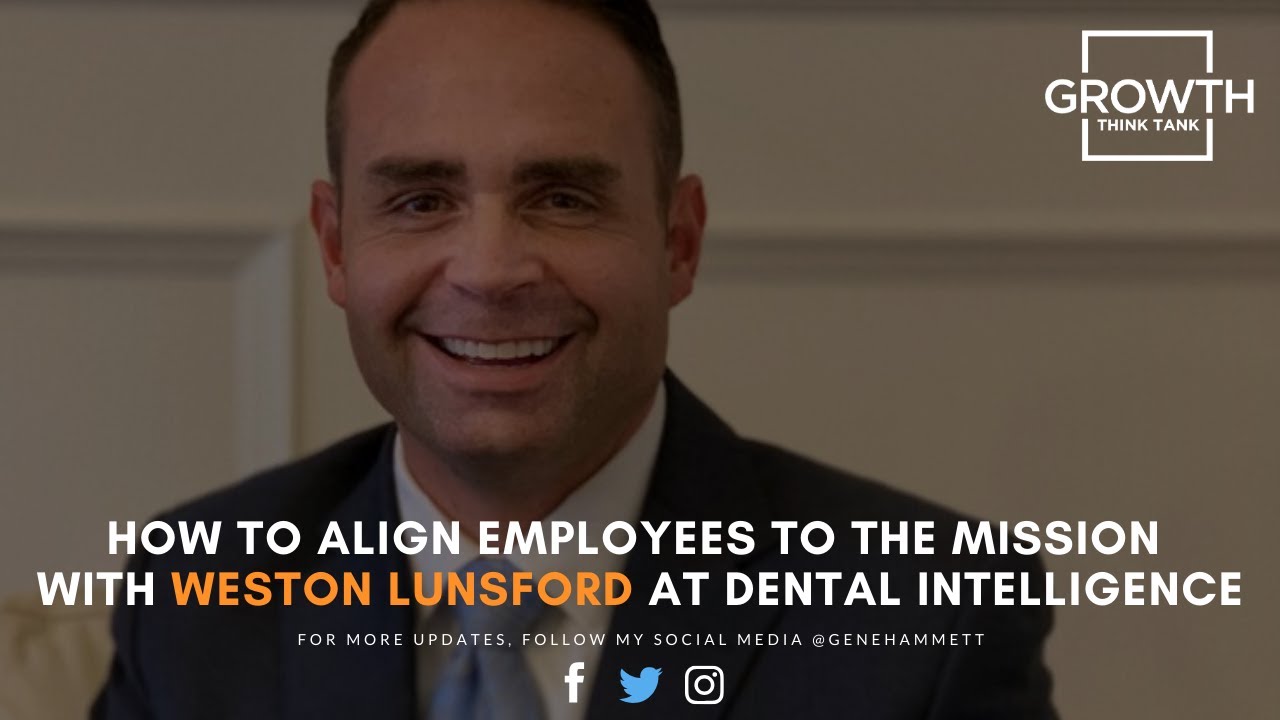
“You can’t buy heart,” he told interviewer Gene Hammett. The phrase suits a founder who talks enthusiastically about measurement but also wants employees to care about the experience of colleagues and customers. A spreadsheet can describe performance. Persuading someone that the work deserves their attention requires another kind of conversation.
A proof requirement gives those conversations some useful discipline. It asks the speaker to do more than admire the wording of the mission. Who benefited? What changed? A company can put almost anything on a wall. Supplying a recent example is more demanding, and considerably less comfortable when nothing has happened.
Lunsford’s career also contains the familiar adjustment of a founder discovering that being involved in everything can limit the organization. In a 2023 conversation with Chris Lee, he described learning to delegate and return to review the results. He said allowing colleagues to run with responsibilities helped the company grow.
That is a revealing qualification to the image of the ever-present entrepreneur. Building a team eventually involves making room for it. The person who once supplied the answer has to become comfortable with other people choosing the route, while retaining a sensible way to notice when something needs attention.
“You can’t buy heart.”
Weston Lunsford, in conversation with Gene Hammett
Coach Weston needs a location
Away from software, Lunsford has coached the American Fork High School mountain-bike team in Utah. In a 2021 essay, he described a rider who arrived late and could not find the trailhead. Directions had already been sent. Unfortunately, instructions are much less useful when the person receiving them cannot say where he is.
Lunsford asked the rider to return to the parking lot, where they could meet and ride out together. The incident gave him a way to explain planning to business owners: establish your present position, decide on a destination, choose a route and keep checking your progress. The teenager reached the team. The accountant acquired another teaching story.
There is some comedy in a software founder finding his business philosophy stranded on a bicycle. There is also a limit to the analogy worth respecting. People lose their way for many reasons. What makes the episode useful is the modest response: find a recognizable place, meet there and continue together.
His public conversations contain other glimpses of the person outside the CEO title. He has talked about enjoying Lake Powell, mountain biking and time outdoors. In the 2023 interview, he described himself as a father of six. Family time is an identifiable part of his life, rather than an abstract reward to be collected after every business problem has been solved.
The coaching story makes his preferred teaching method visible. Begin with a predicament someone can picture. Ask a question that locates the difficulty. Then make the next step small enough to take. It is a more companionable role than standing at the destination and wondering why everyone else is late.

Another industry, familiar paperwork
Lunsford now serves as CEO of Plansight, which makes software for employee-benefits brokers and carriers. The company identifies Steve Overton and David Sitterud as founders; Lunsford brings his experience as an operator and investor to its leadership. His current role extends the career beyond the company that first made his name familiar in dental software.
Plansight’s working territory includes requests for proposals, carrier responses, comparisons and presentations. Its public explanation of the problem is recognizable to anyone who has spent a day rearranging spreadsheet columns: too much manual preparation can leave too little time for the conversation the preparation was supposed to support.
In a Benefits Broker Boost episode with Adam Smith, discussed in a February 2026 company article, Lunsford argued for using technology to reduce repetitive work and give brokers more time for strategy and relationships. His stated direction is practical: professionals should spend more of their day advising clients and less of it assembling information.
There is continuity here without a need to pretend the industries are identical. Accounting, practice analytics and brokerage software involve different customers and different routines. Each has given Lunsford a place to examine the gap between stored information and a decision someone can actually make.
The question from his early accounting years still does useful work. A good month deserves a celebration. A growing company deserves attention. But Lunsford’s more interesting question arrives immediately afterward: can you explain how you got here? On a trail, the answer gets a rider back to the group. In a business, it gives the next day somewhere to begin.