The business plan was the easy thing to ask about. The harder question was whom to call. Women approaching Teresa Alarcos and pharmaceutical executive Sandra Martín wanted help turning ideas into technology companies: a plan, a brand, a little direction. More kept arriving. In Alarcos’s account, the requests eventually exceeded the pair’s capacity to advise informally. They organized an association. A bottleneck in two women’s calendars became the starting point for W Startup Community.
Today, the Spanish nonprofit works in the space between having a promising idea and knowing the people who can help move it forward. Its tools include an international congress, startup awards, mentoring and research. Its audience includes women building technology businesses, along with investors, corporate executives and institutions interested in meeting them. The proposition is practical: make expertise easier to reach, and make founders easier to see.
A bigger address book, with a purpose
Alarcos brings a career that crosses multinational management, company boards and entrepreneurship. Her professional biography lists experience at businesses including L’Oréal, Vivendi, Lycos Europe and Yoigo. That background helps explain the community’s emphasis on connecting a young company with established corporate decision-makers. A founder wrestling with a commercial problem may need someone who understands how a large customer buys, as much as someone who understands how software gets built.
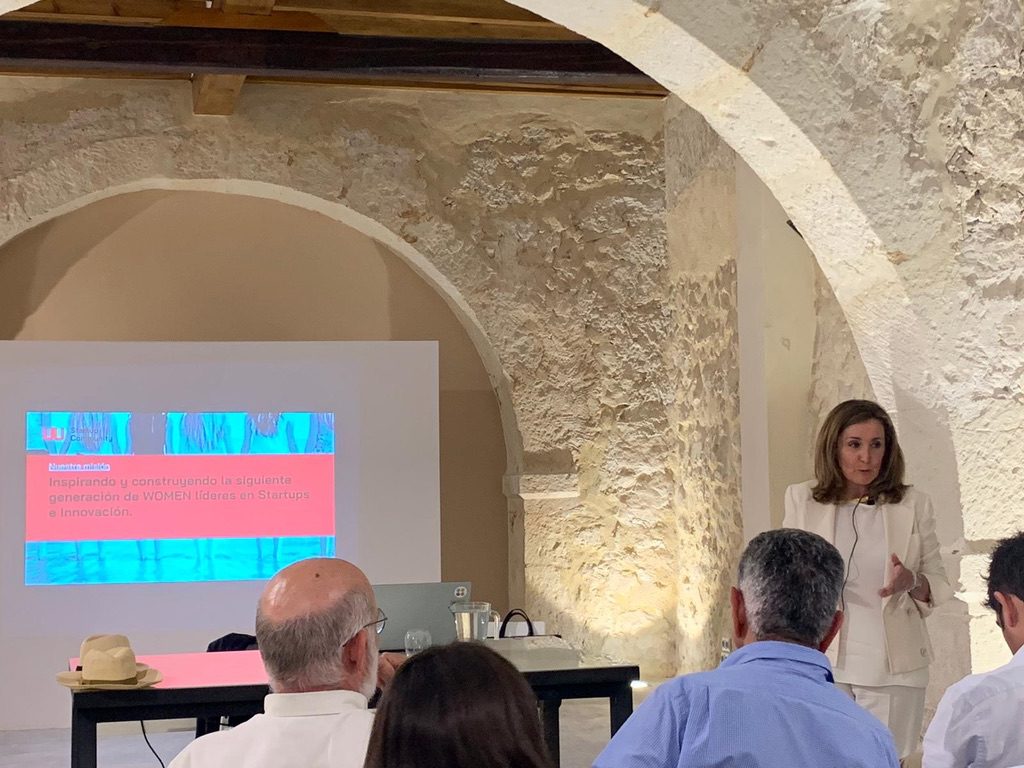
The organization’s beginnings date to 2016 in its own observatory report and a European Women in VC account. Its ambitions soon stretched beyond Madrid. In July 2019, Alarcos presented the initiative at Torre Juana in Alicante. The visit led to a local community with AlicanTEC, adding another regional connection to an international advisory network. It is an instructive piece of expansion: find people already embedded in a place and give the relationship something concrete to do.
Even the name carries that logic. Branding agency Acute says Madrid Startup Community came to it seeking an identity suited to further growth. The answer was Double U, expressed as W. Its explanation was cheerfully literal: “if you join us, your value multiplies.” A name cannot do the work of a network, but this one at least makes clear what members are supposed to get out of it.
The people in the room are the offer
The most visible gathering is Inspiring Women Leaders in the Digital Era. In February 2026, the University of Deusto hosted its tenth edition in Bilbao. The host reported representation from more than 29 countries. Quantum computing, generative AI, cybersecurity, blockchain and investment were among the subjects. The agenda put women’s leadership inside the discussion of how technology businesses operate.
Deusto described a mix of founders, corporations, investors, academics and public institutions. Corporate partners represented included Repsol, Volvo Cars, L’Oréal, Fujitsu, Euskaltel Foundation and QCentroid. The European Parliament provided official sponsorship. One talk addressed AI’s development toward agents; another connected entrepreneurship with government technology. For a founder, the attraction of that mixture is the possibility of testing a question against several kinds of experience in the same visit.
Inspiring Women Leaders reached its tenth edition at Deusto in February 2026.
That format places W Startup Community among organizations that help entrepreneurs find support, with a particular emphasis on women in technology. Someone seeking structured company-building support might consider an accelerator or a university entrepreneurship program. Someone seeking professional peers might join an industry association. W Startup Community combines a leadership network with public recognition and investor-facing conversations. Those functions can sit alongside other programs a founder already uses.
Collaboration also extends directly into investment networks. European Women in VC announced that it had joined forces with WStartupC, describing a network of more than 4,500 global corporate and investment executives alongside women founders. That is a description of the wider community, rather than a tally of paying customers. The distinction matters: access is the relevant unit here, and a large address book becomes valuable only when somebody answers.
Free entry has someone behind it
The economics are unusually relevant to the mission. In a June 2026 interview, Alarcos said the community was financed mainly by large companies and that women received free entry. She identified money as a barrier to participation. The listing for the February 2026 congress likewise offered free online and in-person ticket categories. For that event, the ticket price was zero.
“Una de las barreras clave es la económica.”
Teresa Alarcos, June 2026
“One of the key barriers is economic.”
This arrangement distributes the contribution across different participants. Corporate support helps sustain the gathering; professionals bring their experience; founders bring businesses and questions worth discussing. Free admission lowers one obstacle, although a founder still has to commit attention, preparation and, when attending physically, travel time. The useful calculation is personal: which problem could a conversation here help resolve?
Volunteer work is written into the association’s public ethics code. It calls for unpaid voluntary participation, trust, transparency and responsibility. It also addresses conflicts of interest and democratic decision-making. These are declared rules rather than a description of every working day, but they explain the intended bargain. A community asking people to share contacts and commercial problems needs reasons for them to trust the exchange.
A trophy with homework attached
UUPRIZE gives the organization another way to identify and promote women-led innovation. Its published older rules list investor advice, mentoring from industry leaders and specialist partners, and promotion in social networks and media. There is also a physical trophy and an NFT trophy, a small souvenir of the technology world’s enthusiasm for putting things on-chain. The practical benefits deserve at least as much attention as the object on the shelf.
The application asks for founders, a summary of the business model and a link to a 30-second pitch. Assessment covers originality, viability, planning, research and development, and prospects for international expansion. Those requirements make a useful preparation exercise even before a jury sees the entry: describe what the company does, explain why it can work, and do it without a ten-minute runway.
Categories have covered health and food technology, education, equal opportunities, sustainability, governance and cybersecurity. Older Startup Revelation rules specified a technology company no more than three years old with at least one female co-founder. A founder should read the relevant edition’s criteria before applying. Category fit is part of the application, especially when the business crosses several fields.
The 2025 ceremony at Madrid’s Royal Academy of Engineering recognized 15 recipients across entrepreneurship and other forms of innovative leadership. They included Fujitsu quantum-center director Almudena Justo, IBM AI leader Victoria Gómez and QCentroid founder Pilar Troncoso. QCentroid separately celebrated Troncoso’s quantum-computing recognition. The range shows how the community connects startup founders with women building technology inside larger organizations.
An award can provide a reason to contact a potential partner and a concise signal that somebody has examined the work. It does not establish customer demand or settle an investor’s decision. The sensible next move is specific: use the mentoring conversation to improve a forecast, question a market assumption or identify the person responsible for a possible pilot. Applause becomes more useful when it produces a task.
Count the founders, then ask better questions
W Startup Community also produces research, including an observatory developed with the University of Málaga. The report available through its website in 2024 used a final survey sample of 128 companies after questionnaires went to 500 startups. That gives its advocacy something more substantial than a succession of inspiring biographies: businesses can be compared through their staffing, finance and innovation activity.
Separate measures from the 128-company study. Historical survey findings, not a 2026 census or results caused by the community.
The findings make the audience tangible. Most surveyed companies were small, and many relied entirely on their own financing. The two measures describe different aspects of company life; they should not be added together. They also suggest why introductions and informed advice can matter to a founder who cannot simply hire a specialist for every decision.
Research broadens the organization’s role beyond the stage. Public institutions and program designers need evidence about the companies they hope to support. Founders can use such work to place their own experience in context. The association’s earlier research report, released in 2021, also described scholarships, mentoring and alliances with European venture capital networks. Knowledge and connections have developed alongside one another.
Arrive with a question worth answering
For a woman building a technology company, the practical entry points are the congress, award calls and the community’s contact channels. The offer is most relevant when a founder can identify what she needs: a sharper value proposition, a mentor familiar with her sector, a corporate conversation or help understanding routes to finance. The clearer the request, the easier it is for another person to act on it.
There is a lesson here for anyone organizing a founder community. Begin with repeated, observable questions. Recruit people who can answer them. Give participants a reason to meet again, whether through a research project, an award or a local partnership. W Startup Community’s collaboration with Inspiring Girls Spain adds an earlier point of contact, encouraging girls’ interests in STEM and entrepreneurship before they have a company to pitch.
The approach depends on engaged partners and founders willing to follow through. It is less useful when an entrepreneur needs an immediate capital commitment or hands-on delivery of a technical project. The community creates occasions for help to happen. Its best use is to turn one of those occasions into a next step: a meeting booked, an assumption tested, a person who now knows what you are building.
Keep the conversation going
Explore the official website and UUPRIZE information. Follow the community on LinkedIn, X, Instagram and Facebook.
Watch Teresa Alarcos’s European Women in VC briefing or explore the community’s YouTube channel. Read Deusto’s account of the 2026 congress and the story behind Double U’s name.