Before Neha Sampat had the title that got her into the room, she had another qualification: she knew the wine. While studying to become a sommelier, she worked at a wine bar alongside her technology career. Word travelled. Invitations to executive gatherings followed, including conversations she believed she would otherwise have missed. A hobby had quietly acquired a job description.
She had taken up wine because she enjoyed its taste and the geography and history it opened up. The business applications arrived later. There is something pleasingly untidy about that sequence. A supposedly extracurricular interest turned out to be useful in a professional world with fairly settled ideas about who belonged at the table.
Today, Sampat is co-founder and CEO of Contentstack, an enterprise software company. Her qualifications also include public relations, product marketing, an MBA and a childhood spent watching her parents run businesses. The wine fits into that education. Across these different settings, she kept finding ways to make herself useful before the invitation became obvious.
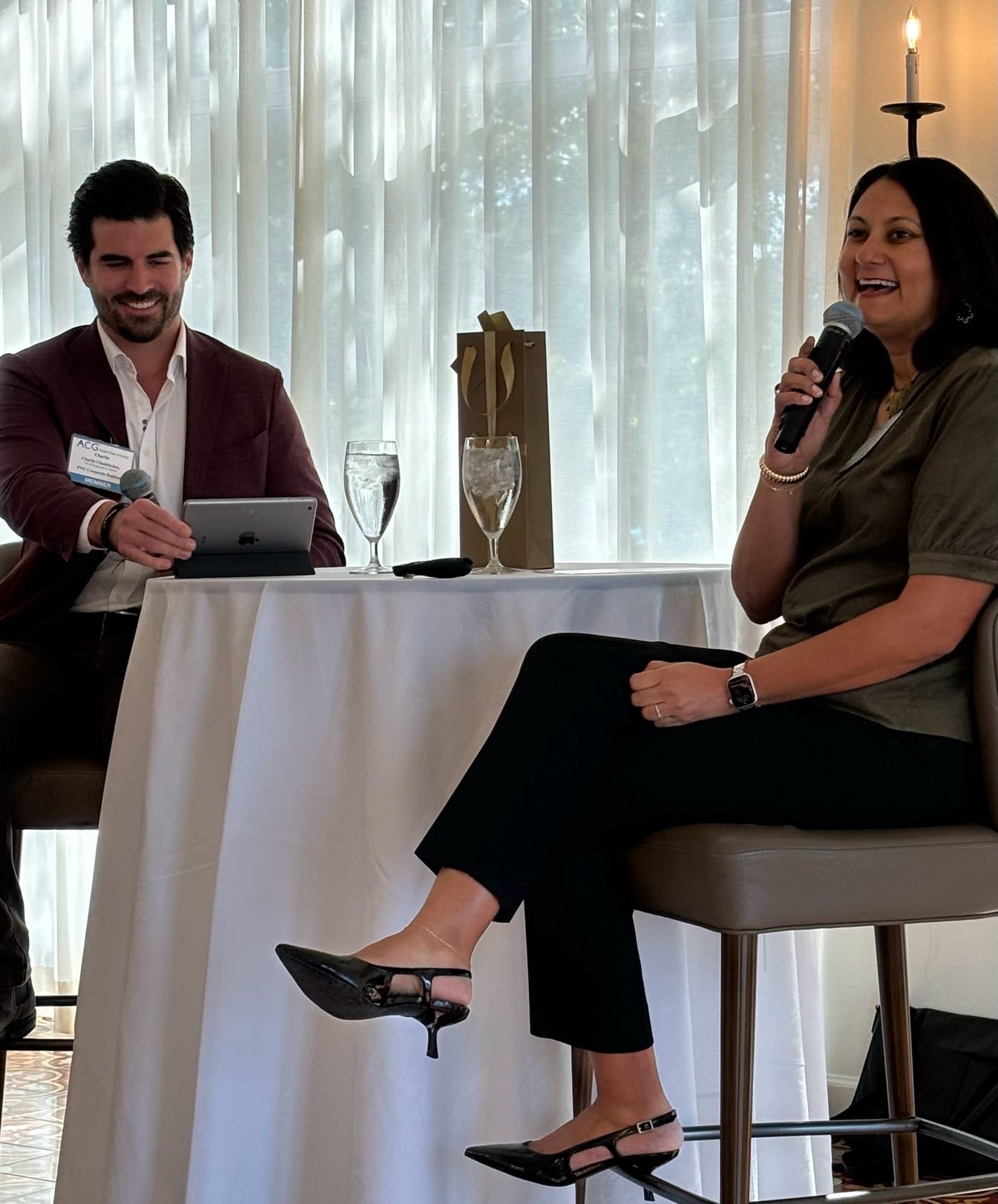
At an Association for Corporate Growth lunch in November 2024, she spoke about entrepreneurship and Austin’s business community. The person who asked the best question received a bottle of wine. By then, she could issue invitations of her own.
A print shop, a boy band, a first profit
Sampat grew up in Pomona, California, where her parents had settled after leaving India. Her father pursued business ideas, and she saw the financial uncertainty that could accompany them. Entrepreneurship was part of household life. The attraction came with a practical understanding that customers, expenses and next month’s obligations would eventually need to meet.
Her parents’ print shop supplied an early production facility. At twelve, she and a friend started a New Kids on the Block fan club, charging $18 for homemade fan gear. They made more than $1,000 in profit and reinvested it in a neighbourhood children’s Olympics. They also tried a babysitters club, inspired by the books. A boy band had inadvertently helped finance a small diversification strategy.
Those ventures required attention to what other people wanted, then enough organisation to deliver it. That combination would reappear in her software career. The scale changed considerably; the basic exercise of finding an interested customer was already familiar.
After graduating from the University of Denver in 1999, she drove to Silicon Valley and entered technology public relations. At twenty-two, she co-founded Special Sauce Communications. The name had appetite. The timing proved less accommodating: the technology downturn and the aftermath of September 11 squeezed PR spending, and the firm closed.
The headline writer among the engineers
Sampat returned to her MBA studies at Santa Clara University, graduating in 2003. An internship at Sun Microsystems helped move her from public relations toward product work. She later led e-commerce at VMware. Her undergraduate subjects, French and mass communications, remained an unusual preparation for a career selling enterprise software.
They also gave her something to contribute. In discussions with engineers, she could reduce an idea to a headline or a sentence about its value. Technical colleagues understood how a system worked. She paid attention to how somebody outside that conversation would understand why it mattered. That ability became part of the product work itself.
Raw Engineering, co-founded in 2007, put her team close to the difficulties companies faced as they adopted cloud and mobile technology. Clients needed their systems to communicate. Built.io addressed integration. Another persistent problem concerned content: changing the words or images on a digital service could demand more technical intervention than the business team wanted.
Contentstack grew out of that work, with co-founders Nishant Patel and Matthew Baier. The company became independent in 2018, the year Built.io was sold to Software AG. Sampat’s career had developed through related problems rather than a single immaculate business plan. Working on one obstruction exposed the next.
- 2007Raw EngineeringHelping companies adapt to cloud and mobile
- 2014Built.ioConnecting systems and applications
- 2018ContentstackAn independent business for managing digital content
What a marketer was actually waiting for
A content management system is the machinery behind the material a business publishes. A headless system separates that material from the interface where people encounter it. The same content can be delivered to different websites, applications or other channels, while developers retain choices about how those experiences are built.
For Sampat, the commercial problem was the working relationship between business teams and technical teams. Marketers wanted to change things quickly. Developers had competing priorities and infrastructure to protect. A request that sounded tiny on one side could create a queue on the other. Much of the opportunity lay in reducing that friction.
That explains why her background mattered beyond a good founder anecdote. She had spent time translating between a product and its audience. Building a company around the gap between business intent and technical execution extended work she already understood.
By November 2022, Contentstack had raised an $80 million Series C, co-led by Georgian and Insight Partners with participation from Illuminate Ventures. Its announced funding total at that point was $169 million. The company said customer numbers had doubled and annual recurring revenue had nearly tripled since its June 2021 Series B. These were dated milestones in the business she was building, rather than a measure of her personal wealth.
The CEO who periodically replaces herself
Growing the company also meant revisiting the job of running it. Sampat has described a practice, inspired by Gainsight CEO Nick Mehta, of mentally firing and rehiring herself every six months. She asks what a new CEO would change and where her own approach needs improvement. It is an economical succession plan: the incoming executive already knows where everything is.
The exercise recognises that founding a company does not automatically prepare someone for every later version of it. More people and larger customers change the demands on the leader. An instinct that helped at the beginning can become a habit that deserves inspection.
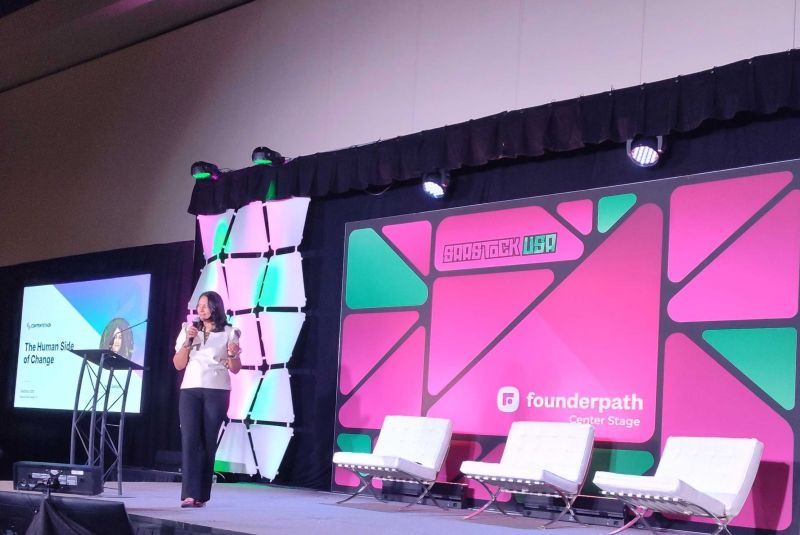
Her public discussions of leadership consistently return to empathy, accountability and enabling other people to work. At SaaStock USA in May 2025, she addressed the human side of change: employees need the understanding and capability to use the technology their organisation introduces. Buying the software leaves a substantial part of the work unfinished.
External recognition followed her operating work. Springboard Enterprises named her its 2024 Entrepreneur of the Year. In June 2025, she was among the EY Entrepreneur Of The Year Gulf South award winners. Inc. also included her on its 2025 Female Founders 500 list. The awards describe different institutions noticing the same career, rather than explaining how that career happened.
An address outside the usual map
Another part of Sampat’s education came from moving between the United States and India. Her parents came from Mumbai and Kolkata, and family visits helped maintain those connections. Her business would give that geography a working purpose.
Contentstack’s engineering roots included a modest office in a repurposed tile factory in Virar, outside Mumbai. By August 2025, Sampat was discussing the company’s expansion across Virar, Pune, Bengaluru and Chennai, alongside an offering that gave Indian developers and startups free access to enterprise-grade content management software.
The location carries a point she has stated plainly: “Talent is everywhere but access is not.” Her interest is in connecting ability with the equipment, experience and opportunity that allow it to become a career. For someone whose own qualifications did not resemble the expected software-founder résumé, that concern has a personal precedent.
She moved to Austin in 2019. Her work there extends beyond Contentstack: she is a co-owner of Austin Woman magazine and serves on Austin Habitat for Humanity’s board. Her Dreammakers podcast has given her another place to talk with people about building businesses and pursuing ambitions. These commitments bring her into conversations that reach beyond the software buyer’s calendar.
“Talent is everywhere but access is not.”
Neha Sampat
The next audience may be an agent
The software itself has continued to change. Contentstack completed its acquisition of customer data platform Lytics in December 2024 and announced it in January 2025. The combination added audience information and real-time data capabilities to its content platform. Understanding the recipient became a more explicit part of deciding what to publish.
On June 9, 2026, Contentstack introduced its Agentic Experience Platform and made Agent OS generally available. The offering connects content, customer data and AI orchestration. The company’s stated objective is to help enterprises move AI work beyond disconnected experiments and into their daily operations, with governance around the content those systems use.
On October 1, it launched Contentstack Canoe, a standalone tool for examining how brands appear in AI-generated answers. Its reports show whether a brand is mentioned, how it is described and which competitors appear. A person who once worked on the language companies used to present themselves is now running a business that helps them examine how machines present them.
There is a smaller recurring appointment in Sampat’s week, too. After leaving San Francisco for Austin, she kept a Tuesday-noon ritual with a foghorn sound on her phone, recalling the city’s emergency test. She uses the interruption to pause and reset. The technology needed for that particular task is modest.
Wine study, a print shop, a PR firm, an engineering business, a different city: her working life contains several kinds of classroom. She has kept the interests that made it her own. One of her published mantras is “Never be boring.” Even the executive lunch has a chance of sending somebody home with a decent question and a bottle.