The expensive thing about a missed appointment is how quiet it is. There is no crash, no alarm, just a space in a calendar where a patient ought to be. The clinician is ready. The room is ready. The reminder may even have gone out. Somewhere between the practice and the person, however, the arrangement has come undone.
Solutionreach has made a business of that interval. It sells patient communication software to dental, eye-care and medical providers: reminders, two-way texting, scheduling, recall, forms and payments. Its proposition is practical. Make it easier for people to answer, book, arrive and pay, and a practice can spend less of its day pursuing them.
- The job: connect everyday patient messages to the practice’s working schedule.
- The audience: individual practices, multi-location groups and health systems.
- The distinguishing detail: the company advertises more than 400 PM/EHR integrations.
- The buying question: how much work remains after the message is sent?
A banker’s text, a dentist’s empty chair
The origin has an agreeable lack of medical grandeur. In Solutionreach’s telling, Jim Higgins started Communitect in 2000 with a small team and technology that let banks text their customers. Then he learned about dental no-shows. A bank notification and an appointment reminder shared a useful property: both concerned information that people could act on without a long conversation.
The business connected its technology to dental practice management systems and became Smile Reminder. By 2005, its repertoire included email reminders, recall and newsletters. By 2011, providers beyond dentistry wanted similar tools. Smile Reminder became Solutionreach. The name had been charming; the market had become less obliging about remaining inside it.
Bank notifications
Beyond dentistry
From booking to billing
In May 2012, Summit Partners announced a growth-equity investment, with financial terms undisclosed. The announcement described a company already working across acquisition, education, retention, receivables and reputation. The larger business was taking shape around a modest entry point: get the communication right, then follow the patient’s next administrative problem.
The reminder that nobody trusts
Saint Francis Healthcare System provides a revealing example. Its older system supported phone and email reminders but no texting. The company’s case study describes unfamiliar outbound numbers and a call center handling basic appointment questions. Messages were being delivered, yet patients still needed help navigating their appointments.
Saint Francis switched to Solutionreach’s customizable text reminders, batch messages and reminder calls from three recognizable numbers. The published case study reports a no-show rate of 5.8%, $3.1 million in additional revenue and an average of 156,000 messages a month. These are vendor-published results for one customer, rather than a forecast for every practice.
No-show rate
Additional revenue
Messages per month
The lesson is that a reminder has several jobs. It must reach someone, appear credible and make the next action manageable. A practice that counts only outgoing messages misses the interesting part: what the patient does afterward. Recognition, reply and scheduling belong to the same transaction.
“No, patients don’t want us to call them. Yes, they do want a text.”
Celina Gauthier / Pediatric Associates of Lewiston
Company-published customer testimonial
A message needs somewhere to go
Solutionreach’s two-way texting lets staff handle appointment changes and questions, receive images and inspect conversation histories from a desktop or mobile app. Recall targets patients due to return. Online scheduling lets people book or request appointments. Digital intake moves forms ahead of the visit. Surveys and review invitations extend the conversation afterward.
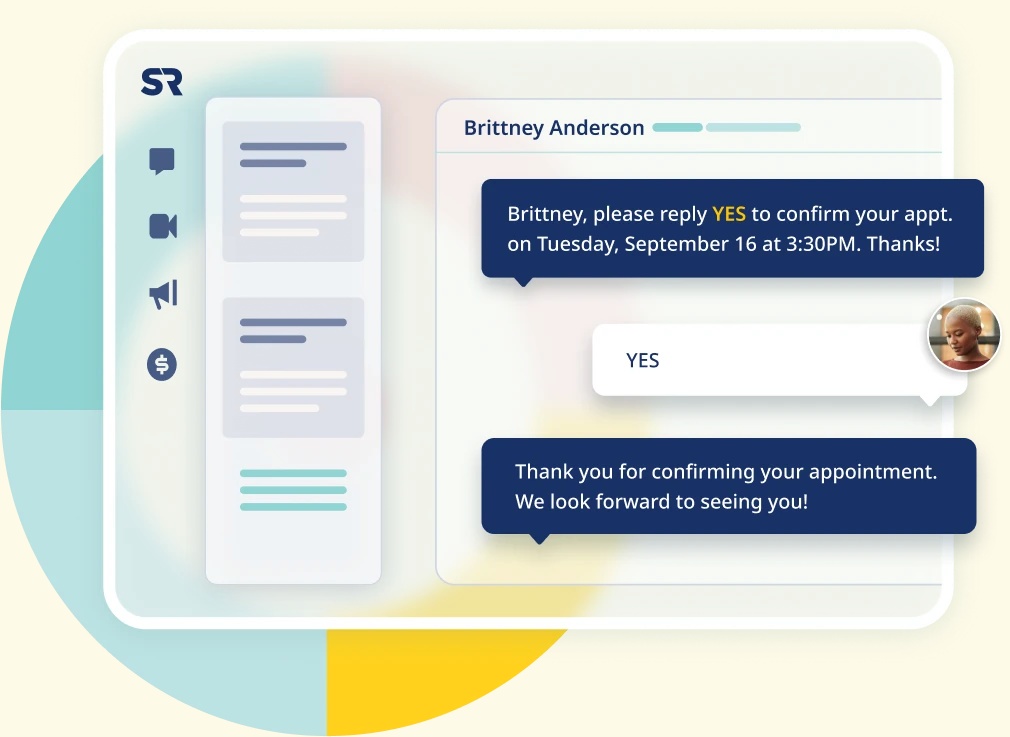
The integration is where those apparently simple exchanges become difficult. A text saying “yes” is useful only if the practice can connect it to the right person and appointment. Solutionreach markets SyncAssure, its proprietary integration architecture, and lists connections including Dentrix, EagleSoft, Epic, NextGen and OfficeMate. Its advertised breadth matters to organizations with established systems they want to keep.
A count of supported systems is an opening question, though. Buyers still need to examine their particular connection: what is read, what is written back and which workflows require staff intervention? The company’s AI scheduling page explicitly qualifies direct booking by supported practice management systems. Compatibility deserves a demonstration with the calendar the practice actually uses.
- 01BookScheduling + recall
- 02PrepareReminders + intake
- 03AttendCheck-in + replies
- 04SettlePayment messages
One patient journey, several handoffs. The value depends on how well they connect.
The bill joins the conversation
In April 2024, Solutionreach announced Revenue Cycle Messaging, bringing financial communication into its account of the patient journey. The remit runs from registration and insurance information to treatment details, payment notifications and overdue balances. Dental Insurance Eligibility followed in June, giving practices tools to request insurance information and verify coverage and usage.
The current payment offering includes text-to-pay, online payments, in-office terminals, notifications, refunds and reconciliation. CareCredit appears as an integrated financing option. This is a broader pitch than filling a calendar: the company wants its messaging platform involved in the administrative steps that turn an appointment into collected revenue.
The distinction matters in a crowded market. Weave, NexHealth, RevenueWell and Lighthouse 360 offer overlapping ways to communicate with patients. Solutionreach’s case rests on healthcare specialization, integration breadth and a collection of workflows spanning dental, vision and medical practices. For larger groups, centralized location management adds another reason to buy. A feature list alone will not settle the choice; fit with existing systems and staff routines will.
A receptionist called Stella
The newer scheduling assistant has a name: Stella. Solutionreach’s AI Receptionist answers calls and SMS messages when staff are unavailable, handles routine practice-information requests, and books, moves or cancels appointments through supported integrations. Conversations are logged for staff review. The company recommends beginning with after-hours coverage.
That starting point is sensible editorially as well as operationally. After hours, the comparison is often a booked appointment versus waiting for a callback. A practice can examine what was captured, where staff had to intervene and whether the schedule stayed accurate before widening the assistant’s responsibilities.
August 2026 release notes offer a glimpse of the work beneath the product pitch. Virtual Scheduling Assistant became AI Receptionist throughout the software. Practices gained up to five weekday text-response windows; eligible patients could select a location before scheduling by text. The same release improved clickable controls, intake drafts and appointment-change notifications. Software becomes useful through details this small.
The price of less phone tag
Solutionreach sells yearly contract options through quote-based packages: Patient Connect, Practice Efficiency, Practice Growth and Enterprise. Enterprise is aimed at organizations with six or more locations. The advertised SMS allowances for the three practice packages are 1,750, 3,500 and 4,500 messages a month; enterprise allowances are tailored. Package limits and add-ons belong in the cost calculation.
A historical example adds texture. An October 2020 HITEQ patient-engagement inventory recorded one federally qualified health center with five sites and 16,000 patients paying $32,000 annually for license and support. That customer reported an unsuccessful adoption and switched tools shortly afterward. The entry identified poor vendor responsiveness and training limited to online videos. It is one dated account, with no basis for treating it as today’s standard experience or price.
It does reveal what can go wrong before an automation promise pays off: the practice must learn and operate the system. Current materials describe a dedicated success coach and onboarding that can take under a week, depending on the practice management system. A useful evaluation therefore includes the subscription, message volume, integration work, training and who answers when the workflow stalls.
The people behind the prompts
Solutionreach marked its twenty-fifth anniversary in July 2025, reporting more than 15 billion cumulative messages. Ken Ernsting, appointed CEO in 2023, leads a business whose market now includes large groups as well as individual practices. The company’s scale claims describe reach; they do not tell us how every customer experiences the software.

Its employer materials emphasize clear communication, looking after teammates and learning from mistakes, alongside hybrid work and community fundraising. Those are declared principles. The harder, customer-facing expression of the same idea is whether a practice gets help when a patient message, calendar update or payment request goes astray.
Readers can copy a useful discipline from this story: pick one handoff, make the message recognizable, make the reply easy and measure the completed action. Keep somebody responsible for exceptions. If records are inaccurate, integrations incomplete or patients poorly served by the chosen channel, faster messaging may simply circulate the confusion faster. The empty chair is a useful place to begin because the result, at least, is visible.