Alexis Fogel tried to repair his washing machine with help from the internet. It did not work. This is a pleasing detail in the career of someone who has spent years making software easier to use. Even a product founder can end up with instructions, determination and an appliance that declines to cooperate.
His complaint went beyond domestic machinery. Tutorials for Photoshop and Final Cut Pro could make him sit through introductions before he discovered they answered a different question. At Dashlane, the password manager he co-founded, he encountered the same difficulty from the opposite side: explaining a product to someone who did not already understand it.
An expert sees a browser extension. A beginner sees another unfamiliar thing to install. Add different browsers, devices and operating systems, and an apparently simple explanation acquires a remarkable number of footnotes. The writer knows which ones matter. The reader has to work that out while already being stuck.
That gap became the subject of Fogel’s next company, Stonly. It also makes his career more interesting than a procession of funding announcements. He helped build one product, watched people struggle with it, and made the struggle itself the reason to build another. The inconvenience had become an idea with a company attached.
Before the password manager
Fogel’s route to software ran through business school. He studied management at ESCP, spent a gap year in information systems audit at Mazars and organisational consulting at Capgemini, and took an exchange in India. His final ESCP year brought him to Centrale for information systems, where he met future Dashlane co-founders.
The combination matters. A product has to work as technology, make sense as a business and survive contact with a person who has other things to do. His education placed those concerns near one another. Later, he would speak about the usefulness of basic accounting and law, alongside lessons in empathy toward colleagues.
Dashlane’s beginning was less tidy than its eventual description. In 2024, Fogel revisited a school project centred on universal one-click purchasing. The route from there to password management involved user feedback, changes in emphasis and the practical difficulties of filling forms across the web.
It is easy, looking backward, to give a company the purpose it eventually found. The early work was a search. Customers helped establish which part of the proposition deserved attention. That experience gives some context to Fogel’s later interest in watching how people actually use software, rather than assuming that a carefully designed feature explains itself.
A second start, with the mistakes included
By the time he left his operating role at Dashlane in 2018, Fogel had spent roughly a decade there and served as chief product officer. He later clarified an easily mangled point in founder biographies: he had left the company, rather than sold his shares. Departure and exit were different events.
His account of starting again has an appealingly practical element. Experience had arrived after many decisions were already made. Technical debt had accumulated. Hiring sometimes answered an immediate need, leaving too little room to think ahead. A new company offered a chance to use those lessons at the beginning, when they might be cheaper.
In 2021 he described recruiting earlier at Stonly, anticipating requirements instead of waiting until a vacancy felt urgent. There is little glamour in that distinction. There is, however, a considerable difference between choosing someone deliberately and discovering on Monday that the business needed them last Thursday.
The lesson kept resurfacing. His product talk, published in 2024, emphasised care at the outset across technical, cultural and security decisions. Repair work has a price. Fogel’s second attempt suggests an entrepreneur interested in reducing that bill, without pretending that a previous company supplies an instruction manual for the next one.
“Saying no in Product is the most important thing”
Alexis Fogel · STATION F interview, 2020
The answer should change with the question
Stonly began in 2018 and launched publicly in 2019. Its proposition was interactive guidance: instructions that could change according to the choices a user made. Instead of asking everyone to read the same long explanation, a business could offer a route through the particular situation in front of them.
Fogel described the opportunity at B2B Rocks as an answer to a problem he had experienced at Dashlane. Customers needed to troubleshoot before contacting support. He had looked for a suitable solution and decided to build one. The starting point was specific enough to test, with room to apply the approach elsewhere.
Consider the example he gave in 2021: helping someone selling an iPhone through Back Market disconnect it from iCloud. The task has a destination. Instructions earn their keep when the person reaches it. An attractive help page that leaves the seller confused has not finished the job, however fine its typography.
The format also changes the work of explanation. A person writing a conventional article must accommodate several possible readers at once. A branching guide can ask which situation applies before proceeding. That places a responsibility on the author to understand the alternatives. The reader sees fewer of them, but somebody still has to do the thinking. In that sense, Stonly’s premise is demanding: make the publisher organise the complexity so the customer does not have to carry all of it. The question becomes whether each step earns the attention it asks for.
Product discipline accompanies that ambition. In 2020, Fogel emphasised the importance of refusing product requests. At the time, he was building Stonly in STATION F’s Zendesk programme. A company devoted to explaining things still has to decide which things it will attempt first.
Three countries, chosen one person at a time
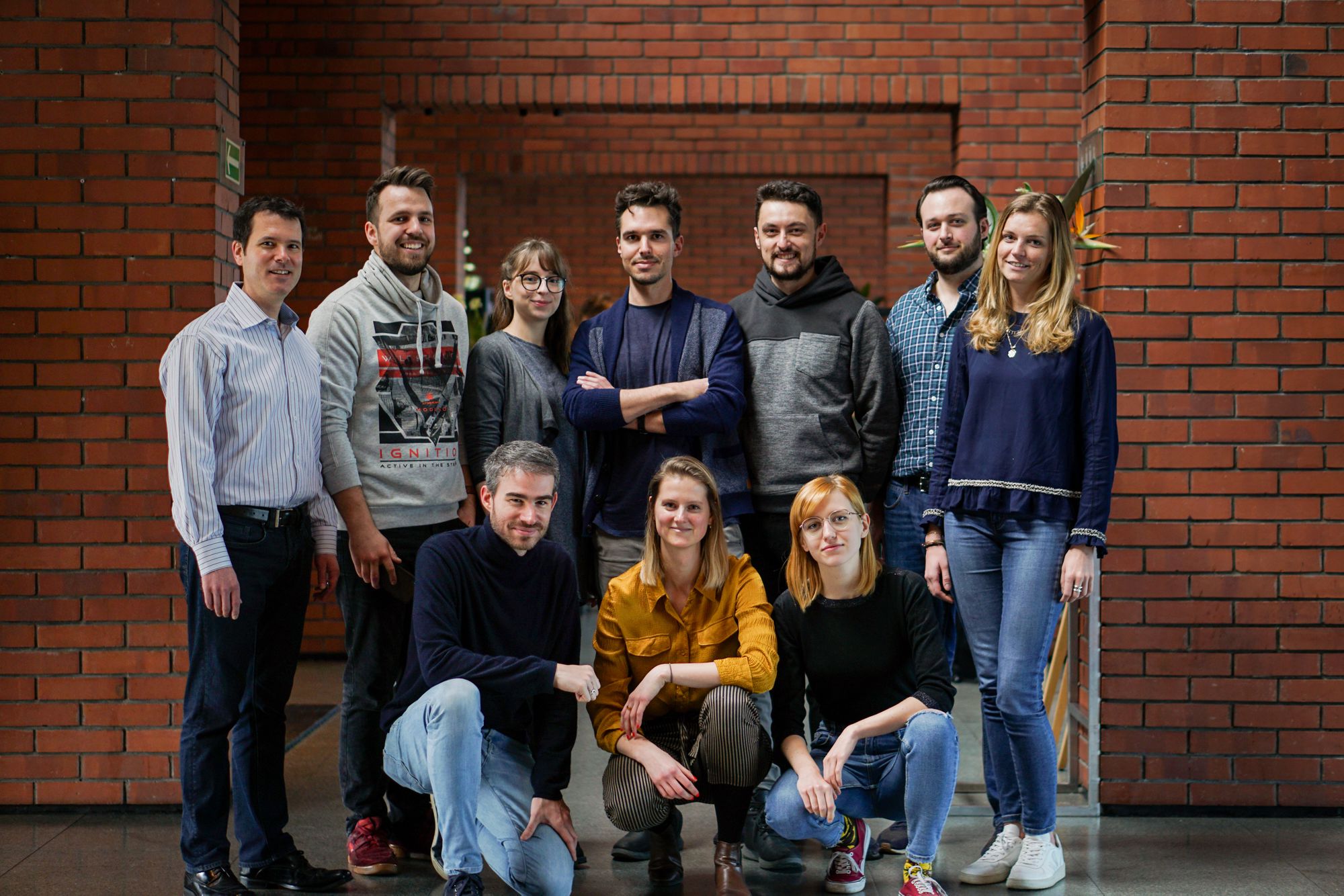
The early team did not emerge from a neat geographical plan. Krzysztof Dąbrowski, a designer Fogel knew from Dashlane, wanted to join the project and wanted to remain in Poland. Building together meant accepting that fact. Poland became part of Stonly’s foundations, with early engineering recruitment in Krakow.
David Rostan was another relationship carried forward. He and Fogel had worked together at Dashlane before Rostan became Calendly’s vice-president of sales and marketing. When the new business needed to develop its commercial side, they found a way to work together again. New York became part of the company’s map.
Fogel’s formulation was direct: “you build around people much more than locations”. France, Poland and the United States followed from those relationships and business needs. The resulting administration was inconvenient, by his own account. The benefit was access to people he wanted beside him.
His later conversations about recruitment broadened that concern. A January 2025 Sonnar podcast explored mentorship, entrepreneurial early hires and the role of cultural fit in team performance. Across these accounts, recruitment appears as part of the product story. The people making decisions together help determine what the product can become.
Money arrives with a job to do
Accel’s first investment in Stonly came in 2020, in a $3.5 million seed round. In January 2022, Northzone led a $22 million Series A, with Accel participating again. The two rounds belonged to different stages of the business, separated by the work of turning an initial proposition into something customers would use.
Northzone’s announcement described a customer base that had grown fivefold during 2021 and named users including Intuit, Criteo, Back Market and UCLA. These were company and investor accounts of progress at that time. Their significance is concrete: a support problem first noticed inside one company was finding an audience outside it.
The backing also brought a network of operators. The Series A included Miro’s Andrey Khusid, Algolia co-founder Nicolas Dessaigne, Personio’s Roman Schumacher and former Dashlane chief executive Emmanuel Schalit. Their involvement connected Stonly with people who had encountered the business of making software useful at scale.
There is a temptation to make the money the climax. For this story, the more revealing question is what it was meant to finance. Better guidance requires product work, distribution and teams capable of understanding customer processes. A funding round makes those commitments possible; customers still decide whether the instructions help.
A chatbot still needs to know the answer
AI gave Fogel another interface through which to pursue the same problem. In March 2024, he described Stonly using it to connect a customer’s request with an answer, a process or an action through internal tools. He also reported a 30 percent reduction in Stonly’s own support tickets after implementing AI in its help experience.
His qualification was straightforward: the technology depends on the content beneath it. Fluent language cannot supply a missing policy or settle a process a company has never defined. For someone whose business began with the shortcomings of instructions, this is a consistent concern. A conversational interface still needs something useful to say.
His essay on the future of customer service develops that argument. Some problems need a sequence of actions. Others require human judgement or a handoff. Knowledge has to be maintained, organised and available where work happens. A chat window is one possible doorway into that system, with consequences for the system behind it.
By 2026, Open CNP had publicly welcomed Stonly into its portfolio, describing an investment already made and a relationship that also involved customers CNP Assurances and the wider La Poste group. Fogel responded by thanking the organisation as both customer and investor. It was a useful intersection for a company built around practical support.
The thread through his career remains the person trying to get something done. A purchase. A login. A phone ready to sell. Each can look obvious to its designer and bewildering to someone arriving fresh. Fogel has made that difference a recurring subject of his work. The instructions have to meet the beginner where the beginner is.