The buy button is a masterpiece of misdirection. It makes commerce look instantaneous: tap, confirm, done. Behind it, the order begins a bureaucratic obstacle course. A retailer sends a purchase order. A supplier acknowledges it. A warehouse reserves stock. A carrier needs a shipping notice. Finance expects an invoice in precisely the right format. Each participant may speak through a different enterprise resource planning system, marketplace portal or decades-old data standard. If one field arrives wrong, the simple order becomes a phone call, a spreadsheet and a delay.
TrueCommerce lives in that delay. The private company, headquartered in Cranberry Township outside Pittsburgh, sells the connective tissue between trading partners and their software. Its platform moves electronic data interchange, or EDI, into and out of ERPs; automates e-invoices; helps vendors plan inventory; connects online marketplaces; and gives business buyers a digital storefront. Customers can operate the tools themselves or hand much of the daily work to a managed-service team.
It is a business built on making machines agree. TrueCommerce says its network makes more than 3 million companies accessible and exchanges about 600 million transactions a year. Those figures describe the scale, but the appeal is easier to understand at human size: fewer people retyping an order from one screen into another.
01 / The workOld standard, new plumbing
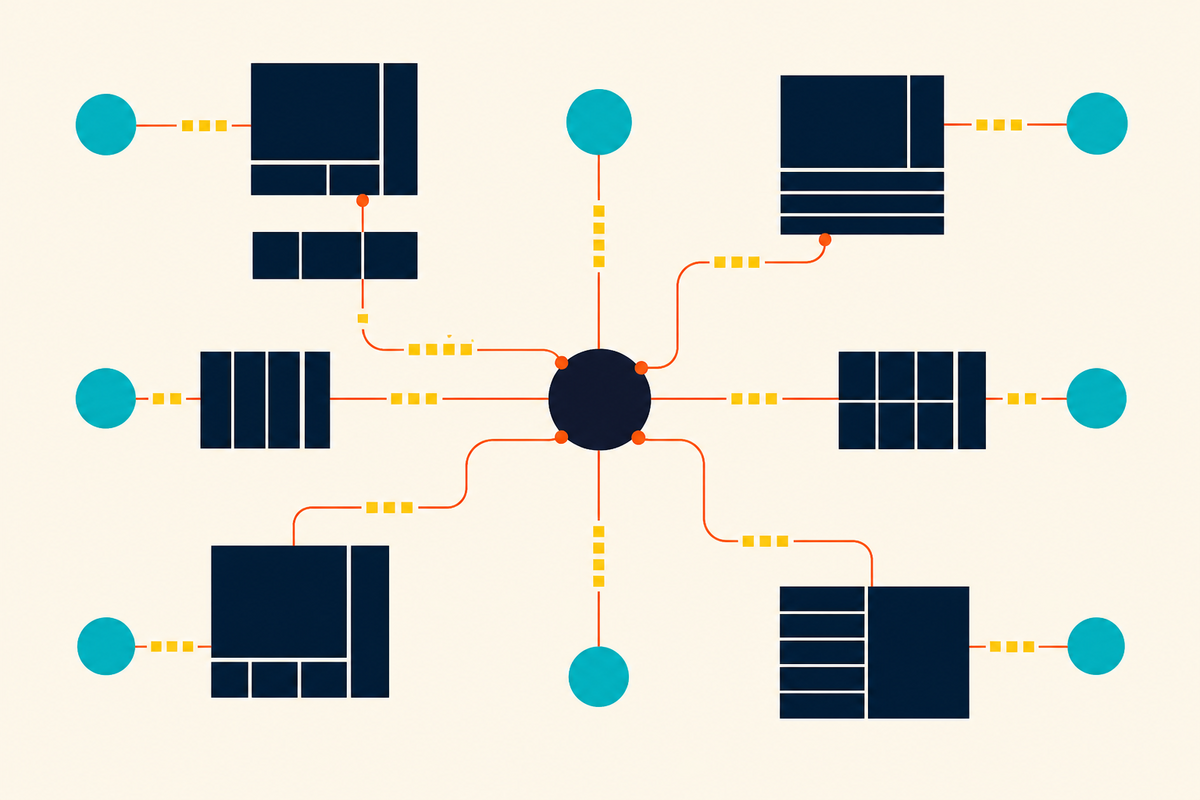
EDI predates the commercial web. It replaces paper business documents with structured machine-readable messages. The idea is durable because purchase orders, invoices and advance shipping notices are durable. The irritation is everything around the standard: mapping one company’s fields to another’s, satisfying a retailer’s particular rules, connecting the result to an ERP and maintaining it whenever any participant changes a requirement.
purchase order
mapping
ERP
shipment
and payment
TrueCommerce wraps that work in cloud software and, importantly, people. Its fully managed offering includes implementation, mapping, trading-partner onboarding, message monitoring and issue resolution. A customer does not merely rent a translator. It can hire the company to watch the translation desk around the clock.
That combination distinguishes TrueCommerce from three common alternatives: running an in-house EDI team, buying a basic value-added network, or assembling integrations one connector at a time. Rivals such as SPS Commerce, Cleo, OpenText, IBM Sterling, E2open and Descartes attack overlapping parts of the same market. TrueCommerce’s pitch is breadth with accountability - the network, ERP integration, adjacent applications and managed operations under one contract.
“Because I’m using cloud-based solutions for EDI and ERP with TrueCommerce, I don’t need an IT staff or servers or anything like that.”Jason Sutherland, customer and CFO
02 / The customerEveryone behind the shelf
The buyers are manufacturers, consumer brands, wholesalers, distributors, retailers and suppliers. Their company sizes vary; their common problem is transaction volume crossing organizational boundaries. A fast-growing food brand may need to meet a national retailer’s EDI rules. A multinational manufacturer may face e-invoice mandates in dozens of countries. A supplier may want real-time point-of-sale data so it can replenish a customer’s shelves without overfilling them.
The company’s published customer roster ranges from recognizable brands such as General Mills, Bayer, Tillamook and Costa Coffee to smaller operators for whom one major retail account can transform the business. This mix matters. Enterprise networks become useful when the large hub and its long tail of suppliers can meet in the same place. A connection already mapped for one customer can reduce the setup work for the next.
That is the quiet network effect. A social network accumulates people; a trading network accumulates relationships, document maps and operating knowledge. None is exciting alone. Together they can shorten the distance from “a retailer wants to carry us” to “we can actually ship and invoice that retailer.”
Consider the small brand that wins its first order from a national chain. The celebration can end when the retailer sends a technical implementation guide hundreds of pages long. The supplier may need to transmit an order acknowledgment, a carton-level shipping notice and an invoice, each with the retailer’s preferred codes and timing. Chargebacks can follow when the message is incomplete or late. TrueCommerce maintains those partner requirements and maps them into the software the supplier already uses. The brand still has to make and ship the product; it should not have to become a standards historian overnight.
At the other end of the market, a retailer faces the mirror image. It may have thousands of suppliers, from sophisticated manufacturers to family businesses that still email PDFs. Supplier enablement is the work of bringing that uneven community onto a consistent exchange. The platform can offer different entry points, while the service team handles outreach, testing and go-live coordination. The value is not simply faster documents. It is a cleaner view of what was ordered, what will ship and what should be paid.
03 / The portfolioMore than messages
TrueCommerce has expanded outward from EDI. Its e-invoicing product handles country-specific formats, Peppol access, continuous transaction controls and archives. That market is being pulled forward by governments that increasingly require structured electronic invoices rather than emailed PDFs. For a company trading across borders, compliance becomes an integration problem with a calendar attached.
Vendor-managed inventory is the planning layer. The supplier receives sales and inventory signals, then recommends or triggers replenishment. TrueCommerce’s ReplenishAI product applies forecasting to seasonal and event-driven demand. In a 2025 company case example involving an unnamed spice manufacturer, TrueCommerce reported improved forecast accuracy on 60 percent of SKUs and a 45 percent reduction in under-forecast demand. Those are company-reported results, not a universal promise, but they show the job AI is being given: prevent an empty shelf, not compose a sonnet.
B2B ecommerce and marketplace integrations handle selling channels. The marketplace connectors synchronize orders, inventory and fulfillment with back-office systems across more than 100 marketplaces. The B2B storefront product gives business buyers a web experience while preserving the less photogenic integrations underneath. Specialized packages such as TrueAuto adapt the same model to part-level automotive transactions and OEM requirements.
These products share a common data trail. An order entering from a marketplace can become a sales order in an ERP, trigger a pick at the warehouse, return tracking information to the buyer and decrement available inventory everywhere else. Without integration, employees become the middleware: downloading files, copying numbers and refreshing portals. That labor does not merely cost time. It creates lag, and lag is how a product that sold an hour ago remains available on another channel.
The e-invoicing opportunity is similar but carries regulatory force. France, Germany and other markets are phasing in structured invoice mandates with different schedules and technical rules. A global finance team could contract with local providers country by country. TrueCommerce argues for one connection that adapts output to each destination. Its approved Peppol access capabilities and support for multiple document standards place it in the increasingly busy overlap between tax compliance and B2B integration.
04 / The machineA subscription built by acquisition
Today’s TrueCommerce is not a tidy garage-startup story. It is an assembled one. The business opened in 1995, then combined with Accellos, a supply-chain software company founded by Mike Cornell, Flint Seaton and Ross Elliott. Under Accel-KKR, the combined operation migrated from on-premise licenses toward hosted subscriptions and went shopping.
WeSupply added retail connectivity; Nexternal and Netalogue added ecommerce; Datalliance added vendor-managed inventory; ecUtopia brought home-furnishings depth; B2BGateway expanded the network. The 2021 purchase of DiCentral was the largest, adding about 5,000 customers and 30,000 connections, according to TrueCommerce. Welsh, Carson, Anderson & Stowe acquired control in late 2020, while Accel-KKR retained a minority stake.
The result is a classic private-equity software model with a network twist: recurring subscriptions, implementation and onboarding work, managed-service revenue, and a portfolio expanded through acquisitions. Pricing is quote-based because a small supplier sending a few document types is not the same job as a multinational connecting multiple ERPs, countries and thousands of partners.
The channel is part of the machine. Accountants and operations teams often encounter EDI during an ERP implementation, so TrueCommerce recruits the consultants and software partners already in that room. Its xChange program had more than 340 partners by March 2025, spanning resellers, ERP specialists, independent software vendors and global integrators. The arrangement gives partners a supply-chain layer to attach to their projects and gives TrueCommerce distribution into communities built around Microsoft Dynamics, NetSuite, SAP, Sage, Acumatica and other systems.
Partnership badges alone are cheap; certified and maintained integrations are not. TrueCommerce has announced SAP-certified connections for both GROW with SAP and RISE with SAP S/4HANA Cloud. It also builds around the peculiar workflows of individual ERPs. That depth is a competitive answer to general-purpose integration platforms such as Boomi or MuleSoft. Those tools can connect almost anything, but the customer or consultant still has to know what a compliant retail order is supposed to do.
The real product is not EDI. It is the absence of the email that begins, “Did you receive our order?”
05 / The next mapAI gets an unglamorous assignment
TrueCommerce’s newer roadmap applies agentic AI to guided support, partner mapping and onboarding. These are sensible targets. Mapping is repetitive but exacting. Onboarding involves a predictable chain of configuration, testing and exceptions. Support teams already sit on years of resolution patterns. An assistant that proposes the next mapping or diagnoses a failed document can save time without pretending the supply chain runs itself.
The strategic risk is familiar to any company assembled over decades: breadth can become complexity. Customers want one platform, but acquired products do not become one experience by appearing on the same product page. CEO Bill Glass, appointed in 2025, has framed the work around innovation, customer experience and operational excellence. CTO Deepti Sharma, who joined from OpenText, is responsible for modernization, reliability and scale. Their less theatrical challenge is to make the portfolio feel as connected as the network it sells.
The organization describes its culture with four verbs: challenge, embrace, drive and deliver. Behind the polished phrasing is a workforce distributed across North America, Europe and Asia-Pacific, with LinkedIn placing the company in the 1,001-to-5,000 employee band. This is not a pure product company where the software is thrown over a wall. Implementation specialists, customer-success managers and a 24-hour service desk are part of what is being purchased. The culture therefore has to reward patient operational work alongside invention.
That balance also determines how far automation should go. An AI tool can suggest a map between two invoice fields, but a failed invoice may stop payment to a supplier. TrueCommerce’s managed model leaves a human escalation path around the algorithm. In a market excited by autonomous agents, the more credible promise is supervised acceleration: let the system handle the repeatable cases, show its work, and bring in an expert when a trading partner invents a new exception.
TrueCommerce fits between integration software and supply-chain applications. It is narrower than a full planning suite, broader than an EDI utility, and more service-heavy than a self-serve connector. Its strongest claim is practical: one connection can reach a large community of counterparties, translate their requirements into the customer’s business system and keep working after go-live.
That work will remain mostly invisible. A good transaction produces no applause; the order simply arrives, the stock count changes and the invoice gets paid. In enterprise software, boredom can be a measurable outcome. TrueCommerce has spent three decades selling it by the document.