A label is a small thing to cause such a large headache. In Adeptia’s account of one global packaging manufacturer, hundreds of customers submitted orders in approximately 50,000 formats. The company could make the labels. Getting the orders into a shape its systems could understand was another matter.
There was an obvious remedy: ask customers to use the same format. There was also an obvious objection: customers tend to believe that buying something entitles them to a little convenience. The manufacturer considered standardization, then absorbed the inconvenience itself. It hired thousands of customer-service representatives to check orders, chase missing information and prepare files for a separate order-entry team.
Success had produced its own clerical punishment. More customers meant more business, but also more translation. Adeptia’s opportunity lived in the space between those two outcomes.
- Adeptia turns outside data into inputs an enterprise can actually use.
- Automate combines mapping, document extraction, validation and workflow handling.
- Its sweet spot is repeated, complicated exchanges with customers and partners.
- The lesson travels: fix the incoming file before celebrating the dashboard.
The customer is right. Their spreadsheet is peculiar.
Adeptia calls this territory “first-mile data”: information arriving from organizations whose habits you do not control. An enterprise can dictate the structure of its own database. Persuading every customer, broker or supplier to obey the same rules is a more delicate social project.
The packaging manufacturer’s initial system put people at each translation point. Representatives checked the incoming order and contacted the customer when something was missing. Another team keyed the prepared information into the back-end system. Before software could process the order, humans had to make it legible to software.
Adeptia’s replacement accepted inputs from multiple sources and formats, applied defined rules, flagged incomplete orders for a representative, then mapped validated information into the ERP. The customer could keep sending a familiar file. The manufacturer could stop treating every arrival as a fresh transcription assignment.
The labeling customer’s reported result, alongside order handling reduced from two days to minutes. Adeptia’s case study; an individual customer outcome.
Those are vendor-reported results from an unnamed customer, rather than a promise to every buyer. The revealing detail is the exception route. An incomplete order still went to a person. Automation worked around the need for judgment instead of pretending judgment had become unnecessary.
Follow the file, not the fashionable acronym
Adeptia is an enterprise software company selling integration and data automation. ETL stands for extract, transform and load. Its current positioning, “Intelligent ETL,” adds AI-assisted design and operational workflows to that familiar sequence. The practical question is wonderfully unfashionable: can this particular piece of information get to the right system in the right shape?
Its flagship is Adeptia Automate, the platform formally renamed from Connect in September 2025. It brings together connectivity, AI-assisted field mapping, business rules, document processing and workflow orchestration. A PDF can yield structured fields. A partner’s field names can be translated into yours. Validation can check what arrives before an operational system accepts it.
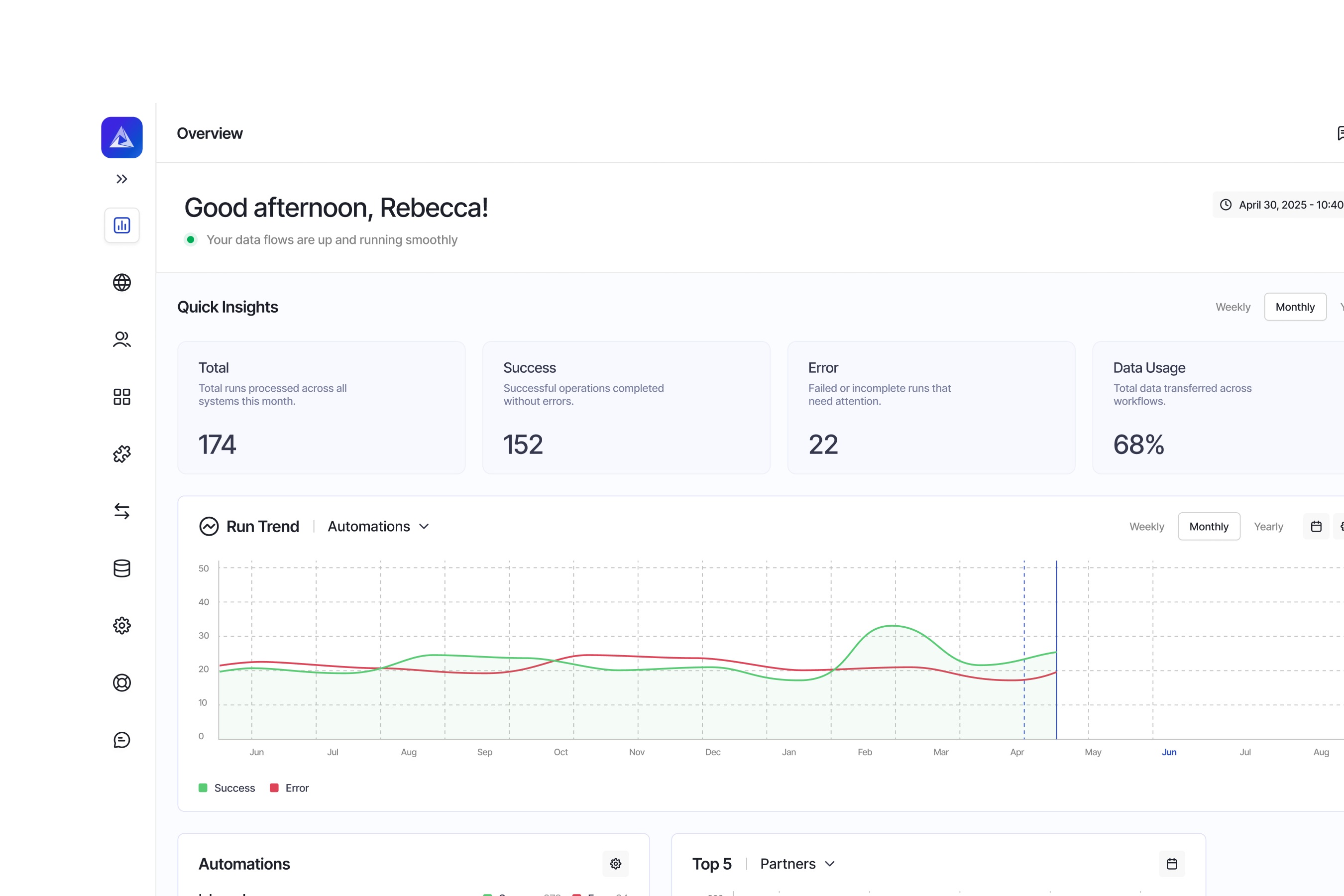
The platform also offers a no-code automation builder, reusable templates and monitoring. Business users are part of the intended audience, alongside integration specialists. That division matters: the person who knows what constitutes a valid enrollment or order may be sitting far from the person who knows how to build a connector.
- 01 / CONNECTAccept the partner’s input
- 02 / TRANSLATEMap it to your schema
- 03 / VALIDATEApply business rules
- 04 / DELIVERLoad accepted records
A different number for the same tin of food
Adeptia’s food-manufacturer story offers a second kind of confusion. Retailers used SKU numbers that did not match the manufacturer’s own. Incoming information also carried spelling mistakes, inconsistent abbreviations and varying formats. The shipment was real. Reconciling its identity was the difficulty.
The account describes a business estimating store inventory from a 10 percent sample. Adeptia says its mapping and matching capabilities reconciled partner SKUs, cleaned incoming data and automated 70 percent of the exchange. It reports inventory and sales accuracy moving from 10 percent to 90 percent, with annual expenses reduced by $500,000.
It is tempting to read this as an AI story. It is equally useful to read it as an accounting story. The company already had information, but could not reliably reconcile it. Faster transport would have delivered the disagreement sooner. Matching made the information useful.
The spare parts never take the weekend off
A named customer supplies a less theatrical picture of scale. Karmak makes business-management software for commercial transportation businesses. Its Adeptia case study describes more than 200 integrations and tens of thousands of files each day, passing between dealers and original equipment manufacturers.
Inventory information travels out; replenishment orders come back. Individual feeds may run once or twice daily, yet their combined volume keeps the platform working throughout the week. This is integration as routine infrastructure: a dealer’s stock position becomes information an OEM can act on.
“I don’t know how we’d handle that much volume if we didn’t have Adeptia software running it.”
Greg Rookey / Partner Solutions Analyst, Karmak
Adeptia says it serves hundreds of organizations worldwide. Its target customers include mid-sized and large businesses in insurance, financial services, healthcare and manufacturing. Its history begins in 2000 with founder Deepak Singh and a small group of developers working on business data exchange.
A $65 million bet, followed by smaller packages
In March 2023, Adeptia announced a $65 million strategic growth investment led by PSG, intended to support software innovation, customer success and market adoption. That is capital invested in the company, separate from what customers pay for an installation.
The subsequent product direction has become more specific. Group health insurance accelerator packs arrived in November 2025, packaging data models, validation rules and workflows. A retirement benefits enrollment accelerator followed in January 2026. Rather than require every buyer to assemble an industry process from a blank canvas, these packages offer a starting structure.
April 2026 brought Automate 5.2 and a native Model Context Protocol server. Adeptia says users and AI agents can query workflow status, execution history and diagnostics through natural language or tool calls. Monitoring an integration is becoming another kind of conversation. The underlying records still need to be trustworthy.
The bill is for the work
Adeptia’s pricing is organized around Workloads: dedicated processing engines that execute integrations, transformations and workflows. Its Basic, Professional and Enterprise plans scale by processing capacity rather than counts of users or connectors.
The distinction affects procurement. Professional includes on-premises or private-cloud deployment, VPN access and single sign-on; Enterprise adds features such as multi-zone high availability, tenant boundaries and version control. Platform license fees exclude professional services, implementation, infrastructure and hosting. A meaningful budget therefore needs both the software configuration and the operating costs around it.
In the broader market, buyers also consider platforms such as MuleSoft, Boomi and Informatica. Adeptia’s case rests on external-data complexity, self-service onboarding and the combination of translation, validation and operational handling. Microsoft described it as a B2B integration partner in 2019. That history is a useful reminder that the company’s problem predates the current enthusiasm for AI.
Copy the sequence before buying the software
The transferable idea is to trace one incoming file all the way to acceptance. Record where someone retypes it, where a code fails to match and where a missing value prompts an email. Define the acceptance rules, assign the exceptions and reuse the mapping when the next partner arrives.
This approach depends on knowing what a correct record looks like. If nobody owns the business rules, or the source omits information required to complete an order, software cannot supply the missing business decision. A small operation with a handful of stable exchanges may also have little reason to take on an enterprise platform.
Adeptia is most interesting where growth multiplies the number of strangers sending data. The packaging manufacturer’s customers were not likely to become more orderly merely because the manufacturer became busier. Accepting that fact changed the design of the work. A label remained a small thing. Reading the order no longer had to be a large occupation.
Keep following the file
Explore Adeptia · Inside Automate · Plans and pricing · Company news · The blog