BREAKING Didero closes $30M Series A •Co-led by Chemistry & Headline, with Microsoft's M12 •30+ manufacturers now run procurement on autopilot •Didero acquires Covalent AI •$37M raised since 2023 •From email chaos to executed purchase orders •BREAKING Didero closes $30M Series A •Co-led by Chemistry & Headline, with Microsoft's M12 •30+ manufacturers now run procurement on autopilot •Didero acquires Covalent AI •$37M raised since 2023 •From email chaos to executed purchase orders •
Company File • Procurement & AI
DIDERO.
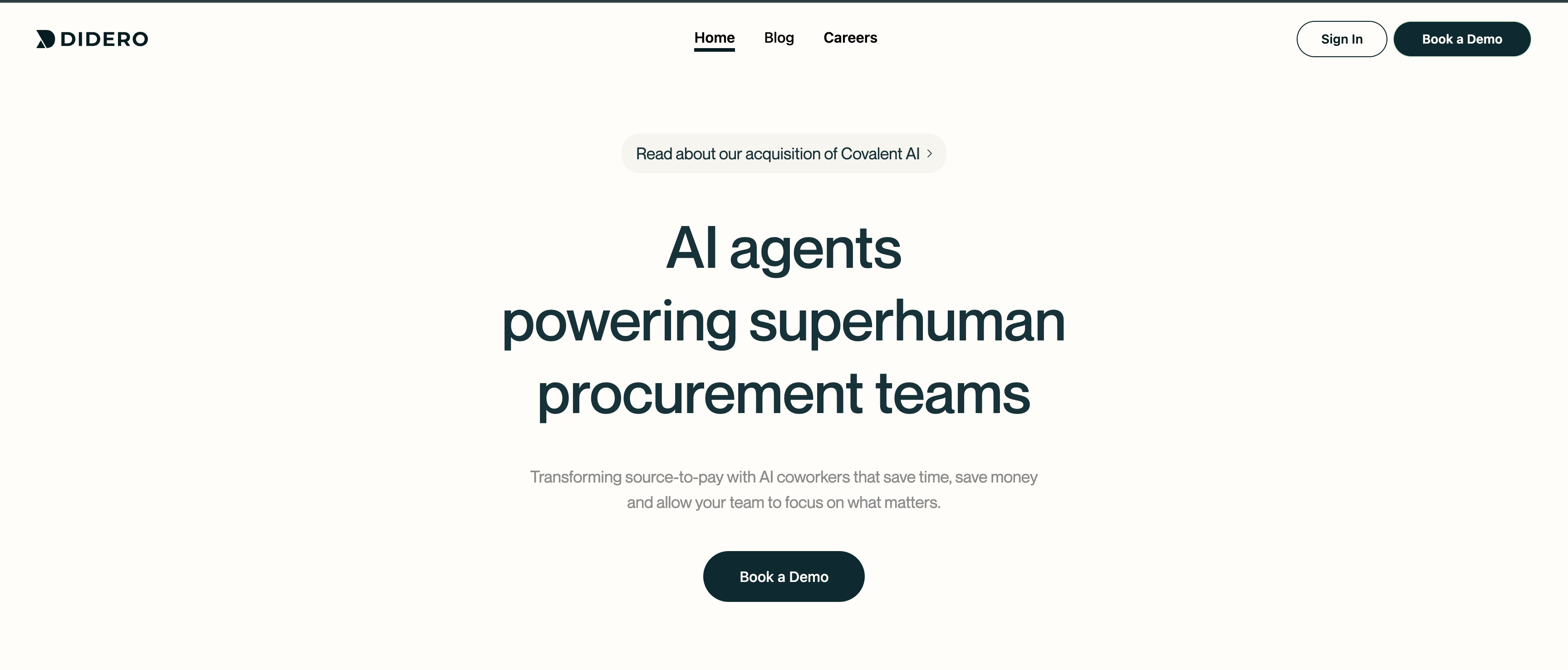
AI agents powering superhuman procurement teams.
The homepage that greets a supply chain manager at 7am, before the first 200 emails land. Didero's pitch in eleven words.
Founded 2023HQ 99 Wall St, New YorkTeam ~42Raised $37MStage Series A
FILED UNDER: AI • SAAS • ENTERPRISE • LOGISTICSYESPRESS COMPANY DESK
Who they are now
The quiet engine behind the things you buy
Somewhere right now, a procurement manager is forwarding a PDF to herself. A supplier emailed a price change. A packing list says one quantity; the purchase order says another. Multiply that by four hundred orders, and you have a job. Didero wants that job.
Didero is a New York company that builds AI agents for procurement - the unglamorous machinery of buying parts, tracking orders, reconciling invoices, and keeping suppliers honest across time zones. Not a dashboard you log into and admire. A coworker that reads your inbox, understands what it means, and does the next thing. The company calls it "supply chain on autopilot," which sounds like marketing until you watch it close a purchase order loop without a human touching a key.
"We want to make trading with companies across the world as easy as trading across the street."
// Didero, on the founding premise
In February 2026 it raised a $30 million Series A. The round was co-led by Chemistry and Headline, with Microsoft's venture fund M12 along for the ride. That is real money for a company that, in the grand tradition of the most useful software, fixes a problem most people have never had to think about - and a handful of people think about constantly, badly, at midnight.
The problem they saw
Global trade still runs on the inbox
The physical economy moves on procurement, and procurement moves on email. Spreadsheets. Phone calls. A messaging thread three apps deep. The big enterprise resource planning suites promised to fix this decades ago, and to their credit they did organize the data - they just never agreed to do the work. Somebody still has to read the supplier's reply, decide what it means, and update six systems by hand.
For mid-market manufacturers, the math is worse. They run complex international supply chains without the budget of a Fortune 100, and without the army of analysts to babysit the back office. The result is a profession that spends its days chasing exceptions instead of making decisions - the corporate equivalent of bailing a boat with a teaspoon while being told to plot the course.
"Teams spend less time chasing emails and exceptions and more time focusing on strategic decisions."
// Tim Spencer, Co-founder & CEO
The insight Didero bet on is almost rude in its simplicity: most procurement work is language. Read this email. Compare it to that order. Notice the lead time slipped. Send the follow-up. Language is precisely the thing large AI models got good at. So the question was never whether software could understand a packing list. It was whether anyone would trust it to act.
The founders' bet
Three people who had felt the pain
Co-founder and CEO Tim Spencer did not discover this problem in a market-sizing slide. He lived it. During the pandemic he ran an e-commerce startup, Markai, where his team drowned in manual procurement just trying to keep shelves stocked. He sold that company in 2023 and, instead of resting, went looking for the part that had hurt the most. He found Didero, alongside co-founders Lorenz Pallhuber and Tom Petit, in late 2023.
TS
Tim Spencer
Co-founder & CEO
LP
Lorenz Pallhuber
Co-founder
TP
Tom Petit
Co-founder
Their bet was a particular one. Not "build a smarter dashboard," but treat AI as an autonomous operator - something that adapts to changing conditions and makes calls based on real-time data about pricing, lead times, and quality issues. The agent sits as a layer on top of the systems a company already runs, rather than asking anyone to rip out their ERP. In a category famous for eighteen-month implementations, "no IT build work" is its own kind of radical.
"Didero applies AI agents directly to that operational layer."
// Kristina Shen, Chemistry
The product
An agent that reads the mess, then acts
Didero's procurement agent ingests the natural-language sprawl of a real supply chain - emails, messaging apps, phone calls, purchase orders, packing lists - and turns it into executed work. It can source and quote, manage the full purchase-order lifecycle, process invoices, and handle the back-and-forth with suppliers. Then it writes the result back into the tools the team already uses.
01
Procurement Agent
Automates source-to-pay: sourcing, quoting, PO lifecycle, invoice processing, and supplier communication.
02
ERP Integration
Connects to existing ERP and procurement tools - no IT build work, no rip-and-replace.
03
Data Ingestion
Reads emails, chats, calls, POs, and packing lists, then executes the updates they imply.
04
Exception Management
Tracks orders and resolves the price changes, delays, and quality flags before they become fires.
"Agents were autonomously executing mission-critical procurement tasks within weeks."
// Stephen Sharr, VP of Procurement, Footprint
The short, fast history
From a sold startup to a Series A
2023 • THE START
Markai sold, Didero founded
Tim Spencer exits his pandemic-era e-commerce startup and teams up with Lorenz Pallhuber and Tom Petit to attack the procurement problem head-on.
JULY 2024 • SEED
$7M to automate mid-market procurement
First Round Capital, Construct Capital, AI Grant, BoxGroup, Company Ventures, and Conviction back the early vision.
2025 • TRACTION
30+ customers deployed
Agents move from demo to production across manufacturing and distribution teams - in some cases live within weeks.
FEB 2026 • SERIES A
$30M, co-led by Chemistry & Headline
Microsoft's M12 and existing investors join. The company also announces its acquisition of Covalent AI to deepen the platform.
NEXT • THE EXPANSION
Into sourcing and payments
Hiring across enterprise sales, customer success, and engineering as the agent stretches further across the source-to-pay map.
The proof
The numbers behind the bet
Conviction in this category is measured in two currencies: who writes the checks, and who runs the software in production. Didero has collected both. The funding tells you investors believe the back office of global trade is up for grabs. The customer count tells you operators agree.
Funding raised, by round
USD • cumulative total: $37M
Seed · 2024
$7M
Series A · 2026
$30M
Source: PR Newswire, AlleyWatch, company disclosures. Bars scaled to the larger round.
$37M
Total Raised
30+
Customers
~42
Employees
2023
Founded
The customer list reads like the supply side of everyday life - the people who actually make and move things.
3i IntermodalAGCAro HomesAuguryCentric PackagingClayton & CrumeDelta GalilEchelonFootprintGroWrkIsland Creek OystersLykaSpot & TangoTech24Total Home Supply
The mission
An autonomous supply chain, on purpose
Didero's stated aim is to build an autonomous supply chain - one where the routine, manual work runs itself so people can spend their hours on judgment instead of data entry. It is a mission that benefits from being measurable. Either the agent closed the loop or it did not. Either the team got its afternoon back or it is still forwarding PDFs.
The company is careful about the framing. The agent is a coworker, not a replacement - it takes the work nobody wanted, the chasing and the copying and the reconciling, and hands back the part humans are actually good at: deciding. That is a quieter promise than most AI companies make, which is probably why it lands.
"Save time, save money, and allow your team to focus on what matters."
// Didero, source-to-pay positioning
Why it matters tomorrow
The boring layer is the strategic one
Tariffs shift. Lead times stretch. A supplier two continents away misses a date and a factory here goes quiet. The companies that handle disruption best are not the ones with the prettiest dashboards - they are the ones that can sense and respond fastest, across thousands of small decisions a day. That capacity is exactly what an agent that lives in the operational layer can provide.
With a Series A behind it and the Covalent AI acquisition folded in, Didero is pushing its agent further across sourcing and payments. The wager is that procurement stops being a cost center to be tolerated and becomes a system that quietly compounds - resilience as a feature, not a fire drill.
So picture that procurement manager again. It is 7am. The inbox already holds two hundred emails - the price change, the mismatched packing list, the supplier who went quiet. Only now most of them are already handled. The price change got logged, the mismatch got flagged, the follow-up got sent at 3am by something that does not sleep. She opens her laptop not to bail the boat, but to steer it. That is the change Didero is selling, and the part it would rather you judge for yourself.
Spread the file
Share Didero with someone who lives in their procurement inbox.